Introduction: A Dossier That Keeps Up with the Series
This book gathers, in one place, everything that the volumes of The Transformed Architecture establish about one fictional organisation: Nordvik Region, a regional public authority in a Nordic member state of the European Union. The organisation appears in thirteen of the fourteen volumes and in the two companions Landscape and Tools. Each volume gives it new facts for its own subject, a system, a decision, a role, an incident or a figure, and no single volume holds the whole picture. A reader of AI Boss sees the people-management slice, a reader of AI Operations sees the services and the restore tests, and neither sees how the two fit together. This chapter says what the dossier is, which volumes it draws on, which rules govern its facts, how the six parts are arranged and how the dossier follows the series as the series grows.
Series state reflected by this edition. Books 1 to 14 of The Transformed Architecture and the companions Landscape and Tools, as published on 2026-11-16. The sibling dossier is Hansa Mutual (hansa.geon.se), on the second fictional organisation of the series. No later volume is referred to.
What the dossier is and what it is not
The dossier is a reference with a narrative. It is organised so that a reader can look up a system, a role, an identifier, a date or a figure and find it with the volume and chapter that state it, and so that a reader who reads from the first page to the last gets the organisation as a whole: what it is, how it is structured, what AI it runs and from whom it buys, how it defends and operates its services, and how each of the thirteen volumes that name it changes the picture.
It is a companion in the sense that Landscape and Tools are companions. It has no number, it is complete in itself, and it refers to Books 1 to 14 and to no later volume. A reader does not need to have read the series. Where a chapter relies on a concept from a volume, it summarises the concept in a sentence or a table, and it names the volume and the chapter so that the reader can go to the source (2, Nordqvist, 2026).
It is not a numbered volume of the series, and it has no new facts of its own. It adds no person, no figure, no date and no identifier that a volume does not give. It is not a case study of a real organisation, and it does not describe one. It is not legal advice: where a chapter names an instrument and an article, it does so to show which obligation applies and frames the point as an architectural implication, as the volumes do.
The dossier does three things that no single volume does. It collects: the same system appears in five volumes under five subjects, and the dossier lists it once with every identifier it carries. It reconciles where it can and records where it cannot: where two volumes give different values for the same thing, the dossier states both, says which volume each comes from, and marks the point as an open thread for Chapter 27. It tests: Part V compares the fiction with real organisations of the same kind, from public sources, to judge whether the fiction is plausible.
Nordvik Region in one paragraph
Nordvik Region is responsible for regional health and social-care coordination, regional development and public transport, and it administers needs-based financial assistance on behalf of its municipalities. It has about 6,000 employees and serves about 450,000 residents. It works under one legal regime, which is public law, and it mostly procures its AI systems rather than building them. Its central system is a procured benefits-triage system that ranks applications for financial assistance by urgency, with a named caseworker deciding every case. It runs no autonomous production agent (no Mode 5), and agentic work tools (Mode 3) are limited to a small platform team. Its leverage is the contract, and its principal risks are the rights of the residents its decisions affect and dependence on suppliers (2, Nordqvist, 2026) (3, Nordqvist, 2026). Chapter 2 gives the one-page picture and Chapters 3 to 7 give the detail.
The series and where Nordvik Region appears
The Transformed Architecture has fourteen numbered volumes. The first, Architecture as Code, is the foundation and refers to no other volume. It has no example organisations, so Nordvik Region does not appear in it, although the later volumes build on its conclusions (1, Nordqvist, 2025). The organisation first appears in Book 2, AI Governance, which introduces both fictional organisations, and it then appears in every volume up to Book 14, AI Environment. Each volume has a period in which its Nordvik material is set. The periods run forward: Book 2 is set at the present of November 2026, Book 13 is set in September to December 2031 and Book 14 in September 2032 to August 2033.
| Book | Title | Period of the Nordvik material | What Nordvik Region is in the volume | Chapter |
|---|---|---|---|---|
| 2 | AI Governance | 2026, with plans to 2028 | The buyer and deployer; the contract is the lever | 8 |
| 3 | AI Platform and Security | 2026 to 2027 | A platform built around something bought | 9 |
| 4 | AI Red Team | 2027 | A small security unit that stretches itself with AI | 10 |
| 5 | AI Threat | September 2026 to March 2027 | The organisation questioned in public by a council motion | 11 |
| 6 | The Transformed Security Architect | Autumn 2026 to autumn 2027 | One security architect in a mostly procuring authority | 12 |
| 7 | AI Boss | December 2026 to November 2027 | A mostly procured AI boss, negotiated before use | 13 |
| 8 | AI Blue | 2027 | A small hybrid blue team with a bought night watch | 14 |
| 9 | AI Purple | January to April 2028 | The organisation that buys the purple loop | 15 |
| 10 | AI Operations | September 2028 to August 2029 | A small owned operations loop around a bought base | 16 |
| 11 | AI Leader | September 2029 to August 2030 | The public-law case for leadership | 17 |
| 12 | AI Developer | September 2030 to August 2031 | A small, cautious, publicly bound builder | 18 |
| 13 | Vibe to Dev | September to December 2031 | The capacity-limited setting for one builder's tool | 19 |
| 14 | AI Environment | September 2032 to August 2033 | The buying, public-law organisation whose levers are the contract and the cap | 19A |
The two companions also use the organisation. Landscape draws Nordvik Region as one of two illustrative landscapes in its notation, for a modelled year 2027 (15, Nordqvist, 2026), and Tools follows both fictional organisations through a toolbox year (16, Nordqvist, 2026). Chapter 20 treats them.
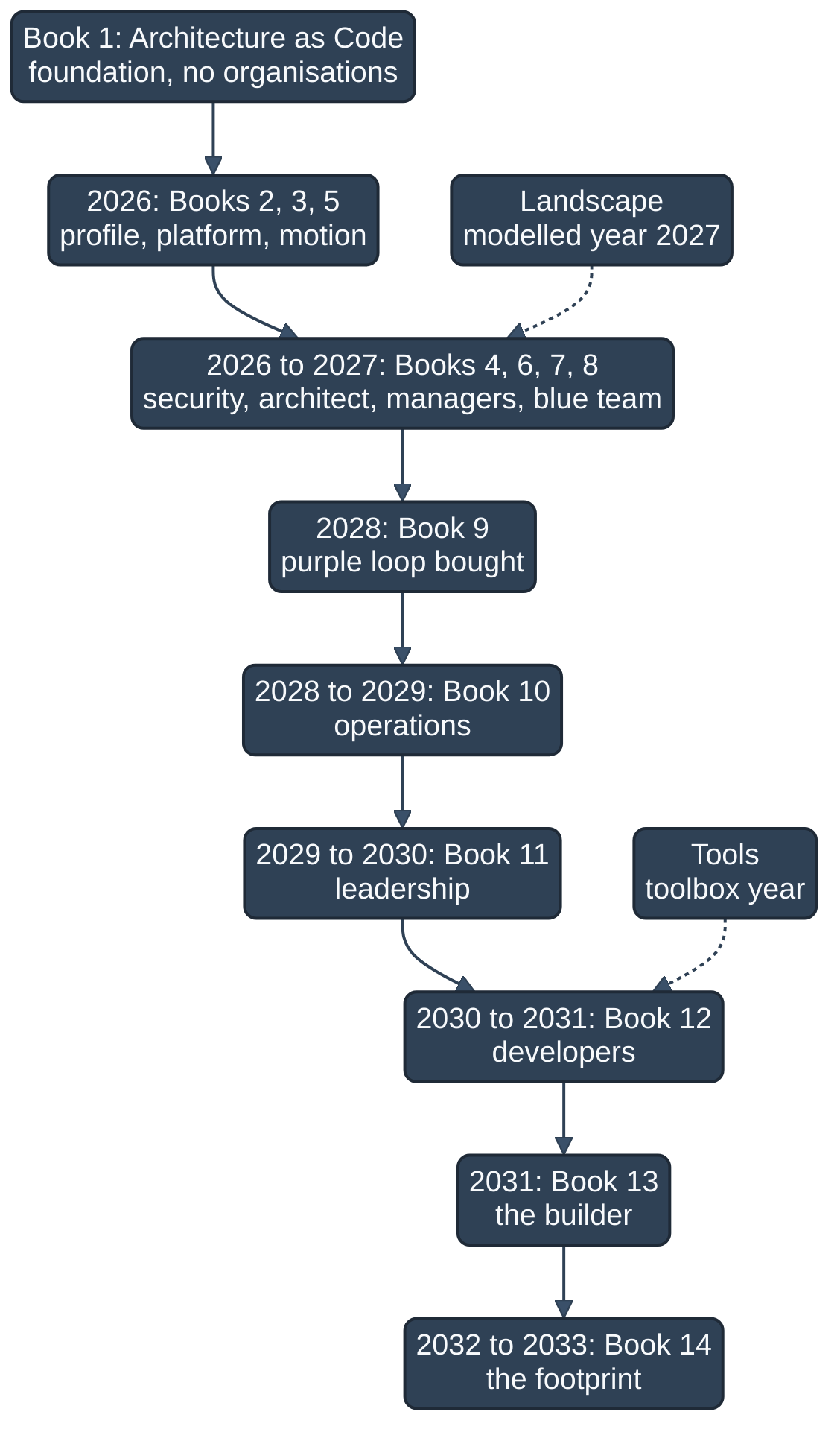
Figure 1.1: Where Nordvik Region appears in the series. Periods from 2027 onward are illustrative fiction written in November 2026.
Established and illustrative
The volumes were written in 2026, so most of their Nordvik material is dated in the future of the writing. The dossier keeps the status that each volume gives. A fact of the profile, such as the headcount, the legal setting, the existence of a system and the identifiers of its first decision records, is established: the volume states it as part of the profile. An event, a figure or a sequence that a volume marks as an example, or dates after November 2026, is illustrative: it is fiction written to show how the subject of the volume would play out. Most events dated 2027 and later are illustrative, and the volumes say so (4, Nordqvist, 2026) (8, Nordqvist, 2026) (12, Nordqvist, 2026). The dossier says which a statement is when it matters, and it gives the evidence age or the clock that the volume gives it, because the series treats a claim without an age as an unfinished claim.
The source rule
The fourteen volumes are the only sources for facts about Nordvik Region. The organisation is invented, so no external source can establish a fact about it. This rule has five consequences.
- Nothing is invented. Every statement about Nordvik Region in a chapter traces to a line of a working extract in the repository and from there to a volume. If the extracts do not say it, the chapter does not say it.
- Every paragraph that states a fact names its volume. The sentence names the volume and the chapter, in plain text ("AI Governance, Chapter 10"), and the paragraph ends with a citation of the volume in the bibliography. The citation proves provenance. It never stands for an external source about the real world.
- Where volumes disagree, both values are stated. The dossier names the volume of each, says which it uses as the working value (normally the later volume's ledger or the profile), and records the finding in Chapter 27. It does not choose silently.
- Real counterparts appear only in Part V. A real organisation is named there, as a comparator, from public sources cited with a retrieval date. It is never the model of an invented fact.
- The volumes are cited in series order. The dossier refers to no volume after Book 13, and when a later volume appears the dossier gains a chapter (see below).
The disagreements are real and some are small. A few examples show the kind. The benefits-triage system has two European Union database identifiers in AI Governance, EUDB-DEP-2026-004213 in Chapter 9 and EUDB-2026-NR-00412 in Chapter 17. The time within which an oversight stop returns the system to date order is 60 seconds in AI Governance, Chapter 10, and within five minutes in AI Platform and Security, Chapters 5 and 24. The identifier RST-NR-2031-0001 is a restore test of a coding-model exit on 2031-02-03 in AI Developer and a restore test of a builder's tool on 2031-12-05 in Vibe to Dev (2, Nordqvist, 2026) (3, Nordqvist, 2026) (12, Nordqvist, 2026) (13, Nordqvist, 2026). Each is an open thread. Chapter 27 collects them with the recommended resolution for the author, and Appendix A lists every identifier with its source.
How to read the six parts
The book has 28 numbered chapters and the lettered Chapter 19A (Book 14, added after Chapter 19 so that no chapter number changes) in six parts, then a glossary, Appendix A (the ledger of identifiers, generated from the machine-readable ledger), Appendix B (templates and tools of the repository), the references and a note about the author. Part III has one chapter per volume and is the part that grows.
| Part | Chapters | Question it answers |
|---|---|---|
| I The Organisation | 1 to 4 | What is Nordvik Region, how is it structured, who are its people and roles, and under which law and supervisors does it work? |
| II The AI Estate | 5 to 7 | Which AI systems does it run and at which usage mode, from whom does it buy, and how does it secure and operate them? |
| III Through the Series | 8 to 20, with 19A | What does each volume, and each companion, add about the organisation? |
| IV Across the Series | 21 to 24 | What do the fourteen volumes say when read together: the chronology, the decisions and records, the numbers and the cast? |
| V Credibility | 25 to 27 | Is the fiction plausible against real organisations of the same kind, and where do the volumes contradict each other? |
| VI Conclusions | 28 | What does the series show through this organisation? |
A reader who wants the organisation first reads Part I and Part II. A reader who wants one volume's view reads its chapter in Part III, each of which has the same skeleton: the volume in brief, the role of Nordvik Region in the volume, what the volume establishes, decisions and records, events and figures, a table across the usage modes or the degrees of delegation, what the volume concludes and the open threads. A reader who wants a lookup goes to Part IV and Appendix A. A reader who doubts the fiction goes to Part V.
Vocabulary used in every chapter
The dossier uses the series' own terms exactly. The usage modes run from Mode 0 Ambient AI to Mode 5 Autonomous production agents, and the degrees of delegation from Level 0 Advisory to Level 4 Autonomous, per action class. Decision records are written AIDR-NNNN, and each volume reserves a number range for each organisation. Where a volume uses an identifier family, such as UC, DEC, EXC, EXIT, FRIA, MND, DLG, ROLE, SVC, RST or CHG, the dossier writes it as the volume does. The dossier uses the AI Act's own terms for roles: provider, deployer, high-risk AI system and general-purpose AI model. It never says that a model understands, wants or decides. A system ranks, drafts, flags, recommends or executes, and it decides only where a decision was formally delegated to it and the record says by whom (2, Nordqvist, 2026).
How the dossier is kept current
The dossier is built to follow the series. When a new volume appears, the update follows a fixed order. A working extract is written from the volume's profile and from every chapter that names Nordvik Region, with the same eight sections as the other extracts: role in the book, profile additions, people, systems and identifiers, events, figures, decisions and inconsistencies. The identifiers, events and figures are appended to a machine-readable ledger, and a script checks that every identifier a ledger line cites is present in the cited chapter. A chapter is added to Part III. Chapters 2 to 7 and 21 to 24 are revised where the profile, structure, legal setting, estate, suppliers or posture changed, and new findings go to Chapter 27. The rules in the repository move to the new series state, the volume is added to the bibliography as the next numbered source, and Appendix A is regenerated. If the volume gives the organisation a new scale, system class, supervisor or incident, the comparison in Part V is rerun for that dimension.
When an earlier volume changes, the update is smaller: the volume's profile is compared, the ledger script is rerun and the chapters it flags are corrected. A correction in a volume that the dossier had recorded as an inconsistency is moved from Chapter 27 to a note in the chapter concerned. Each release states the series state it reflects on the title page of this chapter. The present edition reflects Books 1 to 14 and the companions Landscape and Tools as of 2026-11-16.
The sibling dossier, Landscape and Tools
Two fictional organisations run through the series. The other is Hansa Mutual, a multinational mutual insurance group headquartered in Hamburg, with about 9,500 employees and several legal regimes. It builds as well as buys, and it runs autonomous production agents in several domains (2, Nordqvist, 2026). The volumes choose the two to differ in the ways that matter: Nordvik Region has one jurisdiction and deep public-law duties, and Hansa Mutual has many jurisdictions and a larger attack surface from its agents. The sibling dossier, Hansa Mutual (hansa.geon.se), is written to the same plan, with the same chapter numbers and the same rules, and the two are updated together. Where this book contrasts the organisations, it says so from the volumes, and it leaves the detail on Hansa Mutual to its own dossier.
Landscape is a companion that models the two organisations as illustrative landscapes in a notation of its own, Contour, and Tools is a companion that collects every tool the volumes describe. Neither is a numbered volume. Chapter 20 takes what each adds about Nordvik Region and where each restates or differs from the volumes, and the Landscape model supplies a further check on the estate that Chapter 5 sets out (15, Nordqvist, 2026) (16, Nordqvist, 2026).
Fiction and real instruments
Nordvik Region is declared fiction, and so are its people, its suppliers, its systems and its figures. The suppliers have invented names where the volumes name them, and the dossier uses the names as the volumes do. Real instruments, authorities and standards are another matter. The AI Act, the General Data Protection Regulation, NIS 2, the public procurement directive and the national instruments the volumes cite are real, and the dossier names them to show which obligations apply to an organisation of this kind. Statements about them are attributed to the instrument and the article and framed as architectural implications, and the article numbers are checked against the authentic text before they are written. The dossier does not claim that any real organisation behaves as Nordvik Region does. Part V asks the opposite question: whether an invented organisation of this size, mandate and posture is plausible beside the real ones.
One feature of the fiction needs a note at the start. The profile places Nordvik Region in "a Nordic member state of the European Union" and does not name the state. Several volumes then use Swedish legal sources as the example for Nordvik Region, among them the Co-determination Act, the Local Government Act and the Cybersecurity Act, and AI Operations states that the book sets the organisation in Sweden (7, Nordqvist, 2026) (10, Nordqvist, 2026) (11, Nordqvist, 2026). The profile and the later volumes are therefore not wholly aligned, and Chapter 4 and Chapter 27 take up the point as an open thread.
Summary
This book is the whole picture of Nordvik Region, a fictional regional public authority with about 6,000 employees and about 450,000 residents, gathered from the thirteen volumes and two companions that name it. It reflects Books 1 to 14 and the companions Landscape and Tools as of 2026-11-16, and its sibling is the dossier Hansa Mutual. Its facts come from the volumes alone, each paragraph names the volume and chapter that state them, and where volumes disagree both values are stated and sent to Chapter 27. Facts of the profile are established, and events and figures dated from 2027 onward are illustrative fiction written in November 2026. The six parts move from the organisation, through its AI estate and the volumes one by one, to the series read across, the credibility check and the conclusions, and the dossier is revised by a fixed procedure whenever a volume is published or changed. These are the book's own conclusions about its method, and they add no fact about the organisation.
Sources
- Nordqvist, G. Architecture as Code. (1, Nordqvist, 2025)
- Nordqvist, G. AI Governance: Governing Artificial Intelligence in European Enterprises and Public Authorities. (2, Nordqvist, 2026)
- Nordqvist, G. AI Platform and Security: Building and Securing AI Platforms in European Enterprises and Public Authorities. (3, Nordqvist, 2026)
- Nordqvist, G. AI Red Team: AI as an Active Part of Cyber Defence in European Enterprises and Public Authorities. (4, Nordqvist, 2026)
- Nordqvist, G. AI Boss: When Artificial Intelligence Manages People in European Enterprises and Public Authorities. (7, Nordqvist, 2026)
- Nordqvist, G. AI Blue: How Artificial Intelligence Transforms the Blue Team in European Enterprises and Public Authorities. (8, Nordqvist, 2026)
- Nordqvist, G. AI Operations: How Artificial Intelligence Transforms IT Operations in European Enterprises and Public Authorities. (10, Nordqvist, 2026)
- Nordqvist, G. AI Leader: How Leadership Roles Change When AI Is Used Broadly in European Enterprises and Public Authorities. (11, Nordqvist, 2026)
- Nordqvist, G. AI Developer: How the Developer Role Changes When AI Is Used Broadly in European Enterprises and Public Authorities. (12, Nordqvist, 2026)
- Nordqvist, G. Vibe to Dev: From Vibe Coding to Professional Software, Step by Step, for Builders Who Are Not Developers, in European Enterprises and Public Authorities. (13, Nordqvist, 2026)
- Nordqvist, G. Landscape: A Fact-Based Picture of Architecture and AI at Work, for Leaders, Architects and Citizens. (15, Nordqvist, 2026)
- Nordqvist, G. Tools: A Reference to the Templates, Software and Methods of The Transformed Architecture for European Enterprises and Public Authorities. (16, Nordqvist, 2026)