Numbers and Evidence Age
The volumes give Nordvik Region a large set of numbers: headcounts, volumes of work, costs, thresholds, rates and measured results. A number in the series carries two things besides its value. It has a status, established or illustrative, and it has an age: the date it was measured and the clock that says how long it may be relied on. The later volumes make the second point their own subject. AI Purple writes coverage with evidence age, AI Operations allows a claim of recoverability only for a verified result, AI Leader and AI Developer ask what was measured, when and by whom, and Vibe to Dev gives each tier its own validity period (9, Nordqvist, 2026) (10, Nordqvist, 2026) (11, Nordqvist, 2026) (12, Nordqvist, 2026) (13, Nordqvist, 2026). This chapter gathers the numbers by kind, grades them, gives the ages that the volumes themselves compute, and lists where figures conflict. It draws on Books 2 to 14 and on Landscape.
How the numbers are graded
The dossier grades each number twice.
Status. A figure is established when it is a constant of the profile that every volume shares: the size of the Region, the structure of its units, its main systems. It is illustrative when a volume gives it as an example, which is the case for every measured result and every cost in the series from AI Red Team onwards and for the costs of 2026 that AI Governance marks as illustrative. The writing date is November 2026, so every measurement dated after it is a modelled value (2, Nordqvist, 2026).
Age. The age of a number is the interval between its measurement and the date on which it is relied on. The clock is the interval after which the series stops accepting it. The clocks are not uniform. They are set per kind of claim, as the following table shows.
| Kind of claim | Clock | Where set |
|---|---|---|
| Restore or failover result | 180 days | AI Operations, Ch. 19 and 29 |
| Break-glass test result | 90 days | AI Operations, Ch. 29 |
| Coverage of a technique (all techniques) | 180 days | AI Purple, Ch. 4, 5, 11 |
| Evidence for a Tier A, Tier B and Tier C build | 365, 180 and 90 days | Vibe to Dev, Ch. 20 |
| Takeover test | Twelve months | Vibe to Dev, Ch. 20 |
| Revert or restore evidence for a build | 90 days | Vibe to Dev, Ch. 20 |
| Leadership claim, for a proposed raise in delegation | At most 90 days | AI Leader, Ch. 8 |
| Pulse result | 180 days | AI Leader, Ch. 21 |
| Golden dataset review | 90 days (2026-10-14, next 2027-01-12) | AI Platform and Security, Ch. 20 |
| Review of a high-risk, limited-risk and minimal-risk system | 6, 12 and 24 months | AI Governance, Ch. 9 |
| Usage-mode register review | 90 days | AI Governance, Ch. 2 |
| Footprint of a running use; hardware record; test of a stop path | 90 days each | AI Environment, Ch. 24 |
| Benefit claim | 180 days | AI Environment, Ch. 24 |
| Supplier disclosure | 12 months | AI Environment, Ch. 24 |
| Environmental claim | Not longer than the reporting year; the review date is the earliest expiry minus 14 days; quota drift tolerance 0.05 | AI Environment, Ch. 24 |
The Region has no single evidence policy. It has the clocks of seven volumes, set per kind of claim. A claim that is within one clock may be outside another, which is why Chapter 27 lists the clocks themselves as an open thread (9, Nordqvist, 2026) (10, Nordqvist, 2026) (13, Nordqvist, 2026).
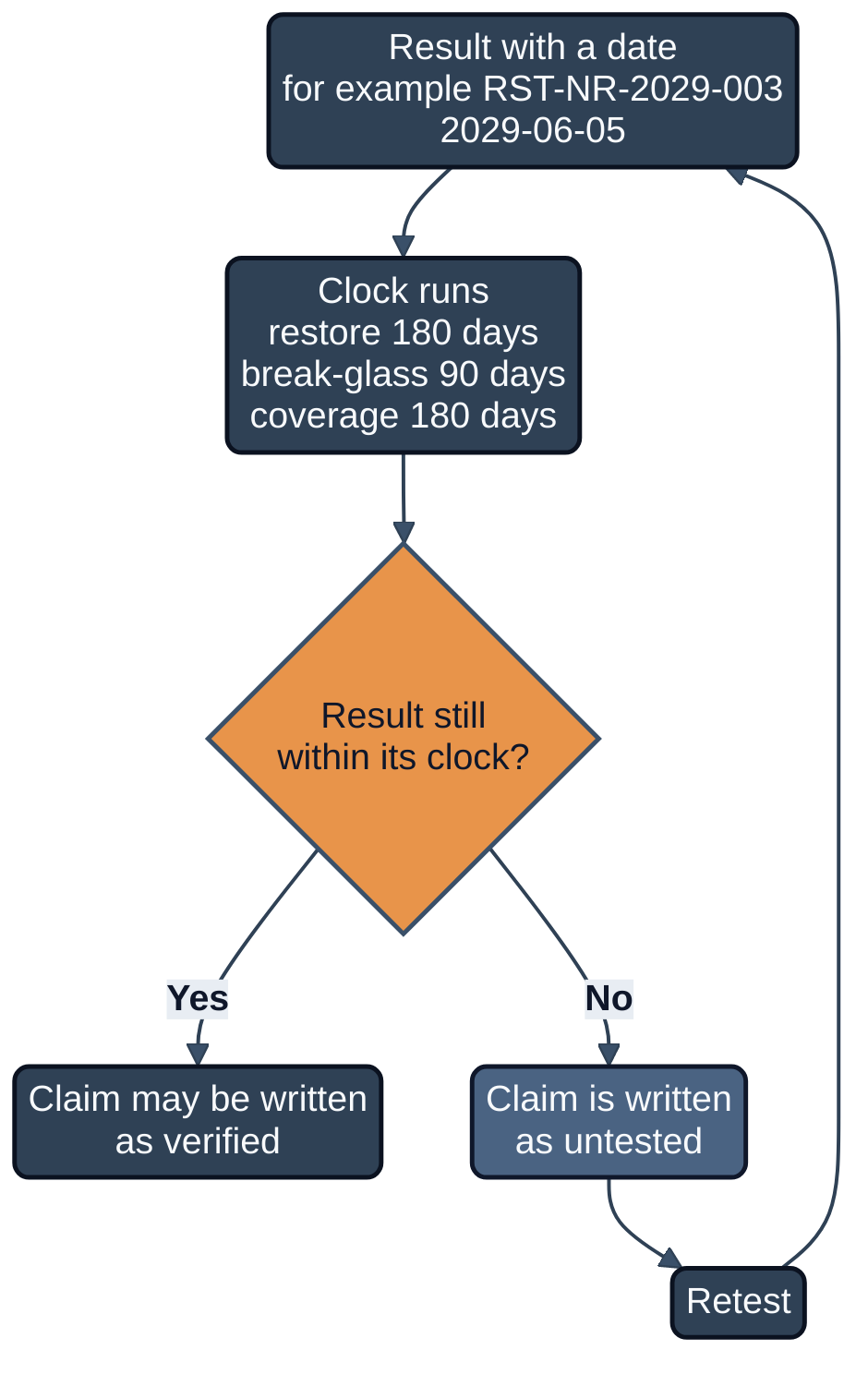
Figure 23.1: The evidence clock. A result supports a claim of "verified" only while it is within its clock. After that the claim is written as untested until a retest gives a new date.
The size and shape of the Region
These figures are the constants of the profile. All are established unless marked.
| Figure | Value | Source |
|---|---|---|
| Employees | about 6,000 | All volumes |
| Residents | about 450,000 | All volumes |
| Employees by area | about 1,900 in two hospitals; 700 in primary care; 1,100 in regional home care for five municipalities; 350 in public transport planning; 1,950 in development, benefits, social services, digitalisation, security and central administration | AI Boss |
| Council members | 61 | AI Leader |
| Managers | about 355 (one in 17); about 45 division heads; about 310 unit managers, median span 28 | AI Leader |
| IT and Digitalisation Unit | about 85, of which 22 infrastructure, 7 platform engineers, 31 applications and integration, 12 service desk, 10 IT management office | AI Operations, AI Developer |
| Security unit | 14, six analysts in office hours; 15 after the trainee post | AI Red Team, AI Blue |
| Code writers | about 25 (18 developers and 7 platform engineers); about 22 consultants; about 140 low-code builders with about 60 apps | AI Developer |
| Staff assistant | about 2,400 then 3,200 users; 3,200 licences | AI Governance, AI Leader |
| Caseworkers using the summariser | 180 | AI Governance |
| Services in the 2026 inventory | 11 AI services, three unreviewed | AI Governance |
| Units in the landscape model | 11 on 2027-01-01, 13 on 2027-12-31 | Landscape |
| Service points in the builder's checker | 24 | Vibe to Dev |
The parts of the figures do not always sum to the whole. The five areas of employment add up to 6,000. The five parts of the IT unit add up to 82, and the profile says about 85 with two vacancies. The four teams and the quality function of Applications and Integration add up to 31, and so do its roles (7, Nordqvist, 2026) (10, Nordqvist, 2026) (12, Nordqvist, 2026). The gap of three in the IT unit is an open thread.
Volumes of work
| Figure | Value | Age or status | Source |
|---|---|---|---|
| Benefits applications ranked | about 40,000 a month | Profile constant; Landscape Chapter 10 now says only that the figure is also used for illustration in AI Threat, so the earlier open thread is closed; AI Environment has about 40,000 claims ranked a month | AI Governance, AI Threat, AI Environment, Landscape |
| Living-support applications | about 31,000 a year | In the FRIA summary, 2026 | AI Governance, Ch. 17 |
| Median waiting time | 31 days | Context of AIDR-0007 |
AI Platform and Security, Ch. 5 |
| Closed cases in the datasheet | 1.9 million, January 2021 to November 2025; 7 per cent of paper rows incomplete | Datasheet v2025-12 | AI Platform and Security, Ch. 6 |
| Two northern municipalities | 4 per cent of rows against 9 per cent of the population | Datasheet | AI Platform and Security, Ch. 6 |
| Open living-support applications on 2030-01-23 | 212; the applicant ranked 14 | Illustrative | AI Leader, Ch. 18 |
| Golden dataset for claims routing | 4,860 cases; 620 from five FRIA groups; 214 disagreements | Reviewed 2026-10-14 | AI Platform and Security, Ch. 20 |
| Staff assistant evaluation | 91 per cent right section link on 1,200 questions; 64 pilot reports gave 41 fixes and 15 corrected documents | 2026 | AI Governance, Ch. 15 |
| Citizen assistant conversations | 60,000 a month | CAP-NR-AI-001, illustrative |
AI Operations, Ch. 15 |
| Citizen assistant, resolved enquiries | 71,000 a month (October 2026); about 146,000 on the open-weight route and about 22,000 on the explanation route, about 168,000 in all, in September 2032 (a factor of 2.4) | Illustrative | AI Platform and Security (SCI), AI Environment |
| Incidents in a quarter | 41; mean resolution 72 minutes against a target of 90, which hid a seven-hour disruption; Q4 2028 median 24 minutes and 90th percentile 2 h 10 min, one incident over the restore target | AI Operations, Ch. 29 and AIDR-0921 |
|
| Deployments in Q4 2028 | 62, with three failures | Q4 2028 | AI Operations, Ch. 20 |
| Repositories | 96; 31 per cent without a living owner | July 2030 | AI Developer |
| Low-code apps | 60: 31 Tier A, 18 Tier B, 11 Tier C | 2030 survey | AI Developer, Vibe to Dev |
Costs
All costs are illustrative. They are in euro.
| Figure | Value | Source |
|---|---|---|
| Staff assistant, 2026 outturn | 395,000 against a cap of 440,000: hosting and use 160,000, integration and support 170,000, evaluation and training 65,000 | AI Governance, Ch. 16A |
| Staff assistant, 2027 | Cap 480,000; forecast 390,000 to 470,000; about 2.30 per approved letter at the median and 4.10 at the 90th percentile; reduced scope saves about 60,000 | AI Governance, Ch. 16A |
| Time saved, counted | 21.5 minutes against 27.0 per standard letter; a staff survey that reported larger savings is not counted | AI Governance, Ch. 15 and 16 |
| Routing policy | 18,000 a month, alerts at 50, 80 and 95 per cent, hard cap 110 per cent; target 0.12 per resolved case | AI Platform and Security, Ch. 22 |
| Reserved accelerators, 2027 Q1 | 16 at 1.85 an hour; up to 8 on demand at 3.40; utilisation target 0.70, floor 0.45 | AI Platform and Security, Ch. 22 |
| IT unit | about 38 million a year, of which about 22 million operations | AI Operations |
| Observability and service management | about 0.9 million | AI Operations |
| Reserved accelerators | about 1.6 million | AI Operations |
| Shared services of the national provider | about 4.3 million | AI Operations |
Citizen assistant, CAP-NR-AI-001 |
53,300 a month, 0.89 per conversation, golden-set pass rate 0.93 on 2028-11-07 | AI Operations, Ch. 15 |
| Benefits-triage contract | 3.4 million over four years; exit test 60,000; second-path study 40,000 | AI Leader, Ch. 26 |
| Modernisation line, 2030 | 1.2 million, unallocated | AI Developer, Ch. 12 |
Development assistant tender NR-2030-041 |
about 1.6 million over four years | AI Developer, Ch. 18 |
| Council threshold for a procurement | 2 million | AI Leader |
The staff assistant cost is the best documented number in the series: a cap, an outturn, a forecast and a stop rule (stop if second-line questions rise more than 10 per cent above 2026 for two months). (2, Nordqvist, 2026) (3, Nordqvist, 2026) (10, Nordqvist, 2026) (11, Nordqvist, 2026) (12, Nordqvist, 2026).
Footprint, benefit and budget
AI Environment gives the Region a set of numbers about energy, carbon, water, benefit and budget. Every one is illustrative, dated September 2032 to August 2033, and none is an established fact of the profile; the dates are the book's construction. A footprint is a measurement at a point in time with a boundary, and the volume ages each one (14, Nordqvist, 2026).
| Figure | Value | Age or status | Source |
|---|---|---|---|
nordvik-dc installed IT power; PUE; heat reuse |
About 640 kW (over the 500 kW threshold of Article 12 of the Energy Efficiency Directive); PUE about 1.55; none | New in Book 14; AI Operations assumed 640 kW | AI Environment, profile |
| Hosting provider, reporting year 2031 | PUE 1.21; total water input at site level only; heat recovery 0 kWh | Received 2032-05-15; valid to 2033-05-15; renewed 2033-06-02 with the same gaps | SDR-NR-0001, -0003 |
| Reserved accelerators | 24 reserved and up to 8 on demand; pool utilisation 0.58 against a target of 0.70 and a floor of 0.45; four empty by plan, about EUR 65,000 a year (4 x 1.85 x 8,760 at the price of 2027) | Q3 2032; HWL-NR-0001 of 2032-11-15, valid to 2033-02-13 |
AI Environment, Ch. 16 |
| Grid factor | 32 g CO2e per kWh, location-based | From the SCI calculation of October 2026 | AI Environment, profile |
Public figure, CLM-NR-0001 |
1.90 g per resolved enquiry (1.02 operational plus 0.88 embodied; 1,970 kWh, 71,000 enquiries, PUE 1.15, 62,400 g embodied); at 350 g per kWh the same load is 12.05 g | October 2026; 2,235 days old when withdrawn on 2032-12-13 (AIDR-1322) |
AI Environment, Ch. 22 |
FPR-NR-0001, revision 1 |
16.3 Wh (7.7 to 30.0) and 0.52 g (0.19 to 1.35) per resolved enquiry; 2,385 kWh a month; draw 0.30 kW; PUE 1.15; pool share 0.40 | Measured 2032-10-04; replaced 2032-12-19 | AI Environment, Ch. 6 |
FPR-NR-0001, revision 2 |
30.5 Wh at the facility boundary (25.2 Wh for GPU servers and host) and 0.98 g (0.85 to 1.17); 4,458 kWh a month; draw 0.52 kW; PUE 1.21; share 0.41 | Measured 2032-12-14; 90-day clock | AI Environment, Ch. 8 |
Reading of 2032-09-01 (RDG-NR-2032-09-01) |
19.4, 27.7 and 31.9 Wh at GPU, GPU plus host and facility boundaries; 0.62, 0.89 and 1.02 g; 1.90 g with embodied | September 2032 | AI Environment |
| Water per resolved enquiry | 9.9 to 199 mL in total (1.4 to 8.3 mL on site), placeholder factors; about 1,400 to 29,000 litres a month | Placeholder, not a measurement | AI Environment, Ch. 7 |
Classifier FPR-NR-0005 |
0.004 Wh per item against 0.12 and 0.80 Wh for two general models; about 0.48 kWh a month at 120,000 items; budget 1 kWh; training budget 900 kWh | MCR-NR-0001 measured 2032-10-11, valid to 2033-01-09 |
AI Environment, Ch. 12 |
BEN-NR-0001 |
Calls within 48 hours per 100 enquiries: 21 without, 14 with the assistant; difference 7 (5 to 9); about 10,200 calls avoided a month; 7.4 g per call avoided (2.1 to 27.0) | Hold-out 2032-10-11 to 10-24; recorded 2032-11-08; expires 2033-05-07; revision 2 on 2033-03-25 | AI Environment, Ch. 9 |
BEN-NR-0006 (the telephone service's count) |
41 calls in August 2031 against 17 in January 2032, one month, no comparison group | 317 days old on 2032-12-13; expired | AI Environment |
EBG-NR-0001 |
4,450 kWh a month; EUR 18,000; target 2.0 g; ladder 0.80, 1.00 and 1.10; rebound alarm 175,200 (20 per cent above 146,000); quota 160,650, recalculated to about 176,600 on 2033-03-25 | 27.7 Wh x 146,000 x 1.1 is 4,450 kWh before the facility markup | AI Environment, Ch. 4 and 10 |
| Quota use in January 2033 | 129,400 on 17 January (80.5 per cent of the quota); 177,800 on 24 January (past 110 per cent) | INC-NR-2033-0007 (Ch. 20) |
AI Environment, Ch. 27 |
| Other budgets | EBG-NR-0002 1 kWh a month (180,000 items), no drill; EBG-NR-0003 3,000 kWh a month for nightly indexing, proposed; EBG-NR-0004 for the staff assistant, with a drilled stop, arrived 2033-03-11 |
Proposed or active by drill | AI Environment |
Placement policy PLC-NR-0001 |
Threshold 10 per cent and 1 kg; replay of nightly indexing in April 2033 found a saving under it | 2032-10-26 | AI Environment, Ch. 17 |
| Procurement | Lead times 9 to 14 months; TA-NR-ENV-01 scored 12 of 100 quality points for environmental disclosure |
Issued 2033-02-14 | AI Environment, Ch. 18 |
| Register status, start and end of the year | Footprints within age: 0 of 6 at the start, 3 of 5 live rows at the end; benefits within age: 0 of 6, then 2 of 5; budgets with a drilled stop: 0, then 3; public claims in force: 1 (aged), then 0 | Table 27.1 of the volume, read as stated | AI Environment, Ch. 27 |
The ages of this section show the same pattern as the others. The first number that the Region published was a measurement at a point in time that had become a policy, the 2026 factor of 27.7 Wh was nine per cent too high by the volume's own measurement of 25.2 Wh at the same boundary, and the stop drilled for the first time failed. The volume's lesson, which is its own conclusion and not a fact about the Region, is that a number should be recalculated when it drifts, a benefit refreshed in an ordinary week and everything dated (14, Nordqvist, 2026).
Thresholds and measures
The thresholds are the values at which a system is paused, retired or reviewed. They are illustrative and are given by the decision that set them.
| System | Threshold or measure | Source |
|---|---|---|
| Triage model | AIDR-0007 retire criteria: precision at 100 of at least 0.80 and parity below 0.05; model 3.2.0 measured 0.83 and 0.03; 4.0.0 measured 0.82 and 0.02; parity drift of 0.06 for 61 days against the criterion of 0.05 for 60 days |
B3, Ch. 5, 7 |
| Triage oversight | At most 40 rankings an hour; at least 45 seconds a case; blind sample 5 per cent; override alarm between 2 and 30 per cent; quarterly test | B2, Ch. 10 |
| Triage fairness gate | False-negative-rate gap at most 0.03 | B2, Ch. 10 |
| Living-support triage | Precision at queue capacity 0.64 against 0.21 for a random draw; single parents flagged 1.3 times as often; threshold 0.70; review above 1.25 times | B2, Ch. 17 |
Disparate-impact gate DIT-NR-CR-01 |
Group of at least 200; block if the lower bound of the selection-rate ratio is below 0.80, the true-positive-rate gap above 0.05 or the proxy AUC above 0.70 | B5, Ch. 12 |
Sycophancy test EVAL-NR-SYC-001 |
At least 200 items, 40 with a false premise; false-premise agreement and capitulation at most 0.05; neutral accuracy at least 0.95 | B5, Ch. 8 |
| Security triage | Missed true positives at most 0.02; hard negatives escalated at most 0.30; one alert in five triaged without the assistant | B4, Ch. 26, 6 |
| Reversibility test | A month without the claims ranker: passed_with_conditions |
B5, Ch. 26 |
| Rostering oversight | 10 of 14 seeded errors found (0.71) against a floor of 0.85; later 12 of 14 (0.86); stand-ins found 2 of 4 | B7, Ch. 26, 30 |
| Open-shift offers | Offer ratio 0.66 for hourly staff; 0.84 on retest; plan requires at least 0.8 | B7, Ch. 12, 30 |
| Claims-routing evaluation | Accuracy 0.94 (observed 0.951); slice without fixed address 0.903 on 152 cases; drift alarm at 0.25 PSI | B3, Ch. 20, 21 |
| Coverage | 2 of 9 techniques verified on 2028-04-26; target 7 of 9 by 2028-12-31 and 9 of 9 by 2029-10-31 | B9, Ch. 17, 28 |
| Observer | Detection of a seeded fault within 2 minutes: 2 min 41 s on 2029-03-19, 2 min 4 s on 2029-04-30 | B10, Ch. 29 |
| Exit test, staff assistant | Gate 0.90; 0.87 on 2029-02-27; 0.91 on 2029-04-24 | B10, B11 |
| Exit test, code model | Gate 0.90 on 120 tasks; 0.86 on 2031-02-03; 0.88 on 2031-03-12 | B12 |
Evidence age in the records
The series computes ages for a small number of results. They are the cleanest examples of a number with a date and a clock.
| Result | Measured | Clock | State when relied on |
|---|---|---|---|
RST-NR-2027-001, case-management restore, 3 h 05 min against 4 h; RPO 11 min against 15 |
2027-04-20 | 180 days, ended 2027-10-17 | 16 months 22 days old at AIDR-0900 on 2028-09-12 |
RST-NR-2027-002, portal failover, 5 h 20 min against 2 h |
2027-10-12 | Failed | First retest 18 months later (failed again); verified after 20 months |
RST-NR-2029-003, portal failover, 1 h 41 min against 2 h |
2029-06-05 | 180 days | Verified to 2029-12-02 |
| Break-glass test, two people, 9 min against 15 | 2029-02-07 | 90 days | Valid to 2029-05-07; retest 8 minutes |
Coverage COV-NR-0001 and -0002 |
2028-02-09 | 180 days | Expire 2028-08-07; 77 days old on 2028-04-26 |
Coverage COV-NR-0008, -0009 (T1190, T1486) |
2027-04-02, 2027-03-30 | 180 days | Expired 2027-09-29 and 2027-09-26; the oldest expired claim 393 days |
| Weekly-active claim for the staff assistant, 61 per cent | February 2029 (ADP-NR-2029-01) |
90 days for a proposed raise | Seven months old on 2029-09-10; recount due 2029-11-30 had no recorded result |
| Exit-test result for the staff assistant, 0.91 | 2029-04-24 | 180 days | 322 days old on 2030-03-12 |
| Carer count, four to seven carers per client | 2029-10-19 | Expired 2030-01-31 | Recount not recorded |
| Developer's "a third faster" note | April 2030 | Usage claims expired July 2030, value claim October 2030 | Withdrawn 2030-12-20; revision 3 on 2031-08-12 says no change beyond last year's variation |
Usage claim AVR-NR-2030-01, revision 2 |
2030-09-16 | To 2031-11-10 | Open |
Builder's restore test RST-NR-2031-0001, 11 min against 30 |
2031-12-05 | 90 days | Expires 2032-03-04 |
| Takeover test of the builder's tool | 2031-12-11 | Twelve months | Lapses 2032-12-11 |
Public energy figure CLM-NR-0001, 1.90 g |
October 2026 | Reporting year at most; no later calculation recorded | 2,235 days old when withdrawn on 2032-12-13 (AIDR-1322) |
BEN-NR-0006, 41 calls against 17 |
2032-01-31 | 180 days | 317 days old on 2032-12-13; expired |
FPR-NR-0001 revision 1, 16.3 Wh |
2032-10-04 | 90 days | Replaced by revision 2 on 2032-12-19 (30.5 Wh); the register carried revision 1 at the snapshot of 2032-12-13 |
BEN-NR-0001, 7 calls fewer per 100 enquiries |
Hold-out 2032-10-11 to 10-24; recorded 2032-11-08 | 180 days | Expired 2033-05-07; revision 2 on 2033-03-25 |
Stop drill of STOP-NR-ENV-01 |
2032-11-16 (failed), 2032-12-07 (passed) | 90 days | Passed again 2033-03-02 and 2033-08-29 |
| Hosting provider's Annex VII figures | Received 2032-05-15 | 12 months | Renewed 2033-06-02 with the same gaps |
| Unverified actions in the incident reviews | Date not given | none | 336 days old (Ch. 12) |
Table 23.1: Results with an age. The age in the first row is the one AI Operations computes at AIDR-0900. AI Leader reads its own claims in the same way: of nine claims in its chapter on the year, six had lapsed or were open (10, Nordqvist, 2026) (11, Nordqvist, 2026) (12, Nordqvist, 2026) (13, Nordqvist, 2026).
The ages share two features. The first is that the first honest figure was lower than the first dashboard, as AI Operations, AI Leader and AI Developer each conclude. The second is that the claims that lapse unnoticed are those with no owner for the retest. The portal failover failed in October 2027, was first retested 18 months later and failed again, and was verified only after 20 months, once a contract annex made a test window available.
Where figures conflict
| Figure | Value in one volume | Value in another | Note |
|---|---|---|---|
| Stop of triage ranking | 60 seconds to date order (AI Governance, Ch. 10) | Five minutes (AI Platform and Security, Ch. 5, 24) | Open thread |
| Waiver length | Policy v2.1: at most 90 days | 180 days for a high-risk system in the escalation matrix (Ch. 13) | Open thread |
| Log retention | 183 days, "six months" in the text (STD-AI-002) |
12 months, at least six for high risk (RET-04); 12 months (SR-02); at least 183 days (AIDR-0513); 90 days (consultation commitments) |
Differs by system and by purpose |
| Tier-1 patch target | 48 hours to verified protection (AI Threat, Ch. 18) | 24 hours to mitigation, 72 hours to fix (DPD-NR-001, AI Red Team, Ch. 11) |
Open thread |
| Units on 2027-01-01 | 11 marks on the day (Landscape, all chapters since the correction of Chapter 5) | 13 entries in the model file, two of them planned; 13 marks on 2027-12-31 | A nuance, not a conflict; Chapter 27 |
| Energy per resolved enquiry | 16.3 Wh (revision 1) | 30.5 Wh (revision 2), at the same facility boundary; 31.9 Wh in the reading of 2032-09-01 | Three inputs differ (draw, PUE, pool share); no independent check |
Budget boundary of EBG-NR-0001 |
27.7 Wh (2026 factor, GPU and host, before facility markup) | 25.2 Wh at the same boundary (revision 2); 30.5 Wh at the facility boundary | "Coverage" depends on the chosen boundary |
| Accelerators reserved | 16 and up to 8 (capacity plan 2027Q1) | 24 and up to 8 (September 2032) | Different dates; the growth is not recorded |
| Resolved enquiries | 60,000 a month (CAP-NR-AI-001, 2028) |
71,000 (October 2026) and about 168,000 (September 2032) | Different measures and dates; not reconciled |
| Quota arithmetic | 160,650 | 146,000 x 1.1 is 160,600 | Rounding |
| Staff assistant users | About 2,400 then 3,200 (AI Governance) | 3,200 (AI Platform and Security, AI Threat) | Consistent in time; no date given |
| Span of control | Cap 30, floor 5 hours of coaching (SPN-NR-2029-01) |
Target 28, cap 35, floor 4 hours (Ch. 16); interim 3 hours a week; three protected hours a month for new managers | Three coaching measures coexist |
| Stop budgets | 10 minutes (own), 15 (supplier), 14 (first drill), 5 minutes (human-led halt), 120 seconds (revocation) | Different stops; not conflicting | |
| On-call load | One week in six | One week in five (AIDR-0734); one in eleven for technical on-call |
Open thread |
| Contestation reply | 14 days (AIDR-0624) |
10 working days (FRIA-2026-007); 30 days (first schedule); AIDR-0631 fixes 10 working days and 14 calendar days |
Resolved by AIDR-0631 |
| Triage model version | 3.2.0 (AIDR-0007) |
3.2.1 (inventory) | Open thread |
| Plan measures | Four (PLAN-NR-SA-2027 chapter) |
Six (profile); N1 to N5 and N1 to N7 for PLAN-NR-MGT-2027 |
Open thread |
Across the degrees of delegation
Every degree of delegation in the volumes is bounded by numbers. The table lists the numbers that keep a system at its level.
| Level | Number that bounds it | Source |
|---|---|---|
| Level 0 Advisory | No numeric bound in the volumes for NR-SEC-003 or NR-OPS-001; the bound is the record that sets the level |
AI Red Team, AI Operations |
| Level 1 Assisted | At most 4 model calls an alert and 900 an hour; one alert in five triaged unassisted; unassisted share of one in ten (AUS-NR-SOC-01) |
AI Red Team, AI Blue |
| Level 2 Supervised | Two hours of oversight per schedule; accuracy below 0.85 in two periods drops the class to Level 1 | AI Boss |
| Level 3 Bounded | At least 100 sampled closures a class a quarter, five seeded incidents a class, stop in 15 minutes; a Level 3 class in operations only after the observer finds seeded faults within two minutes and a stop drill meets its budget | AI Blue, AI Operations |
| Level 4 Autonomous | Never used; the Region's policy sets no number because the level is not permitted | All volumes |
Summary
The numbers of the Region fall in three groups, and the dossier's conclusions follow the groups. The constants of the profile are consistent to within a few units, with one gap in the IT unit. The costs are well bounded in only one case, the staff assistant, and the others are single values with no outturn. The measures carry dates and clocks, and the clocks differ between volumes, so that the same age can be fresh in one volume and expired in another. The ages computed in the volumes show a pattern: a result is fresh only while someone owns the retest, and the numbers that lapsed were those with no owner. The conflicts above are carried to Chapter 27, and a reader who quotes a number from the Region should quote its status, its date and its clock with it.
Sources
- Nordqvist, G. AI Governance: Governing Artificial Intelligence in European Enterprises and Public Authorities. (2, Nordqvist, 2026)
- Nordqvist, G. AI Platform and Security: Building and Securing AI Platforms in European Enterprises and Public Authorities. (3, Nordqvist, 2026)
- Nordqvist, G. AI Red Team: AI as an Active Part of Cyber Defence in European Enterprises and Public Authorities. (4, Nordqvist, 2026)
- Nordqvist, G. AI Threat: Are the Dystopias Coming True? Evidence, Risk and Response for European Enterprises and Public Authorities. (5, Nordqvist, 2026)
- Nordqvist, G. AI Boss: When Artificial Intelligence Manages People in European Enterprises and Public Authorities. (7, Nordqvist, 2026)
- Nordqvist, G. AI Blue: How Artificial Intelligence Transforms the Blue Team in European Enterprises and Public Authorities. (8, Nordqvist, 2026)
- Nordqvist, G. AI Purple: How Red and Blue Learn Together When AI Joins the Loop in European Enterprises and Public Authorities. (9, Nordqvist, 2026)
- Nordqvist, G. AI Operations: How Artificial Intelligence Transforms IT Operations in European Enterprises and Public Authorities. (10, Nordqvist, 2026)
- Nordqvist, G. AI Leader: How Leadership Roles Change When AI Is Used Broadly in European Enterprises and Public Authorities. (11, Nordqvist, 2026)
- Nordqvist, G. AI Developer: How the Developer Role Changes When AI Is Used Broadly in European Enterprises and Public Authorities. (12, Nordqvist, 2026)
- Nordqvist, G. Vibe to Dev: From Vibe Coding to Professional Software, Step by Step, for Builders Who Are Not Developers, in European Enterprises and Public Authorities. (13, Nordqvist, 2026)
- Nordqvist, G. AI Environment: Designing AI for the Greatest Benefit and the Least Environmental Harm in European Enterprises and Public Authorities. (14, Nordqvist, 2026)
- Nordqvist, G. Landscape: A Fact-Based Picture of Architecture and AI at Work, for Leaders, Architects and Citizens. (15, Nordqvist, 2026)