Book 14, AI Environment: The Footprint
This chapter gathers what AI Environment (Book 14) establishes about Nordvik Region: the environmental baseline of September 2032, the six uses of AI that the volume counts, the people who account for them, the records and identifiers the volume adds, the year from September 2032 to August 2033 month by month, the decisions it produced and what it leaves open. It draws on the volume's environmental profile and its identifier table, on the method (Chapter 4), the chapters on measuring (Chapters 5 to 8), justifying (Chapters 9 to 11), designing (Chapters 12 to 16), operating (Chapters 17 to 20) and accounting (Chapters 21 to 25), on the year at the two organisations (Chapter 27) and on the conclusions for each (Chapter 28).
Every environmental figure, volume, cost and date of the volume is fictional and illustrative; only the laws and the external sources it cites are real. The volume's own period is September 2032 to August 2033, after the year of Vibe to Dev, and the dossier is written in November 2026. The chapter keeps the volume's labels, and where a value exists in two revisions it gives both.
The volume in brief
AI Environment asks how an organisation should use AI, use by use, so that the benefit is as large as possible and the environmental harm as small as possible, and what evidence it needs before it says that it has succeeded. Its thesis has five parts. The unit that is managed is the use of AI, not the model. A use is justified when its benefit per unit of environmental cost is shown with evidence, the net-benefit principle, which has three tests: Count (the footprint is measured at a stated boundary, in a stated period, by a stated method, per unit of work), Compare (the benefit is compared with the non-AI alternative and with the rebound the use causes) and Cap (the use has an environmental budget set by someone other than the use's owner, with a stop path that is outside the system it stops). A five-level optimisation hierarchy orders the ways of making a use cost less: necessity, sufficiency of model, efficient serving, place and time, hardware and lifecycle. And footprint figures, benefit figures and supplier figures are claims that need evidence, with a boundary, a date and an independent check, and that expire (14, Nordqvist, 2026).
The volume names five environmental functions: E1 Measure, E2 Justify, E3 Design, E4 Operate and E5 Account. Level 4 Autonomous is never used for an agent that provisions or scales its own compute or starts work beyond a budget set by someone else, for an action that disables the measurement, the budget or the stop path, for publishing an environmental claim, or for a decision about a named person's access to work (14, Nordqvist, 2026).
The role of Nordvik Region in the volume
Nordvik Region is the buying, public-law organisation of the two that the volume follows; the other is Hansa Mutual. The Region owns no accelerators. It buys capacity: reserved accelerators from a European hosting provider, a hosted large model reached through its AI gateway, and an application supplied by TriageSoft that runs in its own halls. It has no Mode 5 use and is not a reporting entity under the Corporate Sustainability Reporting Directive. Its levers are therefore the contract, the cap, a gateway that it controls and the decision not to make a claim it cannot support. The volume writes every statement about the Region so that it can be read in public, because under the Swedish public-access rules the register entries about its AI uses are requestable unless classified (14, Nordqvist, 2026).
The Region illustrates the volume in four ways. First, "the number that outlived what it described": the Region's public statement of 1.90 g CO2e per resolved enquiry, made in October 2026, is withdrawn on 13 December 2032. Second, "the control that existed on paper": the first drill of the stop path fails. Third, "the quota that one notice consumed": a mailing to about 38,000 households takes the citizen assistant to its cap in January 2033. Fourth, the hardware under contract: four of 24 reserved accelerators stand idle by plan until the hosting contract is re-tendered. The year ends with fewer public claims than it began with, a stop path that works, a quota that is recalculated at every re-measurement and a tender that carries the Region's questions (14, Nordqvist, 2026).
What the volume establishes
The environmental profile at baseline
The volume names the country as Sweden. The environmental profile adds the following (14, Nordqvist, 2026).
| Item | Value (illustrative unless stated) |
|---|---|
| Data centre | nordvik-dc, Region Cloud, halls A and B; installed IT power about 640 kW; power usage effectiveness (PUE) about 1.55; no waste-heat reuse; the AI share of its electricity is not metered |
| Reporting threshold | 500 kW in Article 12 of the Energy Efficiency Directive; at 640 kW the Region reports as an operator |
| Reserved accelerators | 24 reserved and up to 8 on demand under NR-2026-031, region eu-north-1; the plan of 2027 had 16 and 8; average utilisation of the reserved pool 0.58 in the third quarter of 2032 |
| Provider reporting | The provider reports under Article 12 of the Energy Efficiency Directive; the Region holds Annex VII figures for reporting year 2031 (PUE 1.21; total water input as a site figure only, not by customer or workload), received 2032-05-15 |
| Reporting regime | A public authority, not a CSRD reporting entity (confirmed in Chapter 21 of the volume); energy and climate in the annual report and to the national channel for data-centre operators (Swedish Act (2025:570), LGL-NR-0001) |
The baseline gaps were many: no footprint record for the staff assistant, triage system or classifier, no energy figure for the hosted route, no benefit record, no environmental budget, no register and no claim record behind the public statement. The only measured effect of an AI use was the 41 to 17 telephone count of Vibe to Dev (14, Nordqvist, 2026).
The six uses
The volume allocates one footprint record FPR-NR-000n and one benefit record BEN-NR-000n to each use. The volumes are those of September 2032.
| Use | Service and decision | Mode | Where it runs | Volume | Owner |
|---|---|---|---|---|---|
FPR-NR-0001 Citizen-service assistant, open-weight route |
SVC-NR-005; AIDR-0014 |
4 | Reserved accelerators; embeddings in nordvik-dc |
about 146,000 resolved enquiries a month | Sara Ekdahl |
FPR-NR-0002 Citizen-service assistant, eligibility-explanation route |
SVC-NR-005 |
4 | Hosted EU model through the gateway | about 22,000 explanations a month (13 per cent of enquiries) | Sara Ekdahl |
FPR-NR-0003 Staff assistant |
SVC-NR-006; AIDR-0211 |
4 | Open-weight model on the reserved accelerators | about 410,000 requests a month; about 3,200 users | Gunilla Roos |
FPR-NR-0004 Benefits-triage ranking |
SVC-NR-001; AIDR-0007, AIDR-0011, AIDR-0018 |
4 | TriageSoft in the Region Cloud; four retrainings a year | about 40,000 claims ranked a month; high-risk | Head of the Benefits Unit (unnamed) |
FPR-NR-0005 Correspondence classifier and case-note summaries |
AIDR-0042; UC-2026-017 |
4 | On premises; encoder of 110 million parameters | about 120,000 items routed and about 9,000 summaries a month | Maja Lindqvist |
FPR-NR-0006 Builder workspace assistant |
AIDR-1200 | 2 and 3 | The platform team's workspace, in a sandbox | about 40 builders; about 9,000 sessions a month | Maja Lindqvist |
The citizen assistant grew from 71,000 resolved enquiries in October 2026 to about 168,000 a month in September 2032 (146,000 plus 22,000), 2.4 times. Ambient AI in licensed software and the embedded-assistant pilot (SVC-NR-008, Modes 0 and 2) are not itemised; they enter the register as supplier-reported rows. The identifier FPR-NR-0007 is the model-footprint sheet requested from the hosting of the hosted model; FPR-NR-0008 is reserved for the platform team's Mode 3 tools (14, Nordqvist, 2026).
People
| Person | Role in the volume |
|---|---|
| Elisabet Holmgren | Regional director; approves budgets above 4,000 kWh a month, any agent that can start work and the publication of every environmental claim; approved the withdrawal of 1.90 g (AIDR-1322) |
| Henrik Dahl | CIO; owns the environmental register; sets EBG-NR-0001; decides budgets up to 1,000 kWh; holds the stop path STOP-NR-ENV-01 with the platform on-call; sponsor of BEN-NR-0001; owner of CLM-NR-0001 |
| Maja Lindqvist | Platform lead; owns the gateway and its telemetry, the classifier and the builder workspace assistant; drills the stop path |
| Astrid Nyberg (new) | Climate and environment strategist in the regional development unit, reporting to the regional director; the sustainability lead; reviewer of most records and the independent check; reviewed the October 2026 calculation |
| Ida Pettersson (new) | Procurement manager in central procurement under Pär Lindgren; holds the supplier disclosure records; sent FPR-NR-0007 on 2032-10-06 |
| Sara Ekdahl | Service owner of SVC-NR-005; holds ROLE-NR-ENV-01; competence record CMP-NR-ENV-02, assessed by Astrid Nyberg on 2032-12-09, valid to 2033-12-09 |
| Mats Öberg (new) | Property and energy manager; runs nordvik-dc (power, cooling, metering) and signs its energy reporting; reviewer of PLC-NR-0001 |
| Service desk manager (unnamed) | Owns BEN-NR-0001, outside the sponsor line, so that the person who wants the use to look good does not measure its benefit |
The volume sets a regional AI board, convened by the AI governance lead of the earlier volumes. It reports to the regional director with the management group and decides budgets of 1,000 to 4,000 kWh a month and every gate with an open or failed test. The Region has no chief AI officer and no sustainability role inside IT (AIDR-1324). No per-person AI-use measure was switched on during the year, because the MBL negotiation comes first (14, Nordqvist, 2026).
Decisions and records
The volume introduces record families, each with an owner and an expiry. The Region's instances are these (14, Nordqvist, 2026).
| Record family | Region's instance | Owner and content |
|---|---|---|
| Footprint and benefit records | FPR-NR-0001 to FPR-NR-0006, BEN-NR-0001, BEN-NR-0003 |
Use owners; FPR-NR-0001 has two revisions, BEN-NR-0001 is owned by the service desk manager |
| Environmental budgets | EBG-NR-0001 to EBG-NR-0004 |
EBG-NR-0001 set by Henrik Dahl, approved by Elisabet Holmgren; EBG-NR-0004 is the drilled stop that is a condition of AIDR-1326 |
| Claim record | CLM-NR-0001 |
Henrik Dahl; reviewers Astrid Nyberg and Maria Åkesson; approver Elisabet Holmgren |
| Supplier, hardware and tender | SDR-NR-0001 to SDR-NR-0003, HWL-NR-0001, TA-NR-ENV-01 |
Ida Pettersson; reviewer Astrid Nyberg |
| Placement, mandate, stop | PLC-NR-0001, MND-NR-ENV-0001, DLG-NR-ENV-0001, STOP-NR-ENV-01 |
Maja Lindqvist and Henrik Dahl |
| Watch list and register | WCH-NR-0001, register/environment-nr.yaml |
Henrik Dahl; reviewer Astrid Nyberg |
Evidence ages, set in the governance chapter (Chapter 24): a footprint of a running use 90 days, a benefit record 180 days, a stop drill 90 days, a supplier disclosure 12 months, a claim the reporting year at most, a hardware record 90 days; the review date is the earliest expiry minus 14 days; the quota drift tolerance is 0.05 (14, Nordqvist, 2026).
The volume's decision numbers are AIDR-1300 to AIDR-1349 for the Region. The first is the adoption of the register; a decision of chapter n is numbered 1300 plus n, and a second decision of the same chapter is numbered from 1326.
| Decision | Date | Content |
|---|---|---|
| AIDR-1300 | 2032-09-20 | Adopt the environmental register and the Count rule for every use; owner Henrik Dahl |
| AIDR-1311 | 2032-10-18 | Adopt the watch list WCH-NR-0001; the reading is "calm with caps", reviewed every 90 days |
| AIDR-1309 | 2032-11-08 | Proceed with the citizen assistant on service and cost benefit, with no environmental claim; recheck 2033-03-31 |
| AIDR-1322 | 2032-12-13 | Withdraw CLM-NR-0001 (1.90 g) and publish a correction |
| AIDR-1326 | 2032-12-13 | Scale-up gate on the staff assistant: not extended; three conditions to 2033-04-29 |
| AIDR-1329 | 2032-12-14 | First decision on the thesis scorecard: write FPR-NR-0001 and BEN-NR-0001 as one reading by 2033-03-31, and no environmental statement about the assistant until then |
| AIDR-1320 | 2033-01-27 | January 2033 quota breach: no change to the January budget, a 10 per cent allowance in February (4,895 kWh), conditional on an updated benefit record by 31 March, weekly sub-quotas |
| AIDR-1325 | 2033-02-08 | Sufficiency rule: decline the extension of the eligibility-explanation route, cap it at 25,000 a month |
| AIDR-1327 | 2033-05-10 | Extend the staff assistant from about 3,200 to about 4,400 users once the three conditions were met; the benefit claim limited to drafting; a rebound check after 90 days |
AIDR-1310, AIDR-1316 and AIDR-1323 are not listed in the volume's allocation. The volume ends the year with a watch list on which M1 (uses with a footprint record inside its age) stands at 3 of 6, 0.50, on 31 March and on 30 June and M4 (uses with a benefit record inside its age) at 1 of 6 on 31 March and 2 of 6 on 30 June (14, Nordqvist, 2026).
Events and figures
The year, month by month (illustrative)
The volume's year runs from the baseline of September 2032 to August 2033. Figure 19A.1 shows the main events of the Region in order.
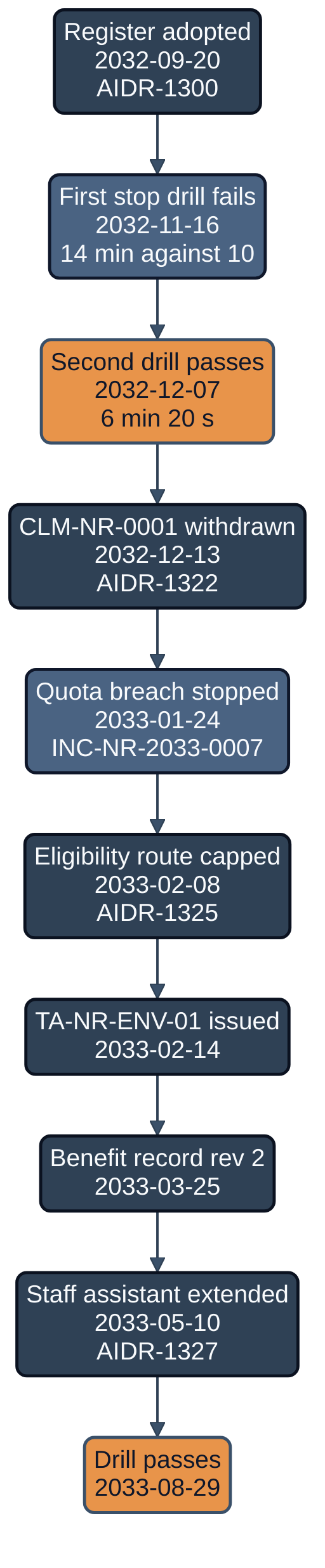
Figure 19A.1: The Region's year in AI Environment, September 2032 to August 2033. The first drill fails and the second passes; the public claim is withdrawn; the January breach is stopped inside a minute. All dates are illustrative.
| Date | Event |
|---|---|
| 2032-09-20 | Register adopted (AIDR-1300); the baseline has one aged footprint figure |
| 2032-10-06 | FPR-NR-0007 sent to the hosted-model provider; the reply falls due 2032-11-30 |
| 2032-11-08 | BEN-NR-0001 written (hold-out 2032-10-11 to 2032-10-24); AIDR-1309 and AIDR-1319 |
| 2032-11-16 | First stop drill of EBG-NR-0001 fails: 14 minutes against a target of 10 |
| 2032-12-07 | Second drill passes in 6 minutes 20 seconds |
| 2032-12-13 | CLM-NR-0001 withdrawn (AIDR-1322); staff assistant not extended (AIDR-1326); register snapshot |
| 2033-01-17 | 129,400 resolved enquiries, 80.5 per cent of the quota of 160,650; alert |
| 2033-01-24 | 177,800 passes 110 per cent; the gateway stops the route within a minute; the rebound alarm of 175,200 is exceeded; INC-NR-2033-0007 |
| 2033-02-08 | Eligibility-route extension declined; cap 25,000 (AIDR-1325) |
| 2033-02-14 | TA-NR-ENV-01 issued; environmental disclosure carries 12 of 100 quality points |
| 2033-03-25 | BEN-NR-0001 revision 2, hold-out in a normal week, the effect smaller; the quota is recalculated to about 176,600 |
| 2033-05-10 | AIDR-1327 and AIDR-1328 |
| 2033-08-31 | FPR-NR-0006 retired with the sunset of the Vibe to Dev builds |
The register ends the year with changed status: footprint records within age, from 0 of 6 rows to 3 of 5 live rows; benefit records within age, from 0 of 6 to 2 of 5; budgets with a drilled stop, from 0 to 3; complete rows, from 0 to 2; public claims in force, from 1 (aged) to 0 (14, Nordqvist, 2026).
Figures of the citizen assistant
The citizen assistant is the use that carries the most numbers, and its two revisions of one footprint are a finding in themselves.
| Quantity | Revision 1 (measured 2032-10-04) | Revision 2 (replaces revision 1 on 2032-12-19) |
|---|---|---|
| Energy per resolved enquiry | 16.3 Wh (range 7.7 to 30.0) | 30.5 Wh at the facility boundary (25.2 Wh IT, GPU servers and host) |
| CO2e per resolved enquiry | 0.52 g (0.19 to 1.35) | 0.98 g (0.85 to 1.17) |
| Monthly energy | 2,385 kWh | 4,458 kWh |
| Power of the serving nodes | 0.30 kW | 0.52 kW |
| PUE | 1.15 | 1.21 |
| Pool share | 0.40 | 0.41 |
The October 2026 calculation (SCI-2026-10) gave 1.90 g, of which 1.02 g was operational and 0.88 g embodied, for 71,000 resolved enquiries at 32 g per kWh. The benefit is 21 calls to the service desk within 48 hours per 100 enquiries without the assistant and 14 with it, a difference of 7 (5 to 9), about 10,200 avoided calls a month and 7.4 g (2.1 to 27.0) per avoided call, valid to 2033-05-07 (14, Nordqvist, 2026).
The budget EBG-NR-0001 is 4,450 kWh a month and EUR 18,000, with a target of 2.0 g, a ladder of 0.80, 1.00 and 1.10 of the quota, a rebound alarm at 175,200 and a quota of 160,650 enquiries a month. The classifier costs 0.004 Wh per item against 0.12 and 0.80 Wh for two general models. The reserved pool's utilisation of 0.58 compares with a target of 0.70; four idle accelerators cost about EUR 65,000 a year at the 2027 price (HWL-NR-0001) (14, Nordqvist, 2026).
Across the usage modes
| Mode | Region uses | What the Region can meter | Position |
|---|---|---|---|
| Mode 3 | Platform team's agentic tools (MND-NR-ENV-0001) |
Tokens and calls through the gateway; sandbox compute | Per session 80 model calls, 150 tool calls, 45 minutes; per month 800 sessions; proposed (AIDR-1315) |
| Mode 4 | Citizen assistant (two routes), staff assistant, triage ranking, classifier | Gateway telemetry; own metering where the Region hosts | Environmental budget per use enforced at the gateway |
| Mode 5 | None | Not applicable | The Region has no Mode 5 use |
Across the degrees of delegation
| Action class | Position at the Region |
|---|---|
| Measure, recommend | Within the starting ceiling of Level 3 Bounded; the meter and its readings stay with named people |
| Alert and defer | Automatic under DLG-NR-ENV-0001 |
| Stop | Automatic at 1.10 of the quota (a gateway control, not a delegated act); the on-call confirms and records the time |
| Provision, scale up | Level 2 Supervised within a budget; none for the agent's own compute |
| Publish a claim | Drafting at most; the regional director approves and Maria Åkesson reviews |
| Any class | Never Level 4; no decision about a named person's access to work rests on telemetry |
The stop path STOP-NR-ENV-01 routes the gateway to an FAQ page and the telephone service; it is held by Henrik Dahl with the platform on-call, outside the assistant (14, Nordqvist, 2026).
What the volume concludes for Nordvik Region
Chapter 28 of the volume draws conclusions under six headings, and Chapter 27 adds two lessons. The first lesson is that a number can outlive what it described: the public figure, the quota and the first footprint all rested on one measurement at one time, and the remedy is to recalculate at drift, refresh the benefit in a normal week and date everything. The second is that a control can exist on paper before it works: the first drill failed because the on-call could read the gateway's routing table but not change it, and the permission was then granted and written into the on-call role. The January breach showed that a single monthly quota lets one notice consume most of it in three weeks. The net-benefit principle forbade setting an unproven benefit against a measured cost, so the February allowance was conditional on a new benefit record (14, Nordqvist, 2026).
Keep the stop path, the classifier, the register, the Count rule and the sufficiency rule. Change the one complete row (settle revision 1 against revision 2 with an independent check), write the five missing footprints and drill EBG-NR-0002 and EBG-NR-0003. Stop using 1.90 g, using BEN-NR-0006 as evidence of benefit and any extension of a hosted route without a figure, the eligibility route staying capped at 25,000 explanations a month (14, Nordqvist, 2026).
The volume asks three suppliers for evidence: the hosting provider (yearly facility figures, monthly metered energy for the pool, water per customer, an option to shrink), the hosted-model provider (energy per request or its method, region, notice of model change) and the triage supplier (energy of each retraining, from the Region's meter). The third row is a conclusion of Chapter 28 recorded nowhere else. The volume's expected outlook is that the re-tender stays open after August 2033 (14, Nordqvist, 2026).
Open threads
These are collected in Chapter 27.
- Revision 1 against revision 2.
FPR-NR-0001is 16.3 Wh (0.52 g) in revision 1 and 30.5 Wh (0.98 g) in revision 2 at the same facility boundary; the difference lies in three inputs (power 0.30 against 0.52 kW, PUE 1.15 against 1.21, pool share 0.40 against 0.41), not in the boundary. The reading of September 2032 gives 31.9 Wh, nearer to revision 2. No independent check has been made, and the register carries revision 1 at the snapshot. The dossier uses revision 2 as the later value. - Three boundaries for one use.
EBG-NR-0001counts at the GPU servers and host before facility overhead with the 2026 factor of 27.7 Wh (4,450 kWh); revision 2 gives 25.2 Wh at the same boundary (the drift is minus 9.0 per cent) and 30.5 Wh at the facility boundary (4,458 kWh). Whether the budget "covers" the use depends on the boundary chosen. The quota is 160,650 against 146,000 times 1.1 equals 160,600, a rounding difference. - Identifiers. AIDR-1310, AIDR-1316 and AIDR-1323 are not in the allocation although Chapters 10, 16 and 23 create records (
HWL-NR-0001,TA-NR-ENV-01);HWL-NR-0001,TA-NR-ENV-01andSDR-NR-0001and0003have no AIDR in the profile. The rule of 1300 plus the chapter is broken only by the second decisions, which the volume numbers from 1326 (AIDR-1326, AIDR-1328). AIDR-1318 is dated 2032-11-02, yet Chapter 18 places the district-heating study "in AIDR-1318".FPR-NR-0007was renumberedFPR-NR-0008for the Mode 3 tools and has a double meaning (the profile uses it as the next use identifier, Chapter 5 as the model sheet);EBG-NR-0002becameEBG-NR-0003for placement. - At the end of August 2033. The re-tender of
NR-2026-031is open;CLM-NR-0001is withdrawn and waits for per-customer metering; the eligibility route has no energy figure (rung 5) and runs on its cap;FPR-NR-0004needs the AI share ofnordvik-dcand the supplier's retraining energy; the district-heating study is open; time-shifting is off; the rebound check of the staff assistant falls about August 2033; and the reading promised by AIDR-1329 was fulfilled withBEN-NR-0001revision 2 on 2033-03-25 but with no separately recorded independent check ofFPR-NR-0001.
Summary
AI Environment shows Nordvik Region as an organisation that bought its AI capacity and therefore had to learn to ask for evidence about it. The facts established by the volume's profile are the baseline of six uses, the new people (Astrid Nyberg, Ida Pettersson and Mats Öberg), the data centre at about 640 kW, the pool of 24 reserved accelerators and the gaps at the start. The illustrative events are one register, two revisions of one footprint, a first drill that failed and a second that passed, a public figure withdrawn after 2,235 days, a notice that took the assistant to its cap in three weeks, two extensions declined and one granted on conditions, and a tender annex that gives environmental disclosure 12 of 100 quality points.
The chapter's conclusion is the volume's: the Region ends the year with fewer public claims and more evidence behind each remaining use. The dossier cannot yet say which revision of the footprint is right or how three boundaries for one budget are reconciled.
Sources
- Nordqvist, G. AI Environment: Designing AI for the Greatest Benefit and the Least Environmental Harm in European Enterprises and Public Authorities. The Transformed Architecture, Book 14. (14, Nordqvist, 2026)