Nordvik Region at a Glance
This chapter puts Nordvik Region on one page, and then gives the page its evidence. It states what the organisation is, what it is responsible for, how large it is, what it is like, which advantages and disadvantages the series gives it, what its AI estate looks like in a paragraph, which usage modes it uses and which it avoids, and how it differs from the sibling organisation Hansa Mutual. Every statement traces to the example-organisation profile of a volume or to a chapter that the profile cites. The profile first appears in AI Governance (Book 2) and is extended by each later volume, and the chapter draws on all of them. The detail behind each line is in Chapters 3 to 7, and the volume-by-volume account is in Part III.
A note on status. The profile itself, meaning the mandate, the headcount, the legal setting, the character and the existence of the principal systems, is established. The dates, figures and events that the volumes set from 2027 onward are illustrative, and where the chapter uses one it says so.
The page
| Line | Nordvik Region |
|---|---|
| What it is | A regional public authority in a Nordic member state of the European Union |
| Mandate | Regional health and social-care coordination, regional development and public transport; administers needs-based financial assistance on behalf of its municipalities |
| Size | About 6,000 employees; about 450,000 residents |
| Legal regime | One jurisdiction, public law (administrative law, public access, archives, public procurement), the AI Act, the GDPR and NIS 2 as transposed |
| Political governance | A regional council and an executive committee of elected members; a regional director leads the professional administration |
| Character | Cautious, accountable to elected politicians and to the public, constrained in budget and specialist skills, dependent on suppliers, concerned with transparency, sovereignty and residents' rights |
| Central AI system | A procured benefits-triage system (Mode 4, high-risk, Annex III point 5(a)); a named caseworker decides every case |
| Lever | The contract, not the platform |
| Principal risks | Residents' rights and public trust; supplier lock-in; small engineering and security capacity |
| AI it avoids | Autonomous production agents (Mode 5); agentic work tools (Mode 3) beyond a small platform team |
| Sibling | Hansa Mutual, a multinational mutual insurer that builds and runs agents |
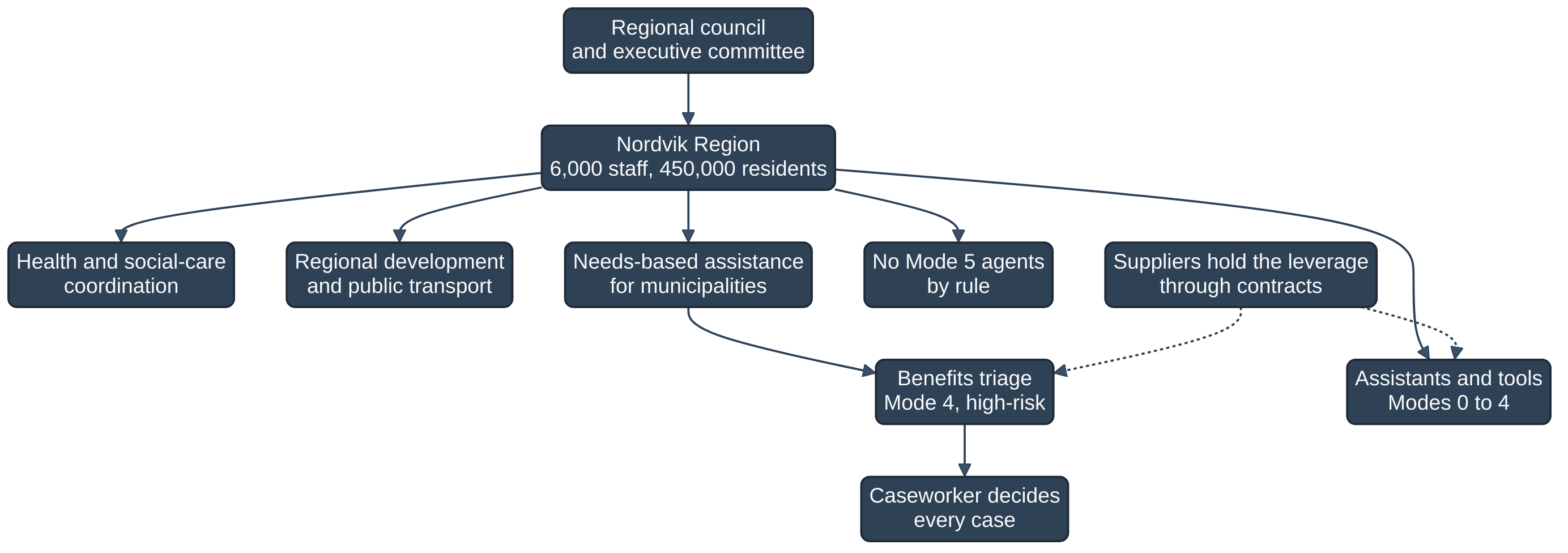
Figure 2.1: The one-page picture. The caseworker decides every case, the suppliers hold the leverage through contracts, and no Mode 5 agent is in the estate.
What it is and what it is responsible for
Nordvik Region is a regional public authority in "a Nordic member state of the European Union". The profile of the earlier volumes does not name the state; AI Environment names it as Sweden (Chapter 4). It is responsible for regional health and social-care coordination, regional development and public transport, and it administers needs-based financial assistance on behalf of its municipalities. It has about 6,000 employees and serves about 450,000 residents (2, Nordqvist, 2026).
AI Boss gives the distribution of the 6,000 employees, which is the fullest breakdown in the series. About 1,900 work in departments and clinics at two local hospitals, about 700 in primary care, and about 1,100 in the regional home-care service that the Region runs for five smaller municipalities. About 350 work in public transport, in planning, traffic control and customer service, with operation itself procured. The remaining 1,950 or so work in regional development, the benefits unit, social services, digitalisation, security and central administration. Specialist care is bought from the university hospital of the neighbouring region (7, Nordqvist, 2026). AI Leader adds that about 355 of the 6,000 hold management posts, one in seventeen (11, Nordqvist, 2026).
The mandate has three further features that later volumes draw out. The Region publishes in the national language and in a regional minority language with little digital text, which matters to what an AI system can be trusted to say. It coordinates regional vocational programmes and advises municipal schools without controlling them. It carries civil preparedness duties, so that health and social-care coordination and public transport must continue in a crisis (5, Nordqvist, 2026).
Geography
The volumes give the geography only as far as it bears on a decision. The Region sits in one jurisdiction, so no cross-border transfer question arises inside its own estate. It serves a population of about 450,000 spread over the municipalities for which it administers financial assistance. The benefits-triage training data in AI Platform and Security has a geographical skew that the book records: two northern municipalities account for 4 per cent of the rows and 9 per cent of the population. The Region provides a shared service to a named neighbour, Eastby Municipality, under service agreement SA-AI-2026-007, which requires log retention of at least 180 days, 60 days' notice of a model change and delivery of logs within five working days. Its datacentre has two halls in nordvik-dc (AI Operations, illustrative), and its reserved accelerators sit in a Nordic datacentre of a European hosting provider (3, Nordqvist, 2026) (2, Nordqvist, 2026) (10, Nordqvist, 2026).
Character, advantages and disadvantages
The series states the character in one sentence and keeps to it. Nordvik Region is cautious, accountable to elected politicians and to the public, constrained in budget and specialist skills, dependent on suppliers, and strongly concerned with transparency, sovereignty and the rights of the residents its decisions affect (2, Nordqvist, 2026).
| As the profile states them | |
|---|---|
| Advantages | A single legal regime; a clear public mandate; strong traditions of openness |
| Disadvantages | Limited engineering capacity; long procurement cycles (9 to 14 months in AI Operations); exposure to supplier lock-in |
AI Governance draws a sharper conclusion from the two lists. The Region is mostly a deployer, so the party that holds the contract holds the leverage, and a weak exit clause becomes lock-in for years. Its difficulty is the depth of its public-law duties, which are the duty to give reasons, public access, archives and procurement, and not the number of jurisdictions (2, Nordqvist, 2026). AI Platform and Security adds that the lever sits in the gateway and in the evidence that contracts can require: release notices, incident notification, patch commitments and the right to evaluate (3, Nordqvist, 2026).
The AI estate in a paragraph
The central system is the procured benefits-triage system. A supplier, TriageSoft (a fictional supplier), provides it under tender NR-2026-117, and it runs in the Region's own data centre. It ranks about 40,000 applications a month by urgency, and a caseworker decides every case. It is a high-risk system under Annex III point 5(a), the Region is its deployer, and its decisions are recorded in AIDR-0007, AIDR-0011 and AIDR-0018 with the fundamental rights impact assessment FRIA-2026-002. Around it the Region runs an internal staff assistant for about 3,200 employees, built on an open-weight model at a European cloud provider under contract NR-2026-031, with the EEA only and customer-held keys. It runs a citizen-service assistant on open-weight models on reserved accelerators, a fine-tuned correspondence classifier, and a case-note summariser for 180 social-services caseworkers that stays on premises because of special-category data. It has ambient AI in licensed software and a controlled pilot of an embedded workplace assistant. It has no autonomous production agents. The first inventory in 2026 found eleven AI services in use, three of them without review (2, Nordqvist, 2026) (3, Nordqvist, 2026). Chapter 5 lists the whole estate.
The estate grows with the series. Book 4 adds security AI under a programme charter NR-SEC-PROG-2027, Book 7 a rostering system and a paused recruitment-screening pilot, Book 10 an operations assistant and a runbook runner, Book 11 a council-paper summariser, Book 12 a coding assistant pilot, Book 13 a builder workspace and Book 14 no new system but a footprint, benefit and budget record for six existing uses. These additions are set in 2027 to 2033 and are illustrative, and the Region's own rule that it runs no autonomous production agent holds across all of them (4, Nordqvist, 2026) (7, Nordqvist, 2026) (10, Nordqvist, 2026) (11, Nordqvist, 2026) (12, Nordqvist, 2026) (13, Nordqvist, 2026) (14, Nordqvist, 2026).
Across the usage modes
The usage modes are the series' own scale, from Mode 0 Ambient AI to Mode 5 Autonomous production agents. The table says which the Region uses, what it uses them for and which it avoids.
| Mode | Use at Nordvik Region | Status |
|---|---|---|
| Mode 0 Ambient AI | AI features inside licensed software, enabled by suppliers; a service-desk classifier in the service-management tool (AI Operations) | Used; the principal blind spot (a supplier's AI acted without a recorded decision in AI Red Team and AI Blue) |
| Mode 1 Conversational assistants | Only through the approved enterprise tool, for public and internal material; consumer endpoints blocked at the proxy (Landscape) | Used with limits |
| Mode 2 Embedded assistants | A controlled pilot of an embedded workplace assistant; in AI Developer a pilot for 12 developers | Used as a pilot |
| Mode 3 Agentic work tools | Limited to a small platform team and the security architect, on open-weight models on reserved capacity | Used, narrowly |
| Mode 4 Applications | Benefits triage, staff assistant, citizen-service assistant, correspondence classifier, case-note summariser, security assistants, later rostering and others | The core of the estate |
| Mode 5 Autonomous production agents | None; the usage-mode register lists Mode 5 as not permitted (modes_not_permitted: [5]) |
Avoided by rule |
The Mode 5 rule is stated in the policy of AI Governance and restated by later volumes. AI Governance says that Mode 5 is not started without containment, a stop mandate, evaluation evidence and a committee decision (2, Nordqvist, 2026). AI Platform and Security adds that the narrowness of the modes is a choice that lasts only as long as something enforces it (3, Nordqvist, 2026). The ceilings the Region sets by charter are lower than the modes alone would suggest. The security programme charter caps security AI at Mode 4 and offensive work at Level 2, and the delegation profile for rostering and the leadership delegation profile set lower caps still (4, Nordqvist, 2026) (7, Nordqvist, 2026) (11, Nordqvist, 2026).
Security, operations and engineering in one line each
These three are small, and the series presents them as small on purpose. The security unit has 14 people, six of them security analysts on office hours, and the rest of the watch is bought from a European managed security service provider under framework agreement NR-2025-044. The IT and digitalisation unit has about 85 people, of whom a platform team of seven engineers carries the practices of site reliability engineering, and depends on a national shared-service provider, SamDrift, for the disaster recovery site, identity federation, external DNS and night monitoring. About 25 employees write code as their main work, with about 22 consultants working in the Region's repositories (4, Nordqvist, 2026) (10, Nordqvist, 2026) (12, Nordqvist, 2026). Chapter 7 gives the posture, and the volume chapters of Part III give the evidence.
How Nordvik Region differs from Hansa Mutual
The series chooses the two organisations to contrast, and the contrast is the best short description of each (2, Nordqvist, 2026).
| Dimension | Nordvik Region | Hansa Mutual |
|---|---|---|
| Kind | Regional public authority | Mutual insurance group headquartered in Hamburg |
| Employees | About 6,000 | About 9,500 |
| Jurisdictions | One, public law | Several inside and outside the EU, with seven legal regimes |
| Build or buy | Mostly buys; builds little | Builds as well as buys, with strong engineering capacity |
| Autonomous agents (Mode 5) | None, by rule | Several, including a claims-triage agent and an IT-operations agent with write access to production |
| Principal lever | The contract | Its own platform and engineering capacity |
| Principal difficulty | Depth of public-law duties and supplier lock-in | Legal fragmentation across jurisdictions and the attack surface of agents |
| Supervision | Public-law oversight, an audit committee and elected revisers | Financial-sector supervisors in each market |
| Working-life law | One national co-determination regime | Works councils and unions under different national rules |
Later volumes sharpen the same contrast in their own terms. AI Blue gives it as "Nordvik must create detection engineering; Hansa must keep its detection engineers from drowning in AI-drafted rules" (8, Nordqvist, 2026). The Transformed Security Architect says that Nordvik "has to build what Hansa already has" (6, Nordqvist, 2026). AI Threat sets the Region's discipline as publicity, against Hansa's discipline as engineering (5, Nordqvist, 2026). Landscape draws the Region as the cautious buyer and Hansa as the builder, and shows the contrast in the landscapes of its opening chapters (15, Nordqvist, 2026). The dossier on Hansa Mutual covers the other side in the same plan.
What the page leaves open
Three points on the page are unsettled or have a nuance in the volumes, and the page is stated as it stands.
- The state is named only in Book 14. The profile says "a Nordic member state"; AI Environment writes Sweden and cites the Swedish Lag (2025:570) on the energy performance of data centres (14, Nordqvist, 2026). AI Boss, AI Operations and AI Leader then take their examples of co-determination, local government and cyber security from Swedish law, and AI Operations states that it sets the Region in Sweden. The dossier keeps "a Nordic member state" as the profile has it and records the Swedish examples where a volume uses them (Chapter 4; Chapter 27).
- The number of units in the Landscape model on 1 January 2027. The model file has thirteen entries, two of them planned, so the picture of the day has eleven marks; the chapters of Landscape now say eleven throughout, and the register of the AI estate there lists thirteen entries. Chapter 5 and Chapter 20 take it up (15, Nordqvist, 2026).
- The benefits volume is stated as applications and as claims. The 40,000 a month figure comes from AI Governance and AI Platform and Security as applications a month, and from AI Threat as claims a month. Landscape has dropped its earlier statement that the profile does not register the figure. Chapter 23 treats the figure and its evidence age.
Summary
Nordvik Region is a regional public authority of about 6,000 employees serving about 450,000 residents, with one legal regime, a public mandate and a procured benefits-triage system at the centre of its AI estate. The profile stays constant across the fourteen volumes: cautious, accountable to elected politicians, short of engineering and security capacity, and dependent on suppliers, with the contract as its lever and the rights of residents as its principal concern. Its usage modes run from Mode 0 to Mode 4 and it avoids Mode 5 by rule. It differs from Hansa Mutual in kind, in size, in the number of legal regimes, in whether it builds, and in whether it runs agents. The dossier's own conclusion from this page is that the organisation is defined less by what it runs than by what it will not run and by whom it must ask, and that the later chapters test this reading against the evidence.
Sources
- Nordqvist, G. AI Governance: Governing Artificial Intelligence in European Enterprises and Public Authorities. (2, Nordqvist, 2026)
- Nordqvist, G. AI Platform and Security: Building and Securing AI Platforms in European Enterprises and Public Authorities. (3, Nordqvist, 2026)
- Nordqvist, G. AI Red Team: AI as an Active Part of Cyber Defence in European Enterprises and Public Authorities. (4, Nordqvist, 2026)
- Nordqvist, G. AI Threat: Are the Dystopias Coming True? Evidence, Risk and Response for European Enterprises and Public Authorities. (5, Nordqvist, 2026)
- Nordqvist, G. The Transformed Security Architect: Role, Craft and Career in the Age of AI in European Enterprises and Public Authorities. (6, Nordqvist, 2026)
- Nordqvist, G. AI Boss: When Artificial Intelligence Manages People in European Enterprises and Public Authorities. (7, Nordqvist, 2026)
- Nordqvist, G. AI Blue: How Artificial Intelligence Transforms the Blue Team in European Enterprises and Public Authorities. (8, Nordqvist, 2026)
- Nordqvist, G. AI Operations: How Artificial Intelligence Transforms IT Operations in European Enterprises and Public Authorities. (10, Nordqvist, 2026)
- Nordqvist, G. AI Leader: How Leadership Roles Change When AI Is Used Broadly in European Enterprises and Public Authorities. (11, Nordqvist, 2026)
- Nordqvist, G. AI Developer: How the Developer Role Changes When AI Is Used Broadly in European Enterprises and Public Authorities. (12, Nordqvist, 2026)
- Nordqvist, G. Vibe to Dev: From Vibe Coding to Professional Software, Step by Step, for Builders Who Are Not Developers, in European Enterprises and Public Authorities. (13, Nordqvist, 2026)
- Nordqvist, G. AI Environment: Designing AI for the Greatest Benefit and the Least Environmental Harm in European Enterprises and Public Authorities. (14, Nordqvist, 2026)
- Nordqvist, G. Landscape: A Fact-Based Picture of Architecture and AI at Work, for Leaders, Architects and Citizens. (15, Nordqvist, 2026)