Book 6, The Transformed Security Architect: The Role
This chapter gathers what The Transformed Security Architect (Book 6) establishes about Nordvik Region: the security architect post, how it was created, what its role charter lets one person decide, what the post's own AI tooling may do, and what the first year of the transformed role looked like. The chapter draws on Book 6 and on the facts of earlier volumes that Book 6 builds on, which are named where they enter. Book 6 marks every YAML example in the volume as illustrative, and its year from autumn 2026 to autumn 2027 is written in November 2026; the chapter therefore keeps established (profile) facts apart from illustrative (fiction) events in each section.
The volume in brief
The Transformed Security Architect is the sixth volume of the series and describes what has happened to the security architect, the person who designs the boundaries, policy points, containment, identity model, evidence chain and stop paths on which the conclusions of the earlier volumes depend. Its thesis is that the role is transformed, not abolished, through four shifts: Shift 1, from documents to code; Shift 2, from gatekeeper to boundary designer; Shift 3, from periodic to continuous, at machine speed; Shift 4, from sole author to conductor of an AI team. The volume covers the craft, the architect's own AI team, the role in the organisation, competence and career, and the experience of the two fictional organisations over a year (6, Nordqvist, 2026).
Book 6 uses the series' usage modes (Mode 0 Ambient AI to Mode 5 Autonomous production agents) and autonomy levels (Level 0 Advisory to Level 4 Autonomous), and names its artefacts as role charters (ROLE-*), control catalogue entries (CTRL-*), mandate manifests (MND-*), competence records (CMP-*) and AI Decision Records in the range AIDR-0500 to AIDR-0599, of which Nordvik Region holds AIDR-0500 to AIDR-0549 (6, Nordqvist, 2026).
The role of Nordvik Region in the volume
Nordvik Region is the volume's case of one security architect in an authority that mostly procures and buys. The post was created in 2025 by converting a post as security coordinator, whose work was policy documents, the annual procured penetration test and supplier questionnaires. It was regraded within fixed pay scales, but it had no written decision rights, no role charter and no deputy (The Transformed Security Architect, Chapter 1) (6, Nordqvist, 2026).
In autumn 2026, after the July 2026 incident between OpenAI and Hugging Face and the threat assessment ATA-NR-2026-01 (both established in AI Threat), the regional director asked the CISO for a role charter and a competence plan before the 2027 budget. That request is recorded as AIDR-0500 (6, Nordqvist, 2026).
The volume's thesis, as it applies to Nordvik, is "contract-first": because suppliers build and run most of what the Region uses, the boundaries are held mostly through tender annexes, supplier evidence and contracts. The three shifts that matter most are building a control catalogue (Hansa Mutual has one already), specifying machine-speed properties the Region cannot build itself, and keeping one person's judgement independent of the AI assistant that is the post's only daily colleague. The volume's conclusion for the Region is that Nordvik "has to build what Hansa already has" (The Transformed Security Architect, Chapter 26) (6, Nordqvist, 2026).
What the volume establishes
The organisation around the post
Book 6 adds the following to the profile of the Region (established unless stated otherwise).
| Element | What the volume states | Chapter of Book 6 |
|---|---|---|
| Authority | Regional public authority in a Nordic EU member state, about 6,000 employees, about 450,000 residents | 1 |
| Security organisation | The CISO reports to the regional director; the security unit has 14 people, of whom six are analysts on office hours; other monitoring is bought from a European managed security service provider (MSSP) under framework agreement NR-2025-044, which requires EU/EEA processing |
profile |
| Architecture function | No architecture department. The enterprise architect in the digitalisation unit is the nearest colleague. An AI architect on the same pay scale owns the AI Decision Records | profile |
| Platform | The platform team ("a handful of engineers") runs reserved capacity, the AI gateway and the only Mode 3 tools | profile |
| Decision forums | No standing architecture review board. Decisions follow the escalation matrix, with the political level in the regional executive committee | 17 |
| Own AI use | Mode 1 through an approved enterprise tool (public material only) and Mode 3 under MND-NR-01, open-weight models on reserved capacity only. No Mode 5 agents and no agent team |
12, 13 |
| Starting artefacts | Reference architecture v2024-1 (eight sections) as a document; an ISO/IEC 27001 Annex A spreadsheet; tender annexes in word-processor files; two artefacts that are already code: the pre-production security checklist and the citizen-service assistant threat model | 1, 25 |
| Model zones | Internal, DMZ, partner; four data classes; exceptions previously granted by letter with no expiry date | 2 |
| Legal setting | The principle of public access and archive law govern every artefact; sensitive detail is kept in a classified annex. One national co-determination regime; the union was consulted before MND-NR-01 version 2.0.0 |
2, 13, 19, 20 |
Four supplier relationships carry the Region's boundaries (The Transformed Security Architect, Chapter 20): TriageSoft, which supplies benefits triage under tender NR-2026-117 and retrains the model inside the Region's own platform; a European cloud provider for the staff assistant under agreement NR-2026-031 (EEA only, customer-held keys); a hosting provider that reserves accelerators in a Nordic data centre; and the MSSP under NR-2025-044 (6, Nordqvist, 2026).
The role charter ROLE-NR-SA-01
The charter is the volume's central artefact for Nordvik. It is version 1.0.0, held in roles/security-architect.yaml, effective 2027-01-01 (illustrative), approved by the CISO, endorsed by the regional director and adopted by the regional executive committee in December 2026 (The Transformed Security Architect, Chapters 4 and 26) (6, Nordqvist, 2026).
| Right | Scope | Time limit |
|---|---|---|
| Decide | Stop-path and egress terms in a tender annex | 5 working days |
| Decide | Gate policy for the boundary of the control catalogue | 2 working days |
| Decide | Stop or restrict the architect's own AI tools | 15 minutes |
| Decide | Compensating design for an exception of up to 90 days | 5 working days |
| Veto | A tender annex without a stop path; an AI go-live without a tested stop path | the CISO can override, in the minutes |
| Recommend | Residual-risk acceptance (the system owner decides); changes to MND-NR-01 (the CISO decides) |
n/a |
Escalation to the CISO is within two working days. The ceiling for the architect's own AI is Level 1 Assisted. The design rule behind the table is that anything that would let one person approve their own work is a recommendation to the CISO (6, Nordqvist, 2026).
The architect's own AI: MND-NR-01
AIDR-0511 commissioned a Mode 3 tool for the architect. Its mandate manifest MND-NR-01 version 1.0.0 allows open-weight models on reserved capacity, data classes public, internal and confidential, edits at Level 2 Supervised, no commit or push, and protected paths tests/, policy/ and schemas/. A worklog is kept in docs/ai-use-log.md, sessions are retained 30 days, and review_by is 2027-05-01. Version 3.0.0 followed the May 2027 review and set edits and commands at Level 1 Assisted and research at Level 0 (The Transformed Security Architect, Chapters 12 and 25) (6, Nordqvist, 2026).
AIDR-0503 (2026-11-04) deferred an agent team. It put version 2.0.0 of the mandate in force with a research skill at Level 0 Advisory and weighed three options: A, build a five-agent team (rejected: no second reviewer); B, buy the supplier's review service (rejected: hosting outside reserved capacity); C, the chosen option. The re-opening triggers are a second security architect post being funded, the platform team gaining agent operators, or a Mode 5 agent entering the environment. The volume's lesson is that capacity, not technology, decides (6, Nordqvist, 2026).
Decisions and records
| Record | Date | What it decides or holds | Chapter of Book 6 |
|---|---|---|---|
| AIDR-0500 | 2026-10-12 | Commissions ROLE-NR-SA-01 and CMP-NR-01; due 2026-11-27; review_by 2027-10-12; deciders regional director and accountable CISO; reviewers HR lead, enterprise architect, AI architect; relates to AIDR-0002 and ATA-NR-2026-01 |
1 |
| AIDR-0509 | 2026-11-20 | Shift assessment assessments/shift-assessment-2026.yaml, scoring Shifts 1 to 4 as 1/1/0/1 |
3 |
| AIDR-0501 | 2026-11-20 | Moves the reference architecture into the AI platform repository as a Structurizr model with four Rego policies; zones platform-control, regional-datacentre, external-supplier; review_by 2027-05-20 |
5 |
| AIDR-0502 | not dated in the extract | Control catalogue with ten supplier-held entries | 9 |
| AIDR-0503 | 2026-11-04 | Defers the agent team; MND-NR-01 v2.0.0 |
13 |
| AIDR-0504 | not dated in the extract | Binding contracts, annexes, exit plan and evidence schedule for the four supplier relationships; SECREQ-NR-2026-117 v3.1.0 |
20 |
| AIDR-0505 | Annual review cycle for the horizon register HZN-NR-SA-01 |
23 | |
| AIDR-0506 | Self-assessment and anti-patterns | 24 | |
| AIDR-0507 | Conclusion and plan PLAN-NR-SA-2027 |
26 | |
| AIDR-0508 | Call-back rule CBR-NR-BEN-01 for benefits triage |
8 | |
| AIDR-0510 | Generated threat modelling extended to benefits triage | 6 | |
| AIDR-0511 | Mode 3 tool for the architect; MND-NR-01 v1.0.0 |
12 | |
| AIDR-0512 | Tier policy for decisions | 17 | |
| AIDR-0513 | NIS 2 and AI Act obligations mapped to tender requirements; executive committee training under NIS 2 Article 20 | 18 | |
| AIDR-0532 | Learning path LP-NR-2027-01 |
22 | |
| AIDR-0540, 0541, 0542 | 2027 | Platform engineer post as deputy; MSSP break-glass credential for one action; deputy as alternate for the stop-path test at model update | 25 |
The dates and the descriptions of the later records are illustrative; the dates of AIDR-0500, 0503, 0509 and 0501 fall in 2026 and are given by the volume (6, Nordqvist, 2026).
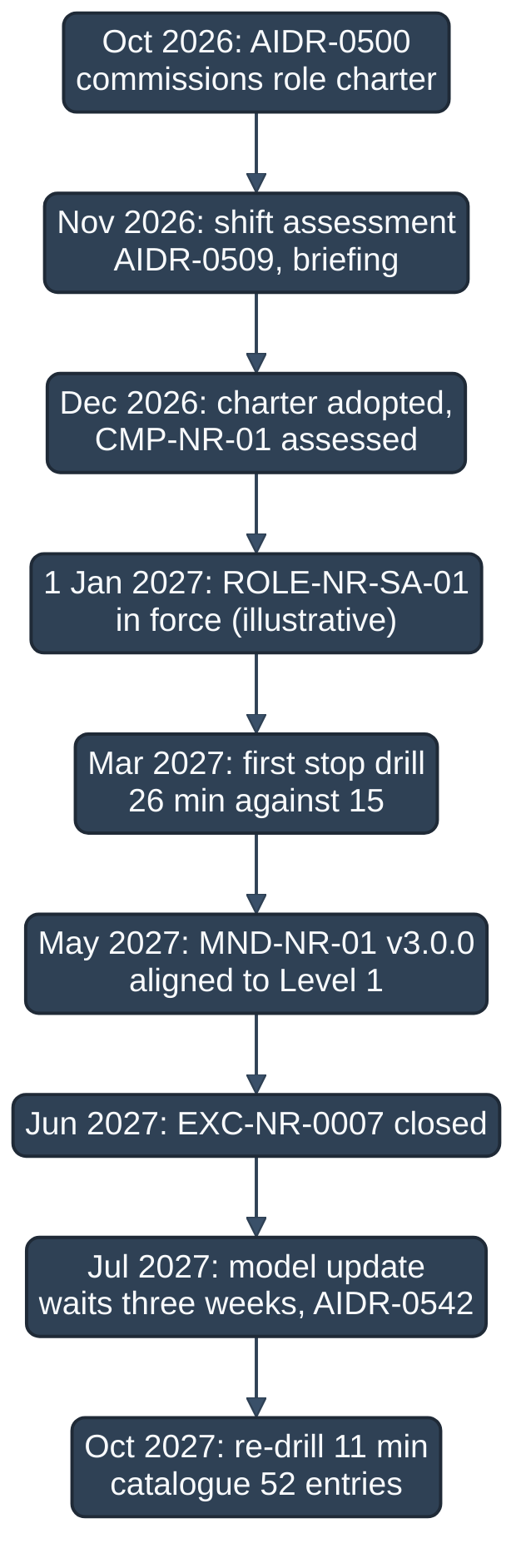
Figure 12.1: The security architect post from commission to re-drill, October 2026 to October 2027. Events from 1 January 2027 are illustrative.
The control catalogue and the supplier annexes
AIDR-0502 created a catalogue of ten supplier-held entries: CTRL-SUP-001 to CTRL-SUP-004, CTRL-IAM-001, CTRL-LOG-001, CTRL-AIG-001, CTRL-AGT-001, CTRL-BKP-001 and CTRL-REC-001. Four were verified, five declared and one failed: CTRL-LOG-001, because the MSSP's detections cover only some Region-specific scenarios. By the November 2026 briefing to the regional executive committee the catalogue held 24 controls (9 verified, 13 declared, 2 failed); in February 2027 it held 38 entries, and at the end of the year 52. The volume's reading is that the catalogue makes the dependence visible: 13 of the 24 were declared, nearly all held by suppliers (6, Nordqvist, 2026).
The contract instruments are these.
| Instrument | Content |
|---|---|
TA-NR-S4 |
Tender annex section 4 for NR-2026-117 and NR-2026-031: policy point, default-deny egress, per-job credentials of at most 60 minutes, an external stop path and log copies (requirements S4.1 to S4.5) |
SECREQ-NR-2026-117 v3.1.0 |
Incorporates TA-NR-S4; SR-01 stop path (control CTRL-SUP-011); SR-02 ranking log within 15 minutes, retained at least 12 months (CTRL-SUP-012) |
EXIT-NR-01 |
Exit plan with a one-day shutdown test; 20 working days' notice before a model change |
MS-1 |
MSSP annex to NR-2025-044: detect within 10, page within 5, act within 20 minutes in a quarterly injected test |
NR-REQ-HOST-RC |
Hosting annex: RC-01 replacement accelerators within 4 hours, RC-04 notification within 12 hours, RC-06 12 months' exit |
NR-SEC-004 |
Monthly restore drills; runbook RB-NR-ISOLATE-01 |
CBR-NR-BEN-01 |
Call-back rule: model version, integration credential and administrator list changes in benefits triage; 24-hour cooling-off; retention 120 months; contact register fixed at contract signature |
The 12-month log retention in SR-02 is set against the six-month floor of AI Act Article 26(6), and AIDR-0513 requires tender logs of at least 183 days (6, Nordqvist, 2026).
Events and figures
Established: the profile figures in the table above; AIDR-0500 on 2026-10-12; AIDR-0503 on 2026-11-04; the exception EXC-NR-0007 granted on 2026-11-12. Illustrative: everything dated from 2026-12-10 onwards, because Book 6 writes its year as fiction.
| Date | Event |
|---|---|
| 2025 | The security coordinator post becomes the security architect post |
| July 2026 | OpenAI and Hugging Face incident (established in AI Threat) |
| 2026-10-12 | AIDR-0500 |
| 2026-11-04 | AIDR-0503: agent team deferred |
| 2026-11-12 | EXC-NR-0007 granted by the CISO at tier 2: key rotation CTRL-KEY-004 is 90 days, the supplier manages 180 until its 2027 Q1 release; staff assistant AIDR-0211, agreement NR-2026-031, RISK-NR-0031; compensating control CTRL-KEY-004-C1; expires 2027-02-10 |
| 2026-11-20 | AIDR-0501 and AIDR-0509 |
| November 2026 | Briefing to the regional executive committee with three decisions: adopt the charter, fund a deputy post, require the evidence schedule in the NR-2026-117 renewal |
| 2026-12-10 | CMP-NR-01 assessed |
| 2027-01-01 | ROLE-NR-SA-01 in force |
| February 2027 | EXC-NR-0007 expires with the control still failed; the CISO renews it once for 90 days. The first seeded-error check misses S3 |
| March 2027 | First out-of-hours stop drill: 26 minutes against a budget of 15 |
| April 2027 | Deputy in post after vetting; degraded-mode exercise showed only two caseworkers could triage without the ranking |
| May 2027 | MSSP annex MS-1 signed (page within 5 minutes); MND-NR-01 v3.0.0; a journalist's request for the catalogue answered in time |
| June 2027 | EXC-NR-0007 closed when the supplier's release arrived |
| July 2027 | Four weeks of leave. TriageSoft announces a model update and the decision on a renewed stop-path test waits three weeks (the model is held); AIDR-0542 follows |
| September 2027 | CMP-NR-01 reassessed: code at Practitioner, design below target |
| October 2027 | Re-drill in 11 minutes against 15; catalogue at 52 entries |
| November 2027 | Role register and horizon register; AIDR-0505, AIDR-0506 |
The seeded-error method (The Transformed Security Architect, Chapter 14) places errors in three of five drafts a quarter. In the first quarter S1 and S2 were caught and S3, a non-existent ISO clause, was missed. Review requests to the architect numbered 17, with a median wait of 14 working days, and 13 were approved unchanged (AIDR-0506). The working-time shift is illustrative: documents and questionnaires from 40 % to 10 %, review forums from 20 % to 10 %, code from 5 % to 25 %, review of AI drafts from 5 % to 15 %, design and threat modelling from 15 % to 20 %, craft practice from 0 % to 15 %, supplier work and reporting from 15 % to 5 %; documents and meetings together fall from 60 % to 20 % (6, Nordqvist, 2026).
Across the usage modes
| Mode | Use in the post | Boundary |
|---|---|---|
| Mode 0 Ambient AI | Supplier-embedded AI is outside the architect's own use; the volume treats supplier-held controls through the catalogue | Contract and evidence |
| Mode 1 | Approved enterprise tool, public material only | Acceptable-use rule |
| Mode 2 | A pilot outside architecture work | Not part of the post |
| Mode 3 | Architect's tool under MND-NR-01, open-weight on reserved capacity |
Level 1 Assisted from the charter; no commit or push; protected paths |
| Mode 4 | Benefits triage and the staff assistant (supplier-run systems, usage modes as established in AI Governance) are systems the architect sets boundaries for | Tender annexes, stop path, call-back rule |
| Mode 5 | None in the environment | Re-opening trigger for the agent decision |
Across the degrees of delegation
The charter ceiling for the architect's own AI is Level 1 Assisted. The MND-NR-01 manifest version 1.0.0 and 2.0.0 allowed edits at Level 2 Supervised until the May 2027 revision, so for about four months the manifest allowed more than the charter. Book 6 notes that the gap was never exercised, since the architect wrote every change from January. The research skill sits at Level 0 Advisory. Level 4 is not used (6, Nordqvist, 2026).
What the volume concludes for Nordvik Region
Book 6 draws these conclusions in its Chapters 25 and 26. The charter gives one person narrow rights, and everything that would let one person approve their own work is a recommendation. The contract is an architectural instrument (Directive 2014/24/EU Articles 42 and 70). Deferring the agent team was a matter of capacity. The catalogue makes dependence visible. Timed drills work: the gap between the MSSP's runbook and its credentials became a requirement. A later instrument governs: the charter's Level 1 Assisted outranks the manifest's Level 2 Supervised, with four months of gap in application (6, Nordqvist, 2026).
The plan PLAN-NR-SA-2027 (AIDR-0507) runs from 2027-10-01 to 2029-09-30 and is summarised in its four measures.
| Measure | Target |
|---|---|
| M1 | Deputy becomes alternate on all protected paths (months 0 to 6) |
| M2 | Stop path within 15 minutes, tested quarterly |
| M3 | Supplier controls verified, at least 60 % |
| M4 | Reopen the agent decision only if two people can supervise |
The decisions put to the regional director are to continue funding the deputy and to fund verification rights in renewals. The plan is revised if the deputy post falls vacant, a supplier changes owner or a Mode 5 agent enters the environment. Learning path LP-NR-2027-01 protects 15 % of time, 20 training days and 48 mentor hours with external mentoring, and the deputy gives 20 % of time from the platform team (AIDR-0532, AIDR-0540). The competence record CMP-NR-01 (assessed 2026-12-10, valid until 2028-12-10, framework SA-CF 2027.1) holds DES-02 at practitioner, LAW-02 at advanced and COD-01 at foundation; the September 2027 target for COD-01 at practitioner is illustrative (6, Nordqvist, 2026).
Unresolved in the volume: how the architect is replaced during a vacancy, and the volume's Question 10, which it answers only in part.
Open threads
These findings are collected in Chapter 27.
- Plan measures. The
PLAN-NR-SA-2027YAML in Chapter 26 of Book 6 has four measures (M3 is 60 % verified, M4 the agent decision); the example-organisation profile describes six (M3 annexes as code, M4 reassessCMP-NR-01, M5 60 %, M6 agent decision). This chapter uses the four-measure version of the volume's chapter. - Charter and manifest. Versions 1.0.0 and 2.0.0 of
MND-NR-01allow Level 2 Supervised edits while the charter caps at Level 1 Assisted. Chapters 25 and 26 say the gap was never exercised; Chapter 25 also says the architect wrote every change from January. - Stop-drill quarter. Chapter 25 places the first drill in "quarter two"; the profile dates Hansa Mutual's drill identifier to 2027 Q1, and Nordvik's drill is "in March".
- AIDR-0501 status. Chapter 5 gives
status: proposed; Chapter 25 treats it as decided. MND-NR-01review.review_byis 2027-05-01 while the CISO decides v3.0.0 in May 2027.- Mode 2. The profile says an embedded pilot exists; the mode table of Chapter 25 reads "Pilot outside architecture work".
- Trigger of the assessment. AI Threat gives a political motion in September 2026; Book 6 names only the July 2026 incident and
ATA-NR-2026-01. - Level 3 gate examples.
DEL-NR-BEN-01andRVT-NR-2027-01are defined in AI Threat, not in Book 6.
Summary
Book 6 shows Nordvik Region as the smallest possible case of the security architect's role: one person, no deputy until 2027, a charter that gives narrow decision rights, and a boundary that is held mostly by contract. The volume's facts are a profile (the security unit of 14, the four supplier relationships, no agent team), a set of records from AIDR-0500 to AIDR-0542, and a year of illustrative events in which the control catalogue grows from 10 to 52 entries and a stop drill that took 26 minutes is repeated in 11. For this dossier the most useful pieces to carry forward are the charter's limits (what the architect decides, vetoes and only recommends), the ceiling of Level 1 Assisted on the architect's own AI, and the evidence-based catalogue in which most dependence is declared rather than verified. The unresolved items are listed above and gathered in Chapter 27.
Sources
- Nordqvist, G. The Transformed Security Architect: Role, Craft and Career in the Age of AI in European Enterprises and Public Authorities. (6, Nordqvist, 2026)