Book 12, AI Developer: Owning the Software
This chapter gathers what AI Developer (Book 12) establishes about Nordvik Region: who writes software in the Region and under which contracts, what it runs, how AI took part in development before and during the volume's year, the delegation profile that caps it, the ownership and verification rules the Region adopted, the release incident of December 2030, and the claims that were withdrawn, kept or left open. It draws on the volume's development profile and on its chapters on the delegation ladder (Chapter 4), ownership (Chapter 12), review and verification (Chapters 9 and 14), the platform team's mandate (Chapter 8), the pilot and its value claim (Chapters 7 and 20), the union agreement (Chapter 22), the incident (Chapter 23), the legal frame (Chapter 24), exit (Chapter 26), the dark week (Chapter 31) and the plan (Chapter 32) (12, Nordqvist, 2026).
The status of the facts is the volume's own. The profile of the development organisation and its legacy estate is established; the volume marks everything in its year, September 2030 to August 2031, as illustrative, and the book is written in November 2026. The chapter says which kind it is giving where it matters.
The volume in brief
AI Developer asks what happens to the developer, and to the development organisation, when AI writes, reviews, tests and deploys code across the organisation: in the editor, the pull request, the pipeline, the ticket, the legacy migration and the citizen's low-code app. Its thesis has five parts. The developer is transformed, not abolished: from author of code to framer, verifier and steward of software. Delegation of development work is graded and has a ceiling, and Level 4 is never used for a change to production without a gate that the change itself cannot alter, for code in a security-critical or safety-critical path without review by a named developer, for a change to the agent's own mandate, permissions, credentials, test oracles, review rules or pipeline gates, for an irreversible action on production data, or for a decision about a named person's employment, pay, performance rating or access to work. Verification, not generation, becomes the scarce skill, and the junior pipeline must be rebuilt. AI may draft, generate, refactor and, within a mandate, execute, but may not own: the stewardship principle says a named developer or team passes the tests Name, Understand and Revert, and the test oracle must be independent of the generator. Productivity, quality and competence are claims that need evidence (12, Nordqvist, 2026).
The work divides into five developer functions, D1 Frame, D2 Design, D3 Build, D4 Prove and D5 Steward, and ten classes of development work: specify, design, generate, refactor, test, review, deploy, operate, document and migrate. They are not the operations functions O1 to O5 of AI Operations nor the leadership functions L1 to L5 of AI Leader (12, Nordqvist, 2026).
The role of Nordvik Region in the volume
Nordvik Region is one of the two organisations that run through AI Developer. It is a small, cautious builder bound by public law: about 25 people write code as their main work, about 22 consultants work in its repositories, and nine inherited case and register systems live on. The volume uses it to show three things. The stewardship principle meets an organisation where ownership and an independent test oracle are missing: 31 % of 96 repositories have no living owner, and for the inherited systems there is no independent oracle, so the tools stay at Level 0. A claim, "a third faster", had reached a governing body without an evidence age and had to be withdrawn and replaced by "not known". And public law (reasons for decisions, public access, archive law, procurement and co-determination) sets the order of work: own, decide, negotiate, measure, and only then widen (12, Nordqvist, 2026).
The Region never reaches higher than Level 2 Supervised in the volume (documentation, and the platform team's drafts of infrastructure code), has no Level 3 and no Mode 5. The commission is AIDR-1100 (2030-09-16): the CIO, Henrik Dahl, endorsed by the regional director, asks the head of Applications and Integration and the platform lead to describe the developer role in a Region that uses AI broadly, with the HR director, the union's IT representative and the regional lawyer as reviewers. The first report was due on 2031-06-30 and was filed on 2031-06-27 (12, Nordqvist, 2026).
What the volume establishes
The development organisation
Applications and Integration has 31 people under Gunilla Roos: 18 developers (three of them tech leads, two juniors), four testers or quality engineers, five product owners or analysts, two designers or accessibility specialists and two managers. The platform team has seven engineers under Maja Lindqvist, who write infrastructure code, the GitOps pipeline and the golden paths. There is no site reliability function, no architecture group beyond the enterprise architect and the AI architect, and no tester pool outside Applications and Integration. About 25 employees write code as their main work (18 plus 7) (12, Nordqvist, 2026).
| Team | People | Release rhythm |
|---|---|---|
| Case platform team | 8 | Monthly |
| E-services team | 7 | Weekly for the portal |
| Integration and data team | 6 | |
| Business-systems team | 6 | Quarterly for inherited systems |
| Quality function | 4 |
Sprints are two weeks. Some 22 consultant developers work under the framework agreement NR-2025-102, from three suppliers, about 40 % on the case platform, and the agreement had no clause on AI tools. Supplier teams at TriageSoft (tender NR-2026-117) and SamDrift (framework agreement NR-2026-088) write code that the Region does not review. About 140 employees build small apps in the low-code product FormFlow: about 60 apps, 11 with personal data. Since 2027 the Region has published citizen-service components under an open licence on the national public-code platform (12, Nordqvist, 2026).
The technical estate
| System | Description |
|---|---|
SVC-NR-003 Case management |
Java 8 and Oracle, vendor product Ärendia, about 1.1 million lines of Java and PL/SQL, customised for 14 years, vendor support ends in 2033 |
SVC-NR-002 Citizen portal |
TypeScript and Spring Boot, built 2022 to 2024, about 340,000 lines |
| Nine inherited sector systems | From the "One Region" reorganisation of 2024; five on PL/SQL and Java 8 |
Socialia register |
About 600,000 lines of stored procedures, from 2008 |
Regression suites exist only for the portal and the benefits flow. A budget line of EUR 1.2 million for 2030, "assessment of modernisation", is unallocated; modernisation was postponed in the 2028 budget. The Region has two golden paths (a Spring service and a TypeScript front end), a package proxy with only approved registries, and the Region's AI gateway for Mode 4. The coding tools did not sit behind the gateway; the pilot called the model directly (12, Nordqvist, 2026).
AI use at the start of the year
| Mode | Use |
|---|---|
| Mode 0 | Ambient completion in the IDE, on by default after the vendor's update of March 2030; no decision was recorded until AIDR-1102; also in ServiceFlow |
| Mode 1 | Approved enterprise assistant, not for special-category data, credentials or the benefits-triage rules |
| Mode 2 | Pilot NR-DEV-001 for 12 developers since February 2030, a self-hosted open-weight code model, completion and chat |
| Mode 3 | The platform team only (four of seven engineers): infrastructure code and runbooks, never applied |
| Mode 4 | No AI application for developers |
| Mode 5 | None, by rule |
The pilot's figures are an acceptance rate of 31 %, "about four hours saved a week" from a survey answered by 9 of the 12 (April 2030), and a note to the executive committee saying "a third faster". Delivery time had never been measured (AVR-NR-2030-01). In a sprint from 2030-10-06 to 10-17 Linnea Sjöberg's work map shows 80 hours, 33 of them in contact with a tool (the holder's own estimate) (12, Nordqvist, 2026).
People
| Person | Role in the volume |
|---|---|
| Linnea Sjöberg | Senior developer, case platform, 17 years; ROLE-NR-DEV-01; sceptical pilot user; dissent in ADR-NR-0031; practice plan CMP-NR-2030-DEV-P01; mentor to Emil Nordgren |
| Emil Nordgren | Junior, case platform, hired August 2030 from the graduate programme; ROLE-NR-DEV-02; APR-NR-2030-01 |
| Frida Lund | Junior, e-services |
| Anders Falk | Tech lead and head of integration and data (six people); ROLE-NR-TCL-01; ran the pilot, wrote the April note; owner of portal-register-adapter |
| Saga Edvardsson | Quality engineer, ROLE-NR-QA-01; owns the portal's regression suite; asks "who writes the oracle?" |
| Sofia Hedlund | Mid-level developer in integration and data; CMP-NR-2030-DEV-01; ROLE-NR-DEV-03 |
| Maja Lindqvist, Joakim Wester | Platform lead; senior platform engineer, who reviews most agent-drafted infrastructure code |
| Gunilla Roos | Head of Applications and Integration; accountable for DLG-NR-DEV-01; incident commander of INC-NR-2030-0094 |
| Hanna Wikström | Product owner, e-services; builds prototypes herself with a Mode 1 assistant |
| Henrik Dahl, Ingrid Halvorsen, Maria Åkesson | CIO; HR director (the "partner" who keeps the log); regional lawyer |
| Birgitta Almqvist, Tomas Ekblad | Union; Ekblad is the IT representative and asked in June 2030 for negotiation before the pilot was widened |
Elisabet Holmgren and Lars-Erik Nyström are mentioned only in the profile (12, Nordqvist, 2026).
Legal and representation frame
The Region is an AI Act deployer. DORA does not apply to it: Article 9(4)(e) and Delegated Regulation 2024/1774 Article 17 are described as a defensible standard. Public procurement under Directive 2014/24/EU applies, with the EUR 2 million line for the executive committee. Public-access and archive rules make source code and design documents official documents, and whether prompts are documents is open for the archivist and the lawyer. The Region is not a manufacturer under the Cyber Resilience Act but may be an "open-source steward" for its published components; reporting duties apply from 2026-09-11 and manufacturer duties from 2027-12-11, and the Product Liability Directive applies to products after 2026-12-09. Co-determination follows MBL sections 10 to 12; MBL-NR-IT-2027-01 requires negotiation before any tool that logs engineers' questions is put into use; MBA-NR-2029-02 does not cover code tools; MBA-NR-2030-03 was opened on 2030-09-15 (12, Nordqvist, 2026).
Decisions and records
The delegation profile
DLG-NR-DEV-01 (version 1.0, AIDR-1101, adopted 2030-09-23, owner Henrik Dahl, accountable for use Gunilla Roos) sets the degree of delegation per class of development work. It was reviewed on Friday 2031-03-21, two days before its due date of Sunday 2031-03-23 (AIDR-1135), and every ceiling was kept (12, Nordqvist, 2026).
| Class | Ceiling | Note |
|---|---|---|
| Specify | Level 0 Advisory | |
| Design | Level 0 Advisory | |
| Generate | Level 1 Assisted | Suggestions accepted line by line |
| Refactor | Level 1 Assisted | |
| Test | Level 1 Assisted | Drafts only; never the oracle for the same change |
| Review | Level 0 Advisory | |
| Deploy | Level 0 Advisory | |
| Operate | Level 0 Advisory | |
| Document | Level 2 Supervised | |
| Migrate | Level 0 Advisory | |
| People class | Not delegated |
The records of the year
| Record | Date | What it records |
|---|---|---|
AIDR-1100 |
2030-09-16 | The commission |
AIDR-1102 |
2030-09-16 | Retrospective decision on ambient completion and continuation of NR-DEV-001 to 2030-12-31 only |
AIDR-1106 |
2030-10-21 | AI involvement recorded in ADRs, as a transcript summary only |
AIDR-1108 |
October 2030 | MND-NR-DEV-01 for the platform team (Mode 3, Level 1 Assisted at the start, never applying change) |
AIDR-1111 |
adopted 2030-10-28, effective 2030-11-01 | The gate-and-revert rule; review due 2031-05-01 |
AIDR-1112 |
2030-10-14 | A named owner and deputy for every repository by the end of December 2030, or a proposal to archive |
AIDR-1114 |
effective 2031-02-01 | ROLE-NR-DEV-01 v1.0.0, with a review budget of 25 % of working time, negotiated in MBA-NR-2030-03 |
AIDR-1116 |
2030-11-18 | The pilot continues after 2030-12-31 only through the AI gateway, which records metadata only; golden path nr-spring-service v2.0; platform drafting raised from Level 1 to Level 2 Supervised |
AIDR-1118 |
2030-10-14 | Tender NR-2030-041: open procedure, best price-quality ratio, about EUR 1.6 million over four years, below the EUR 2 million line; an amendment of NR-2025-102 with AI-tool clauses |
AIDR-1121 |
2030-12-02 (agreement adopted 2030-11-26) | Practice agreement of the e-services team, seven people; review due 2031-06-02 |
AIDR-1122 |
2030-12-09 | Interim protocol with the union, signed 2030-12-12, valid to 2031-06-30; the pilot is not widened beyond 12 developers |
AIDR-1123 |
2030-12-16 | Filed after the release incident (Chapter 23 of the volume) |
AIDR-1124 |
2031-01-21 | Developer section of DRR-NR-001-LEG v2; pipeline rule intended-purpose-change; the lawyer's position on steward status by 2031-03-31 |
AIDR-1125 |
2031-02-10 | Three mappings of values to rules (equal treatment, access, honesty); review due 2031-08-10 |
AIDR-1126 |
2031-02-10 | Toolchain dependency and exit record |
AIDR-1127 |
2030-12-09 | Competence records |
AIDR-1128 |
2031-02-10 | Interview practice for the 2031 intake |
AIDR-1129 |
2031-05-12 | Approves HZN-NR-2031-01; next review 2031-11-30 |
AIDR-1130 |
check dated 2031-02-10, expires 2031-08-10 | Anti-pattern check for the integration and data team |
AIDR-1132 |
2031-09-01 | The twelve-month plan |
AIDR-1136 |
2031-05-19 | Modernisation assessment of three registry systems with regression suites, not Socialia |
AIDR-1137 |
2030-10-28 | Interim practice-plan scheme |
AIDR-1133 is unused. The gate-and-revert rule is the volume's hard rule for production: a gate the change cannot edit, a named owner, and a revert rehearsed within 90 days. The review rule for citizen-facing changes in SVC-NR-002 and the benefits flow requires second reviewers from outside the team and an oracle approved by the quality engineer. For inherited systems without a suite the tools stay at Level 0, and AIDR-1136 starts the modernisation inquiry only on the three registry systems that have one (12, Nordqvist, 2026).
Other artefacts
OWN-NR-2030-00 is the inventory of July 2030 (31 % of 96 repositories with an owner who left or changed team). OWN-NR-2030-04 is portal-register-adapter: owner Falk since 2030-10-14, revert tested 2030-10-09, Understand shown 2030-10-16, decision ADR-NR-0017. OWN-NR-2030-0101 is a FormFlow tracker, the "missing-documents tracker", tier C on condition, with 0 of 20 independent test cases. SPC-NR-2030-0001 (2030-10-14) specifies help with filling in a home-care application in SVC-NR-002 (an R4 assumption), and SPC-NR-2030-0007 is Wikström's prototype learning record. ADR-NR-0031 (2030-10-21) has Falk as decider, Sjöberg's dissent and a review due 2031-04-15, with RULES-NR-PORTAL-01. RUN-NR-2030-0019 (2030-11-18) took 22 minutes; a README change outside the task was reverted. AVR-NR-2030-01 is the adoption claim (revision 2 on 2030-09-16, revision 3 on 2031-08-12) with a stop rule: no extension after 2030-12-31 without a filed, signed result. Other identifiers are APR-NR-2030-01, DLG-NR-DEV-02 (illustration, FormFlow) and a twelve-month plan file governance/twelve-month-plan-2031.yaml (12, Nordqvist, 2026).
The tender NR-2030-041 has seven weighted criteria: life-cycle cost 35, fit with the Region's stacks 20, security 15, data handling and logging 10, accessibility 5, exit 10 and evidence for claims 5. An agentic mode is allowed only through a separate decision. The outcome is not reported in the volume (12, Nordqvist, 2026).
Events and figures
The year in order (illustrative)
Before the year the volume records the "One Region" reorganisation (2024), the union agreement MBL-NR-IT-2027-01 and the open-source publication (2027), the pilot (February 2030), the IDE update and INC-NR-2030-0071, a secret placed in a prompt (March 2030), the April note, Ekblad's request (June 2030), the ownership inventory (July 2030) and Nordgren's hiring (August 2030). The Region's earlier incident INC-NR-2026-0214, the TriageSoft outage of 5 h 10 min, is reused from AI Operations (12, Nordqvist, 2026).
| Date | Event |
|---|---|
| 2030-09-02 | Nordgren's quarterly plan starts |
| 2030-09-15 | MBA-NR-2030-03 opened |
| 2030-09-16 | AIDR-1100, AIDR-1102 |
| 2030-09-23 | DLG-NR-DEV-01 |
| 2030-10-07 | The April note reissued with scope and expiry |
| 2030-10-14 | AIDR-1112, AIDR-1118, OWN-NR-2030-04 |
| 2030-10-21 | ADR-NR-0031, AIDR-1106 |
| 2030-10-28 | AIDR-1111, AIDR-1137 |
| 2030-11-04 | Revert rehearsal; Sjöberg's practice plan |
| 2030-11-07 | CHG-NR-2030-0212 |
| 2030-11-18 | RUN-NR-2030-0019, AIDR-1116 |
| 2030-11-26 | The e-services practice agreement adopted |
| 2030-12-02 | Release CHG-NR-2030-0091 |
| 2030-12-12 | Interim protocol signed; INC-NR-2030-0094 raised |
| 2030-12-15 | Post-incident review; all 53 applicants called |
| 2030-12-20 | "A third faster" withdrawn |
| 2031-01-08 | Revert rehearsal repeated (11 minutes) |
| 2031-01-24 | Sjöberg's work sample |
| 2031-01-27 | The IDE policy that switches off ambient completion tested |
| 2031-02-01 | ROLE-NR-DEV-01 in force |
| 2031-02-03 | Exit test fails |
| 2031-03-04 | Advisory about a library, json-schema-check 5.1.6 (fictional) |
| 2031-03-12 | Exit retest 0.88 |
| 2031-03-21 | Review of the delegation profile; all ceilings kept |
| 2031-06-16 to -20 | The dark week |
| 2031-06-27 | First report filed |
| 2031-08-12 | AVR-NR-2030-01 revision 3 |
The release change and the incident
CHG-NR-2030-0212 (window 2030-11-07) is the volume's example of verified AI-assisted change. The pilot assistant wrote 38 of the 61 lines. The oracle was VER-NR-2030-0011, owned by the quality engineer, and the revert was rehearsed on 2030-11-04 in 9 minutes against a target of 15, then repeated in 11 minutes. The run is RUN-NR-2030-0031 (12, Nordqvist, 2026).
CHG-NR-2030-0091 is the release of 2030-12-02 in which the specification had a gap: 53 applicants were not called for ten days. INC-NR-2030-0094 was raised on 2030-12-12 with Gunilla Roos as incident commander, and the feature was switched off 22 minutes after the decision. The review PIR-NR-2030-0006 on 2030-12-15 found a specification gap and that the Understand test failed. The review could not establish whether AI had been involved in the change, because prompts were not kept. The volume notes that Hansa Mutual had a run journal in the same situation (12, Nordqvist, 2026).
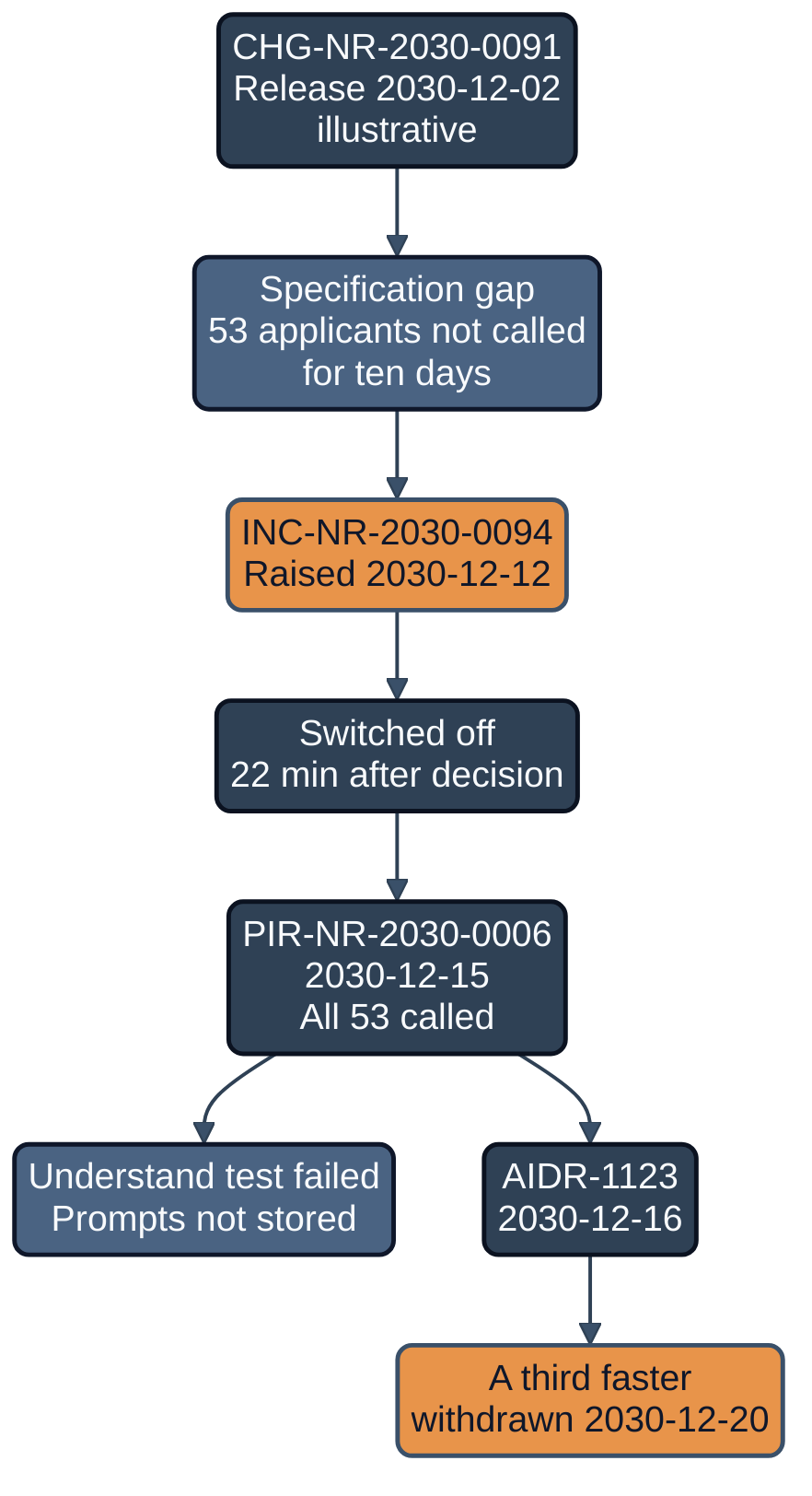
Figure 18.1: The release incident at Nordvik Region. All events are illustrative.
Claims and their evidence
The pilot's claims have an age. The usage claims expired in July 2030 and the value claim in October 2030. AVR-NR-2030-01 revision 3 of 2031-08-12 reports lead time, change failure and rework within the previous year's variation and states that it "does not exclude a small effect". The executive committee left consultant volume unchanged for 2031 in April 2031 and will decide for 2032 on four quarters of data, with no conclusion about headcount. The use claim expires on 2031-11-10 (12, Nordqvist, 2026).
Other figures of the year: the FormFlow sweep found 60 apps, of which 31 tier A, 18 tier B and 11 tier C, and one tier C rule list that orders a verification queue was reclassified to tier D. Exit tests of the code model: RST-NR-2031-0001 on 2031-02-03 scored 0.86 against a gate of 0.90 on 120 tasks, and RST-NR-2031-0002 on 2031-03-12 scored 0.88 and failed again. The dark week, RST-NR-2031-0003 (2031-06-16 to 06-20), ran without the assistant; the revert outside the pipeline took 34 minutes against 30, and four changes merged during the week (illustrative). The measure K9 found 4 of 5 seeded defects, three with the assistant's comment visible, with a revert of 22 minutes against 30 and an expiry of 2031-04-14. The protected review time is four hours per developer per sprint (e-services agreement); Sjöberg's plan sets three hours a week without the assistant and two hours of code reading. The ledger at 2031-08-31 shows 4 open, 4 closed, 1 closed with condition and 1 in progress (12, Nordqvist, 2026).
Across the degrees of delegation
| Class of work | Position at the Region | Condition for more |
|---|---|---|
| Completion and suggestions in the editor | Level 1; ambient completion on by default until the IDE policy | Decision of record (AIDR-1102) |
| Generated code in production paths | Level 1; revert rehearsed within 90 days; second reviewer outside the team for citizen-facing changes | AIDR-1111 |
| Tests | Level 1 drafts; never the oracle for the same change | Oracle approved by the quality engineer |
| Platform infrastructure drafts | Level 2 Supervised from 2030-11-18, drafts only, never applied | Entry in MND-NR-DEV-01; DLG-NR-DEV-01 still says Level 1 |
| Documentation | Level 2 | |
| Inherited systems without a suite | Level 0 | Suite and oracle first |
| Deploy, operate, migrate, review | Level 0 | Filed result; no tool raised without one |
| Decisions about named people | Not delegated | Never; no telemetry to assessment or pay |
What the volume concludes for Nordvik Region
The ceilings are right for what has been shown; nothing is raised without a filed result. The public-law order is ownership, the archivist's decision and a union agreement before any widening. Capacity sets the pace, because the platform team is seven people. The consultants are the least examined risk. Chapter 32 of the volume sets a decision table of eight decisions across the CIO, the HR director with the union, the archivist and the lawyer, the executive committee and the regional director, where the people class is never delegated. The plan from 2031-09-01 to 2032-08-31 runs in four quarters: close (to November), open (December to February), decide (March to May) and read (June to August). Later dates in the plan are the use claim on 2031-11-10, the end of MBA-NR-2030-03 or its extension on 2031-11-30, the protocol on 2031-12-31, the review of the delegation profile on 2032-03-23, the budget and modernisation decision on 2032-04-30, the reading of the measures on 2032-08-31, and the end of vendor support for the case system in 2033 (12, Nordqvist, 2026).
The lessons stated in Chapter 31 are that the first honest figures were lower than the first dashboards, that evidence expired faster than it was recalculated, that the quiet failures mattered most (an ignored flag, a gap without an owner, an ownerless build), and that the journals turned disagreement into text: Sjöberg's dissent and Edvardsson's right to hold a release. No Level 4 was used, and no telemetry goes to assessment or pay. In March 2031 an advisory on json-schema-check 5.1.6 showed that ownership is not yet complete: three repositories pulled the version, and one of them had no owner (12, Nordqvist, 2026).
Open threads
These are collected in Chapter 27.
- Level of platform drafting. Agentic drafting by the platform team is Level 2 from
AIDR-1116(2030-11-18), while the generate ceiling inDLG-NR-DEV-01is Level 1; Chapter 32 makes registration in the mandate a first-quarter step. - Missing outcomes. The tender
NR-2030-041; the lawyer's position on steward status (due 2031-03-31); the register reread of 2031-07-21; the archivist's position on prompts; the deputy for the register adapter (to be named by 2030-12-15);MBA-NR-2030-03is open (prompt retention, consultants); break-glass accounts to be tested by 2031-09-30. - Possible breach. Whether extending the pilot without negotiation breaches
MBL-NR-IT-2027-01is discussed in Chapter 22 and not decided. - Understand. The Understand test failed live in
PIR-NR-2030-0006; no other live test is recorded. - Pilot figures. 31 %, 9 of 12 and "a third faster" lack a measured delivery time; the usage claims expired in July 2030 and the value claim in October 2030.
AIDR-1102is a decision in two parts (retrospective ambient completion and pilot continuation) and is cited differently in Chapters 1, 3, 4, 7, 16 and 20. The reference to a rehearsal "of 8 January" in Chapter 31 is not an AIDR. The review date 2031-03-23 is a Sunday; the review was held on Friday 2031-03-21.- Link to Book 13. Vibe to Dev gives builders at the Region a Mode 2 and Mode 3 assistant with a ceiling of Level 3 Bounded from autumn 2031, while this volume keeps Mode 3 to the platform team and requires a separate decision for any agentic mode. Vibe to Dev also reuses
RST-NR-2031-0001for the build's restore test of 2031-12-05, while this volume uses it for the exit test of 2031-02-03 (Chapter 19 of this book). - Hanna Wikström is in the profile a product owner who builds prototypes; Vibe to Dev makes her the builder of
service-point-check.
Summary
AI Developer shows Nordvik Region as a cautious public builder with about 25 developers and 22 consultants, an inherited estate with a vendor product whose support ends in 2033, and ownership that lapsed in 31 % of its repositories. The established facts are the teams, the estate, the modes of AI use before the year and the legal frame. The illustrative year adds a delegation profile that caps every class at Level 2 or below, a hard gate-and-revert rule, named owners and deputies, a union protocol, a release incident whose review could not say whether AI had taken part, and the withdrawal of "a third faster".
The chapter's conclusion is the volume's: the ceilings hold because nothing filed justifies more, and the claims that remain open are about ownership and consultants more than about tools. What the dossier cannot yet say is the tender's outcome, the archivist's position on prompts and the lawyer's on steward status, and whether the next year's evidence will show an effect that the year of the pilot could not exclude.
Sources
- Nordqvist, G. AI Developer: How the Developer Role Changes When AI Is Used Broadly in European Enterprises and Public Authorities. The Transformed Architecture, Book 12. (12, Nordqvist, 2026)