Book 13, Vibe to Dev: The Builder
This chapter gathers what Vibe to Dev (Book 13) establishes about Nordvik Region: the builder and her build, the twelve steps the build passed through, the records and identifiers it produced, the workspace the Region provided around it, the takeover test that failed once and the promotion that followed, and what the volume leaves open. It draws on the volume's builder profile and builds file and on its chapters on the method (Chapter 4), the steps (Chapters 5 to 16), the organisation around the builder (Chapters 17 to 21), the two builds step by step (Chapter 23) and the conclusions for the Region (Chapter 24) (13, Nordqvist, 2026).
All names, figures and identifiers of the volume are fictional and illustrative, and the volume's own period is September to December 2031, after the year of AI Developer; the book is written in November 2026. The build's outcome is measured by a before-and-after count with no control group, which the volume itself points out, and the chapter keeps that limitation with the figures.
The volume in brief
Vibe to Dev is a step-by-step guide for the person who is not a developer and builds software with an AI assistant: how to work as a professional developer does, and how to end with a solution others can rely on. Its thesis has five parts. The gap between vibe coding and professional development is a set of habits, not a gift, and twelve steps cover it: Step 1 Intent, Step 2 Tier, Step 3 Workshop, Step 4 Specification, Step 5 Design, Step 6 Build, Step 7 Prove, Step 8 Secure, Step 9 Ship, Step 10 Run, Step 11 Own and Step 12 Hand over, each ending in a gate that is met by showing an artefact. Structure is proportionate: the four tiers of AI Developer, Chapter 19 (A personal, B team, C business, D project) set how much of each step applies, and Tier D is not a citizen build. A professional result passes the takeover test: a named colleague can, in a working day, run it, change it and ship the change, and switch it off and restore it. AI may draft, generate, explain and, within a mandate, execute, but may not own and may not be the only judge of its own work (the stewardship principle, Name, Understand, Revert, and the independent test oracle). Both sides close the gap: the builder by habits, the organisation by sandboxes, templates, golden paths, a register and receiving developers (13, Nordqvist, 2026).
The volume uses the five developer functions of AI Developer (D1 Frame to D5 Steward) behind the steps. Level 4 is never used for the builder's assistant for a change to production without a gate the change cannot alter, for code in a security-critical path without review by a named developer, for a change to the assistant's own mandate, permissions, credentials, test oracles or pipeline gates, for an irreversible action on production data, or for a decision about a named person's employment, pay, performance rating or access to work. Mode 5 is not for builders (13, Nordqvist, 2026).
The role of Nordvik Region in the volume
Nordvik Region is the public-law, capacity-limited one of the two organisations that follow a build through the twelve steps. The builder is Hanna Wikström, product owner in the e-services team, who is not a developer. Her build service-point-check compares opening hours and notices for the Region's 24 service points across the three places where they are published (the citizen portal, the printed leaflet export and the phone-service script; the build reads them as the files portal.json, phone.csv and notices.csv) and writes a weekly report to the team's wiki. It never writes to any source (13, Nordqvist, 2026).
The Region illustrates the volume in four ways. First, "the tool that grew": a Tier B build (on request, one team, public and internal data) becomes Tier C once it runs on a schedule and is used by other units (AIDR-1203). Second, "the gate that fell": the Revert test of Steps 9 and 12 failed when Rasmus Holm followed the rollback note, which gave the tag v0.1.0 where the scheduled-job template requires the release name. Third, the capacity limit: a platform team of seven and one receiving developer, three named people as a single point of dependence. Fourth, the public context: archive law, the public-access principle, accessibility and negotiation with the unions (13, Nordqvist, 2026).
What the volume establishes
The builder and the problem
Hanna Wikström has built prototypes with a Mode 1 assistant since 2030, as AI Developer records. Her manager is Gunilla Roos and her deputy is Elin Berg, a business analyst in e-services. The Region publishes its 24 service points (SP-01 to SP-24) in three places (the citizen portal, the printed leaflet export and the phone-service script) that differ after every change. The telephone service receives calls from residents who travelled to a closed service point. The report language is Swedish (13, Nordqvist, 2026).
In July 2031 Wikström wrote hours_compare.py with the Mode 1 assistant. The first run gave 61 discrepancies, many of them format differences such as 9-16 against 09:00-16:00. The first version of about 120 lines was ready on 2031-09-05, with variants hours_compare_v3.py and hours_compare_v2_final.py and a wiki token pasted into the file. On 2031-09-08 it was scored against the twelve steps: no discipline present, three partly present, nine absent, and BLD-NR-2031-0001 was opened the same day (13, Nordqvist, 2026).
The build
| Property | Value |
|---|---|
| Language and libraries | Python 3.12, standard library, pytest, PyYAML |
| Repository | service-point-check, in the Region's Git service |
| Size | About 600 lines including tests at v0.1.0; Hanna Wikström could read about half the code with confidence |
| Modules | sources, compare, report, cli |
| Inputs | portal.json, phone.csv, notices.csv; synthetic copies in data/synthetic/ |
| Rules | R1 opening hours are equal; R2 a notice that covers today exists in both sources; R3 every SP-01 to SP-24 exists in all three |
| Never do | Write to the portal, the telephone scripts or the notice spreadsheet |
| Personal data | None about residents; no model is called at run time |
| Tests | 14 at v0.1.0, 21 at v0.2.0 |
| Oracle cases | 12, written by Saga Edvardsson from real notices without personal data; 20 at v0.2.0, with eight added by 2031-12-01 (Tier C requires 20 independent cases) |
At v0.1.0 the build runs on request by Wikström (Tier B). From v0.2.0 it runs on a schedule on Mondays at 06:00 through the platform's scheduled-job template, which injects PORTAL_EXPORT, PHONE_EXPORT and NOTICES_EXPORT as readable paths and WIKI_TOKEN from the secret store, runs python -m spcheck.cli --week auto, writes the report to the wiki page "Service point check" and sends failure alerts to the e-services channel. Releases are named service-point-check-0.1.0-b2 and service-point-check-0.2.0-b3 (pattern {job}-{version}-b{build}). The tool jobctl handles releases, rollback with --release, suspend, resume and run. The files are pipeline.yml (schema region-scheduled-job/v1, policy region-policy/builder-scheduled-job@3), docs/design.yaml, docs/rollback.md, docs/manual-check.md, docs/mandate.yaml, docs/platform-supported.md and promotion_criteria.yaml@1.0 (13, Nordqvist, 2026).
The organisation around the builder
The platform team (Maja Lindqvist and Joakim Wester) opened the builder workspace on 2031-10-06 (AIDR-1200). It provides an approved assistant in Mode 2 in the editor and Mode 3 for delegated tasks in a sandbox, synthetic data, a secret store, the Region's Git service and the scheduled-job template. The lane manifest is LANE-NR-2031-01 (template version 0.3.0, with the rules secrets_scan, ownership_file, oracle_cases_present and synthetic_data_only). There is no production access, no Mode 5, and the stop path is held by the platform team. The effort is illustrative: about half an engineer in the first 90 days, then about a fifth (13, Nordqvist, 2026).
The receiving developer is Rasmus Holm of the integration and data team (head Anders Falk). He gives half a day a fortnight per build in the first quarter, holds office hours on Tuesdays 14:00 to 15:00, responds in two working days and fixes template faults within ten. The lane was rehearsed on 2031-10-27 with a volunteer builder (13, Nordqvist, 2026).
People
| Person | Role in the volume |
|---|---|
| Hanna Wikström | Builder; owner OWN-NR-2031-0001; learning plan BLP-NR-2031-01 (opened 2031-11-03; Rung 2, Rung 4 for her own tools); CMP-NR-2031-01 (2031-12-19) |
| Elin Berg | Deputy; ran the explain-it-back drill 2031-12-02; ran the restore test 2031-12-05; read the free-text column for personal names (none found); read back the intent; ran the Monday report after the handover |
| Gunilla Roos | Manager; accountable; approves tier decisions, specification, build record and promotion (AIDR-1203) |
| Saga Edvardsson | Wrote the oracle cases; second assessor in the learning plan |
| Anders Falk | Reviewed the design (2031-10-20) and the code (2031-11-05, RVW-NR-2031-0001) |
| Rasmus Holm | Receiving developer; ran the takeover test on 2031-12-11; coach under BLP-NR-2031-01 |
| Maja Lindqvist, Joakim Wester | Owner of the lane; issued the replacement token and checked dependencies |
| Henrik Dahl, Tomas Ekblad | CIO; the union's IT representative, who is shown the register fields under MBA-NR-2030-03 |
Decisions and records
The identifiers of the build
| Identifier | What it is |
|---|---|
BLD-NR-2031-0001 |
Build record, opened 2031-09-08 |
SPC-NR-2031-0001 |
Specification, approved 2031-10-15 |
DSG-NR-2031-0001 |
Design, docs/design.yaml |
MND-NR-BLD-2031-01 |
Builder mandate (AIDR-1201) |
OWN-NR-2031-0001 |
Ownership: owner Hanna, deputy Elin, sunset 2033-08-31 |
HND-NR-2031-0001 |
Handover pack |
TKT-NR-2031-0001 |
Takeover test |
LANE-NR-2031-01 |
The workspace lane |
BREG-NR |
The register of builds |
ALR-NR-001 to -003 |
Alerts: did it run (a run between 06:00 and 07:00 on Monday), did it fail, is it slow (over 5 minutes); job timeout ten minutes |
RUN-NR-2031-0004 |
Slice 1, 2031-10-22 |
RUN-NR-2031-0014 |
Release 0.2.0 |
RVW-NR-2031-0001, -0003 |
Review of the code (Falk, 2031-11-05) and of 0.2.0 |
CHG-NR-2031-0001, -0002 |
Changes for 0.1.0 and 0.2.0 |
VER-NR-2031-0001 |
Verification plan |
PRV-NR-2031-0001 |
Provenance record, 2031-11-06 |
RBK-NR-2031-0001 |
Runbook |
RST-NR-2031-0001 |
Restore test, 2031-12-05, Elin Berg, 11 minutes against 30, expires 2032-03-04 |
RST-NR-2032-0001 |
Planned restore test |
PLN-NR-2032-01 |
90-day plan |
BLP-NR-2031-01, CMP-NR-2031-01 |
Learning plan, competence record |
The AI Decision Records are AIDR-1200 (2031-10-06, workspace), AIDR-1201 (2031-10-13, mandate) and AIDR-1203 (2031-12-15, promotion to Tier C). AIDR-1202 is unused. Three architecture decision records record what the build left out: ADR-0001 chose the scheduled-job template (the assistant proposed a small web service and a cloud function; Wikström declined because nobody in the Region maintains them), ADR-0002 limits the tool to three sources, and ADR-0003 chose a plain Markdown report on an existing wiki page (13, Nordqvist, 2026).
The mandate MND-NR-BLD-2031-01 lets the assistant read the repository and synthetic data, edit on a branch, and run tests and linters. It may not read secrets or production data, push to main, trigger the pipeline, change AGENTS.md, pipeline.yml, tests/oracle/ or the mandate itself. Every session becomes a RUN-* record. The takeover test has ten items, T1 find to T10 secrets. The policy file permit-by-tier.yaml (version 1, adopted 2031-12-17) sets the assistant ceiling at Level 3 Bounded and never Level 4, review every 180 days, and evidence validity of 365 days for Tier A, 180 for B and 90 for C. Tier D is not a citizen build and requires a development project with a mandate and an impact assessment (13, Nordqvist, 2026).
Events and figures
The twelve steps at the Region (illustrative)
| Step | Dated event |
|---|---|
| 1 Intent | Gate on 2031-09-10 |
| 2 Tier | Tier B decided on 2031-09-11 by Hanna Wikström and approved by Gunilla Roos; two signals that would raise it: scheduling and use in other units |
| 3 Workshop | Workspace 2031-10-06; mandate and gate on 2031-10-13 (a clone-and-restore by a colleague) |
| 4 Specification | Approved 2031-10-15 |
| 5 Design | Read by Falk on 2031-10-20 |
| 6 Build | Slice 1 on 2031-10-22; Steps 6 and 7 on 2031-11-05 |
| 7 Prove | The 12 oracle cases passed on the first run; Falk found a missing test for a missing service point, added the same day |
| 8 Secure | 2031-11-06: the secret scan stopped a commit in which the assistant had put WIKI_TOKEN as a default value; the token was treated as leaked, a new one issued and the old one revoked the same day |
| 9 Ship | v0.1.0 on 2031-11-12, Tier B, on request; gate met on 2031-12-12 |
| 10 Run | First runbook 2031-11-10; version 2 on 2031-12-01; Hanna runs the report manually every Monday from 2031-11-17; seeded faults on 2031-12-04; gate on 2031-12-05 |
| 11 Own | Ownership confirmed and explain-it-back on 2031-12-02: Elin Berg answered five of six questions at once, and could not say who gets the alert if the scheduled job fails; a line was added to the runbook |
| 12 Hand over | Pack written on 2031-12-05; takeover test on 2031-12-11; retest on 2031-12-12 |
Other dated events: Falk reviewed the code on 2031-11-05 (RVW-NR-2031-0001); on 2031-11-03 the learning plan was opened; on 2031-12-04 Hanna and Elin seeded two faults (a renamed export path and a broken notices.csv) and Elin received both alerts; Hanna rehearsed rollback in 6 minutes against a target of 15 on 2031-12-05; v0.2.0 was deployed on 2031-12-08 with the schedule held until a promotion record existed; AIDR-1203 and permit-by-tier.yaml followed on 2031-12-15 and 2031-12-17; CMP-NR-2031-01 was issued on 2031-12-19; the first scheduled run was Monday 2031-12-22 (13, Nordqvist, 2026).
The takeover test
The takeover test TKT-NR-2031-0001 was run by Rasmus Holm on 2031-12-11, from 08:30 to 16:30. The item time totalled 6 h 25 min.
| Item | Minutes |
|---|---|
| T1 | 15 |
| T2 | 25 |
| T3 | 30 |
| T4 | 95 |
| T5 | 40 |
| T6 (Revert) | 70, failed |
| T7 | 20 |
| T8 | 45 |
| T9 | 35 |
| T10 | 10 |
The volume names T1 as find, T4 as the change task and T10 as secrets; it names the failed item as Revert, T6. T4 was to report a notice whose end date is before its start date, and it included an oracle case written by Saga Edvardsson for the test branch. One call to Hanna was needed to close a gap. T6 failed because the rollback note gave v0.1.0 where the template requires the release name. The note was corrected on 2031-12-12 to rollback_to: service-point-check-0.1.0-b2, verified by Holm, and the retest passed. Wikström's own rollback had worked; the note for others had not. The assistant had also written a rollback paragraph that sounded right and was wrong by one word. The volume reads this as the gate that could be found only by someone who had not built the tool (13, Nordqvist, 2026).
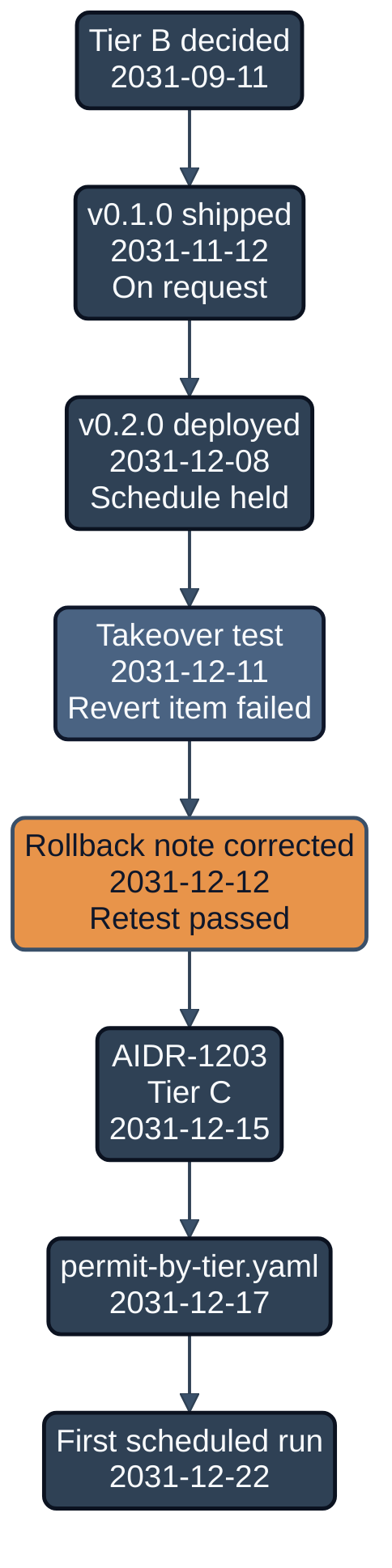
Figure 19.1: The build's path from Tier B to Tier C. The dates are illustrative.
The measure and the plan
The telephone service's category "wrong opening hours" had 41 calls in August 2031 and 17 in January 2032, the first full month on schedule (measured_on: 2032-01-31). It is the Region's own category count, over one month, with no control. At the end of December 2031 it was not yet measured. The volume says to cite 41 to 17 only with its limitations (13, Nordqvist, 2026).
Planned events are these: January 2032 report (17 calls); the 90-day plan PLN-NR-2032-01 from 2032-02-02; the next ownership review on 2032-03-01; the restore test and register entry expiring on 2032-03-04; G1 on 2032-03-05, when the deputy runs the report; G3 on 2032-04-16, the explain-it-back with Rasmus Holm; the day-89 review on 2032-04-30; the first Tier C register review on 2032-06-15 (half-yearly); the takeover test's validity ending on 2032-12-11; and the sunset on 2033-08-31. The ownership cycle is 90 days, and the Tier C review six months; takeover evidence is valid twelve months, and revert and restore evidence 90 days (13, Nordqvist, 2026).
Across the degrees of delegation
| Action class | Position at the Region |
|---|---|
| Read repository and synthetic data, edit on a branch, run tests | Allowed under MND-NR-BLD-2031-01 |
| Tests and formatting at Tier B | Level 3 Bounded in the lane manifest |
| Listed classes at Tier C | Level 3 Bounded in the lane manifest and permit-by-tier.yaml |
Secrets, production data, push to main, pipeline, mandate, oracle, pipeline.yml |
Not permitted for the assistant |
| Any class | Never Level 4; Mode 5 not provided; the assistant cannot read production configuration |
The legal frame is light: the Cybersecurity Act and Article 4 of the AI Act on AI literacy (BLP-NR-2031-01). The build is not high-risk and benefits data is kept out of the lane, although the Region is deployer of the benefits-triage system under Annex III point 5(a) and provider and deployer of the benefits-explanations service. Source code and release notes can be official documents and archive rules apply; whether the changelog and run logs are documents is a question for the archivist and the lawyer. The archivist's answer on prompts is that prompts in the assistant's log are kept for 30 days and then deleted, recorded as an ADR in the platform team's repository (13, Nordqvist, 2026).
The 2030 FormFlow sweep (60 apps: 31 tier A, 18 B, 11 C) is the background: one tier C app, a rule list that orders a verification queue, was reclassified as tier D. The same reasoning bars Tier D from the lane, because a rule list that orders a benefits verification queue ranks applicants (13, Nordqvist, 2026).
What the volume concludes for Nordvik Region
Chapter 24 of the volume draws three conclusions. A sanctioned route now exists for one build, and the next 90 days decide whether it becomes a route for many or an exception that hangs on three named people. The build is a good Tier C because it only reads and reports, and a wish to write back requires Step 2 to be redone in writing. The measure 41 to 17 should be cited with its limitations, because the Region answers to elected representatives. Four leadership decisions follow (Roos and Dahl; no AIDR numbers assigned): name at least two receiving developers as a role that counts as work; fund the workspace as a service with a named owner and time allocation; set a rule for other builders as a role, not a person; and say in writing to the union representatives (Ekblad, MBA-NR-2030-03) that the register is for support and review dates, not ranking, before the register grows (13, Nordqvist, 2026).
What the Region should stop doing: citing 41 to 17 as a tool effect without limits, reviewing the builder's work in conversation without an RVW-* record, and treating the 2030 FormFlow sweep of 60 apps as complete. The volume's risks are one builder owning everything, one receiving developer, scope creep, stale evidence, insecure generated applications (it cites a study finding vulnerabilities in 91.0 % of 200 generated apps), faults shared between the assistant's code and its tests, Article 4 literacy, gatekeeping or bypass, and over-use of before-and-after figures. The lesson of Chapter 23 is that deciding what the tool must never do was most of the work, and the code was the fast part (13, Nordqvist, 2026).
Open threads
These are collected in Chapter 27.
- Restore-test date. Chapters 14 and 23, the builds file and the profile give
RST-NR-2031-0001on 2031-12-05 (11 minutes; expires 2032-03-04); Chapter 16 gives the restore test on 2031-12-04 with expiry 2032-03-03. - Gate order. The Step 10 gate and the rollback rehearsal of 2031-12-05 precede v0.2.0 (2031-12-08) and the schedule. Chapter 13 says the rehearsal was on 12-05 but the Step 9 gate was met only on 12-12 after the takeover test failed; the profile gives Step 9 on both 2031-11-12 and 2031-12-12.
- January measure. The January count (17 calls) lies after the volume's four months; Chapter 23 says "not yet measured" at the end of December, Chapter 24 gives 17 with
measured_on: 2032-01-31, and Chapter 25 describes the status as if done. - Levels. A Mode 2 and Mode 3 assistant with a Level 3 Bounded ceiling for builders (
permit-by-tier.yaml, lane manifest) is in tension with AI Developer, whereDLG-NR-DEV-01holds generate, refactor and test at Level 1, Mode 3 is for the platform team only, and the tender's agentic module needs a separate decision and mandate (Chapter 18 of this book). The volume names no product and no link to the tender. - Identifier collision.
RST-NR-2031-0001is used in AI Developer for the code-model exit test of 2031-02-03 and here for the build's restore test of 2031-12-05. - Who adopted the file. The profile says
permit-by-tier.yamlwas adopted by the digital steering group; the file givesowner_role: Head of IT and Digitalisationand a 180-day review. - No AIDR numbers for the four leadership decisions;
AIDR-1202is unused. - Capacity. How many builds the platform team and one receiving developer can support is open (Chapter 25), and no organisation has measured coaching hours per builder (question Q29 in the volume's foundations).
- Takeover items. Chapter 16 says nine items passed and the Revert item failed; Chapter 23 says the first five passed, the sixth failed and the other four passed. These agree. Hanna Wikström is a product owner who builds prototypes in the profile and the builder here; the volume treats her in three separate roles.
- Reuse in AI Environment. That volume attaches
FPR-NR-0006andBEN-NR-0006to the builder workspace assistant (AIDR-1200, about 40 builders and 9,000 sessions a month, September 2032), against the 140 FormFlow builders and 60 apps of Book 13's profile; the 41 calls in August 2031 against 17 in January 2032 are Book 13's measure for one build,service-point-check, which Book 14 calls a one-month, uncontrolled comparison and the only measured effect in the estate. The sunset of the Book 13 builds on 2033-08-31 is retired as a row of the register (14, Nordqvist, 2026). Chapter 19A.
Summary
Vibe to Dev shows Nordvik Region as an organisation that gave a non-developer a sanctioned way to build, and then tested whether anyone else could take the result over. The established facts of the profile are the builder, her manager, her deputy, the problem of 24 service points in three sources, and the earlier FormFlow sweep. The illustrative events are one build, twelve gates, a workspace opened on 2031-10-06, a takeover test that failed once on a rollback note and passed on 2031-12-12, a promotion to Tier C on 2031-12-15, and a measure of 41 calls falling to 17.
The chapter's conclusion is the volume's: the build is proportionate because it reads and reports, and its safety rests on three named people. What the dossier cannot yet say is whether the route will serve a second builder, whether the January measure will hold with its limitations, and how two identifiers and two ceilings are reconciled across AI Developer and this volume.
Sources
- Nordqvist, G. Vibe to Dev: From Vibe Coding to Professional Software, Step by Step, for Builders Who Are Not Developers, in European Enterprises and Public Authorities. The Transformed Architecture, Book 13. (13, Nordqvist, 2026)
- Nordqvist, G. AI Environment: Designing AI for the Greatest Benefit and the Least Environmental Harm in European Enterprises and Public Authorities. (14, Nordqvist, 2026)