Book 11, AI Leader: Answering for Decisions
This chapter gathers what AI Leader (Book 11) establishes about Nordvik Region: how the Region is led, which leaders use AI and how, the delegation ceiling the Region set after its briefing incident, the decisions and records of the volume's year, and the claims that had expired or were still open when the year ended. It draws on the volume's leadership profile and on its chapters on the leadership loop (Chapter 4), the briefing incident (Chapter 6), the delegation profile (Chapter 8), span and layers (Chapter 9), the mid-level manager (Chapters 16 and 17), the duty to give reasons (Chapter 18), adoption evidence (Chapter 20), the union agreement (Chapter 22), the crisis exercise (Chapter 23), the legal frame (Chapter 24), dependency (Chapter 26), a year in leadership (Chapter 31) and the plan (Chapter 32) (11, Nordqvist, 2026).
The facts have two statuses. The leadership profile of the volume (structure, named leaders, spans, the delegation order, existing AI use, the history from 2024) is established. The volume's year, September 2029 to August 2030, and the plan after it are illustrative, and the book is written in November 2026. Results that the volume labels "in this illustration" were not measured, and the chapter says so where it uses them.
The volume in brief
AI Leader asks what happens to leadership, in the board, the executive team, the middle layer, the first line and the public authority, when AI is used broadly across the organisation, not in one system or one function. Its thesis has five parts. Leadership is transformed, not abolished: from information intermediary to sense-maker, designer of decision rights and accountable answerer. Delegation of leadership decisions is graded and has a ceiling: Level 4 is never used for a decision about a named person's employment, pay, discipline or access to work, for a decision that law assigns to the management body, a named office or an accountable official, for a decision that sets an AI system's own mandate, budget, oversight or stop path, or for an irreversible decision beyond the system's mandate. The span grows and the middle layer is redesigned, not deleted. AI may inform, draft, prepare and, within a mandate, execute, but may not answer: the answerability principle says a named leader passes three tests, Name, Explain and Reach. Adoption, productivity and leadership capability are claims that need evidence (11, Nordqvist, 2026).
The work divides into five leadership functions, L1 Orient, L2 Decide, L3 Organise, L4 Enable and L5 Answer, and seven decision classes: strategic, resource, structural, people, risk, external and crisis. They are not the management functions M1 to M5 of AI Boss (11, Nordqvist, 2026).
The role of Nordvik Region in the volume
Nordvik Region is the volume's public-law case: an elected regional council and executive committee, a regional director who leads the professional administration, a delegation order that does not mention AI, and a clear duty to give reasons for decisions. The volume uses the Region to show leadership changing in an organisation without a Mode 5 agent, where the leaders' own use of AI sits at Level 0 to Level 1 (11, Nordqvist, 2026).
The starting point is AIDR-1000 (2029-09-10, illustrative). The regional director, Elisabet Holmgren, instructs the HR director, Ingrid Halvorsen, and the Head of IT and Digitalisation, Henrik Dahl, to describe the leadership roles of an organisation that uses AI broadly, with a report to the executive committee by 2030-06-30 and the executive committee and the chair of the central work environment committee as reviewers. What drives the case is the briefing incident of April 2029 (LDR-NR-2029-0003, AIDR-1001): a wrong waiting-time figure in a summarised paper reached the executive committee's bundle, and nobody could say whether the figure came from the assistant or from the source. The Region chooses the lowest ceiling, Level 1, after an incident whose record could not name the cause. The year goes to provenance, to span and layers, to the duty to give reasons, to informing the unions, and to a dependency and exit question about TriageSoft. The volume's conclusion in Chapter 32 is to close what has lapsed before anything new is opened (11, Nordqvist, 2026).
What the volume establishes
Political and administrative structure
The regional council has 61 members and decides questions of principle, the budget, the tax rate and the delegation order. The executive committee, chaired by Lars-Erik Nyström in his second term, is the political executive. An audit committee and elected auditors scrutinise. The regional director reports on AI to the executive committee and on risk to the audit committee (11, Nordqvist, 2026).
The regional management team has ten members.
| Role | Holder |
|---|---|
| Regional director (since 2024; previously administrative director at a university hospital) | Elisabet Holmgren |
| Sector directors (six): health and care; primary care and home care; regional development; public transport; social services and benefits; central administration | Not named, except that the sector director for social services and benefits signed and rejected drafts on 2029-11-20 |
| Finance director | Pär Lindgren |
| HR director (since 2023) | Ingrid Halvorsen |
| Head of IT and Digitalisation | Henrik Dahl (nine years in the Region) |
The chief information security officer, the AI governance lead, the data protection officer and the regional lawyer, Maria Åkesson, attend when needed. There is no chief AI officer, and the AI governance lead sits in the digitalisation unit under the Head of IT and Digitalisation (11, Nordqvist, 2026).
Layers and spans
The organisation has six levels from the council to the front line. The regional director has nine direct reports, sector directors six to eight, and the department and division heads (about 45) eight to ten. There are about 310 unit managers, with a median of 28 employees: 12 in specialist clinics, about 35 in home care, up to 60 on some wards. About 355 of 6,000 employees hold a management post, one in 17. The "One Region" reorganisation of 2024 reduced nine departments to six sectors, removed the heads of section and saved 31 posts. Two years later 41 % of unit managers had spans above 35, sick leave had risen, coaching of new unit managers had ended, and the saving had not been evaluated. Unit-manager posts take on average seven months to fill (11, Nordqvist, 2026).
AI use among leaders
| System | Mode | Use by leaders |
|---|---|---|
| Staff assistant (AIDR-0211) | Mode 4 | Directors and managers use it for memoranda and summaries; 3,200 licences |
| Embedded work assistant (pilot) | Mode 2 | Extended in 2029 to "the 18 members" of the management group and their assistants (the volume's profile gives the group as ten members; see Chapter 27) |
Council-paper summariser (MND-NR-LDR-01) |
Mode 4, Level 1 Assisted | In the council secretariat; the secretary checks every summary against the source; the only Mode 4 system built for leaders |
| Ambient AI in the office suite | Mode 0 | General |
There is no Mode 5 agent and no agent that decides for a leader (11, Nordqvist, 2026).
The Region's current degree of delegation per decision class, as the profile gives it before the volume's year, is in the table. The volume's new profile DLG-NR-EXE-01 then sets a ceiling of Level 1 Assisted in every class, with the people class not delegated.
| Class | Profile before the year | DLG-NR-EXE-01 ceiling |
|---|---|---|
| Strategic | Level 0 | Level 1 |
| Resource | Level 0 | Level 1 |
| Structural | Level 0 | Level 1 |
| People | Not delegated (recruitment screening paused, AIDR-0601) |
Not delegated |
| Risk | Level 0 | Level 1 |
| External | Level 1 | Level 1 |
| Crisis | Level 0 | Level 1 |
The delegation order of the regional council has 38 pages, was adopted in 2019 and amended in 2023, and does not mention AI. Case decisions on needs-based financial assistance are taken by a named caseworker, and benefits triage is advisory. Procurements above EUR 2 million need a decision by the executive committee (11, Nordqvist, 2026).
Representation, supply and law
Co-determination follows the Swedish model. The chair of the employee side of the central work environment committee is Birgitta Almqvist; the employer side is the HR director. Since 2028 the unions have asked to be informed before any AI system is used to prepare personnel decisions. The legal frame is the Local Government Act, chapter 6 section 37 (automated decision-making) and chapter 12 section 1 (auditors), section 11 of MBL, and the public-access rules. The Region is deployer of the benefits-triage system under Annex III point 5(a) of the AI Act, with obligations under Articles 26 and 27 from 2027-12-02 and, under Article 111(2) as replaced by Regulation (EU) 2026/1744, it must have taken the necessary measures by 2030-08-02 for systems already in use. The Cybersecurity Act applies to it as an essential operator (11, Nordqvist, 2026).
Three suppliers matter to leadership. A European cloud provider supplies the accelerators under the staff assistant (contract NR-2026-031). SamDrift supplies identity federation, name service and the recovery site, and four functions share a fault domain. TriageSoft supplies benefits triage. Procurement lead times are 9 to 14 months (11, Nordqvist, 2026).
People
| Person | Role in the volume |
|---|---|
| Elisabet Holmgren | Regional director; owner of the AIDR-1000 commission; led the crisis staff on 2029-11-20; kept a diary 17 to 21 September 2029; practice plan CMP-NR-2029-21; declared the TriageSoft extension without the assistant in August 2030 |
| Henrik Dahl | Head of IT and Digitalisation; owner of the staff assistant and the council-paper summariser; co-owner of AIDR-1000 |
| Ingrid Halvorsen | HR director; owner of the personnel side and the leadership development plan; employer chair in the central committee; reads three first views a quarter, does not read assistant logs |
| Mikael Strand | Unit manager, Strandvik home care, about 35 employees; the mid-level manager whose span and coaching time the volume measures; CMP-NR-LDR-031 |
| Lars-Erik Nyström | Chair of the executive committee; political voice in the crisis staff |
| Pär Lindgren | Finance director; owns the exit-test and second-path budget in LDR-NR-2030-0026 |
| Maria Åkesson | Regional lawyer; consulted on serious incidents; owns the reread of the duty register |
| Birgitta Almqvist | Chair of the employee side; co-owner of the limits in TSP-NR-2030-01; signed MBA-NR-2029-02 |
| Dr Sofia Berglund | Head of the gastroenterology department; author of LDR-NR-2029-0019 |
Sigrid Berglund, chair of the elected auditors (Chapter 13 of the volume), is a different person from Dr Sofia Berglund. Unnamed roles also appear: the secretary of the council and committee, a controller who owns the evidence for the 61 % recalculation, the sector director for social services and benefits, the data protection officer and the AI governance lead (11, Nordqvist, 2026).
Decisions and records
The volume's AIDR-1000 to AIDR-1049 are the leadership series. The table lists the ones the volume files.
| Record | Date | Decision |
|---|---|---|
| AIDR-1000 | 2029-09-10 | The commission to describe leadership roles |
| AIDR-1001 | filed 2029 | The briefing incident (event of April 2029) |
| AIDR-1002 | 2029-10-01 | DLG-NR-EXE-01: Level 1 Assisted ceiling in all classes, people not delegated; owner Henrik Dahl, "answerer for papers" Elisabet Holmgren; review 2030-04-01 |
| AIDR-1009 | 2029-11-05 | SPN-NR-2029-01, span and coaching |
| AIDR-1010 | 2029-11-12 | A plain-language template for case text, in place of a ban on consumer chatbots |
| AIDR-1011 | 2029-10-08 | Coaching of all new unit managers for twelve months; owner Halvorsen |
| AIDR-1012 | 2030-02-12 | ACC-NR-2030-01, the accountability map |
| AIDR-1013 | 2029-11-19 | The provenance rule |
| AIDR-1016 | in force 2030-02-01 | ROLE-NR-MGR-01 and TRN-NR-2030-01 |
| AIDR-1017 | 2029-10-19 | LDR-NR-2029-0011, the ShiftWise rota rotation |
| AIDR-1018 | 2030-02 | The triage rank is not a ground for a decision |
| AIDR-1019 | 2029-11-12 | ROLE-NR-CLN-01 |
| AIDR-1020 | 2029-10-01 | Remeasure the 61 % claim |
| AIDR-1021 | 2030-01-14 | TSP-NR-2030-01, the trust-and-safety pulse |
| AIDR-1023 | 2030 | A crisis class in the delegation order |
| AIDR-1024 | 2029-12-10 | DRR-NR-001-LEG, the duty register |
| AIDR-1025 | 2029-11-05 | DLG-NR-VAL-01 |
| AIDR-1026 | 2030-03-12 | The TriageSoft extension, LDR-NR-2030-0026 |
| AIDR-1027 | 2029-11-28 | Purposes and readers of competence records |
| AIDR-1028 | 2029-12-04 | MBA-NR-2029-02 |
| AIDR-1038 | 2030-01-21 | The anti-pattern catalogue applied to MND-NR-LDR-01 and SPN-NR-2029-01 |
| AIDR-1046 | 2029-11-12 | CMP-NR-2029-21 |
| AIDR-1047 | 2030-09-02 | The twelve-month plan |
| AIDR-1049 | June 2030 | The horizon register (revisit 2031 and 2034) |
AIDR-0007, -0011 and -0018 (benefits triage), AIDR-0188 (register entry NR-ALG-2026-003, living support), AIDR-0211 (staff assistant), AIDR-0601 (screening pause) and FRIA-2026-002 are reused from earlier volumes (11, Nordqvist, 2026).
Other artefacts: the director's decision profile DLG-NR-DIR-01 (reviewed 2029-10-01, next review 2030-04-01; strategic, people, external and crisis); the load map LOAD-NR-DIR-01-2029-09; the directive on AI use LDR-NR-2029-0004 (no AIDR; Chapter 5); the briefing specification BRD-NR-2029-01 (adopted 2029-10-02); the role charters ROLE-NR-DIR-01, ROLE-NR-MGR-01 and ROLE-NR-CLN-01; the accountability maps ACC-NR-2029-05 and ACC-NR-2030-01; the decision-rights register DRR-NR-001, with "decided elsewhere" entries and a right to stop held by a set that includes the CISO and the system owner; the head-of-department profile DLG-NR-HCD-01; the decision LDR-NR-2030-0014 on living support; the audit LDR-NR-2029-0019; the adoption record ADP-NR-2029-01; the decisions LDR-NR-2030-0023, -0031 and -0032; and RST-NR-2029-001 and RST-NR-2030-003, imported from AI Operations (11, Nordqvist, 2026).
Events and figures
The week of the diary (illustrative)
Holmgren's diary for 17 to 21 September 2029 is the volume's measurement of the director's load (LOAD-NR-DIR-01-2029-09). The unions were informed of the diary on 2029-09-12.
| Measure | Value |
|---|---|
| Papers | 9, 412 pages, of which 6 papers read as machine summary |
| 380 | |
| Meetings | 27, 31.5 hours |
| Decisions logged | 20: strategic 1, resource 4, structural 1, people 3, risk 3, external 8, crisis 0 |
| AI-prepared decisions | 7, of which 4 had the figure checked and 3 did not |
| Name | 20 of 20 |
| Explain | 17 of 20 |
| Reach | 20 of 20 |
The year in order (illustrative)
The volume's events and the Region's records run in this order. In February 2029 the 61 % figure for weekly active users of the staff assistant was checked, and ADP-NR-2029-01 records it: 3,200 licences, 61 % weekly active users counting every session over a minute, last checked against logs in February 2029, seven months old at the start. In April 2029 the briefing incident occurred, with a correction from a unit manager two days before the vote. On 2029-10-01 AIDR-1002 and AIDR-1020 were filed; on 2029-10-02 BRD-NR-2029-01 was adopted, with a link to the source, a dissent field that is never empty, the secretary checking every figure, and the unsummarised paper as the stop path. On 2029-10-19 Mikael Strand submitted his count of carers per client (four rising to seven different carers per client, nine clients with dementia, eight weeks before and after the rota tool). In October the gastroenterology sample of about 300 unassisted procedures was drawn, the mapping workshop found that 4 of 11 caseworkers used a consumer chatbot, and a diary by 12 unit managers ran from 2029-10-01 to 10-26 (11, Nordqvist, 2026).
On 2029-11-20 a crisis-staff exercise ran: benefits triage ranked urgent applications wrongly for six days after a change in an upstream data flow. The exercise is illustrative and is not an incident. On 2029-11-30 the deadline for recalculating the 61 % passed with no result registered. On 2029-12-04 MBA-NR-2029-02 was signed, and on 2029-12-12 Strand's competence assessment found 3 of 6 seeded rota errors on 5 December. In 2030, interim coaching of 3 hours a week began on 2030-01-08; the pulse specification followed on 2030-01-14; the carer-count claim expired on 2030-01-31 with no recount registered; the charters and TRN-NR-2030-01 came into force on 2030-02-01; ACC-NR-2030-01 was tested on 2030-02-05 and adopted on 2030-02-12. The TriageSoft decision LDR-NR-2030-0026 was taken on 2030-03-12. In May 2030 the charter was applied at Strandvik and two other units. The AIDR-1000 report was due 2030-06-30, the horizon register was filed in June, the Article 111(2) date was 2030-08-02, and at the end of August Holmgren declared the TriageSoft extension without the assistant. The plan LDR-NR-2030-0032 was set on 2030-09-02 (11, Nordqvist, 2026).
Span and coaching figures
The diary of 12 unit managers showed 11.5 of 40 weekly hours on reporting, scheduling and routine questions and 3.5 hours of coaching. SPN-NR-2029-01 proposed a span of 30 and a coaching floor of 5 hours. Chapter 16 of the volume revised this to a target of 28, a ceiling of 35 and a floor of 4 hours a week, and Chapter 17 gives 8.75 hours a week for fortnightly one-to-ones at a span of 35. The stop criteria are coaching under 75 % of the floor for two consecutive quarters or sick leave above the regional average (11, Nordqvist, 2026).
The living-support decision
LDR-NR-2030-0014 is the volume's worked case for the duty to give reasons. An application for living support was received on 2030-01-22; benefits triage proposed rank 14 of 212 open applications on 2030-01-23; the named caseworker decided on 2030-02-12 and granted two of the four months applied for. On 2030-02-14 other caseworkers wrote the reasons without the rank, and the Explain test passed. The tests of ACC-NR-2030-01 on 2030-02-05 gave Name approved on ten letters, Explain approved with a condition (8 of 10 letters could be recreated without the ranking), and Reach approved with a condition (the minutes-per-case measure is to be removed). AIDR-1018 says that the rank is not a ground for a decision or a reason, and the volume proposes a change to the delegation order stating that no automated decision function exists under the Local Government Act, chapter 6 section 37 (11, Nordqvist, 2026).
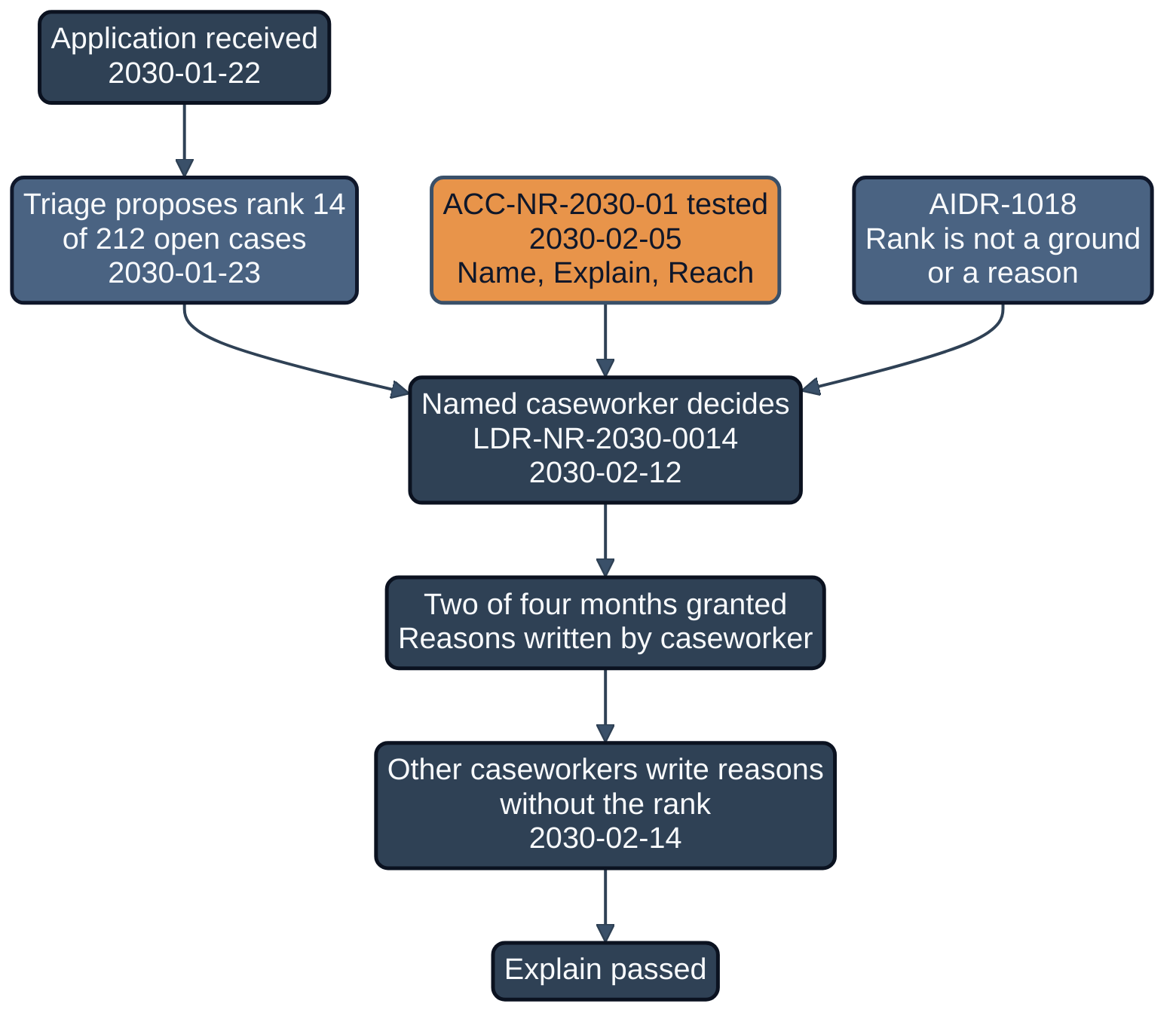
Figure 17.1: The living-support decision LDR-NR-2030-0014. The sequence is illustrative.
Further figures
The gastroenterology audit rests on about 300 procedures, a sample the volume calls too small; its clause sets no usage target, one procedure in ten unassisted, and a review after six months. The TriageSoft contract is EUR 3.4 million over four years. The volume recommends option B, a one-year extension with a new procurement, with an exit test of EUR 60,000 and a second-path study of EUR 40,000. The staff assistant's exit result of 0.91 was 322 days old at the decision (first 0.87 against 0.90, retest on 2029-04-24), and the signature was conditional on RST-NR-2030-003. The pulse covers groups of at least eight with a 180-day expiry, and MBA-NR-2029-02 requires release notes ten working days ahead (11, Nordqvist, 2026).
Across the degrees of delegation
The volume sets the Region's rule per class of leadership decision. Its working form is the following.
| Class or use | Position at the Region | Condition |
|---|---|---|
| Papers and briefings to the executive committee | Level 1 Assisted; summaries need a source link and the secretary's check | Provenance for every figure; mechanical comparison against the source; evidence no older than 90 days; a seeded-error exercise |
| People decisions | Not delegated | No assistant result is used for a named employee |
| Unit manager's coordination, reporting and first-line questions | Level 2 | The assistant may be stopped in the unit |
| Coaching, conflict, representation | Level 0 | |
| Triage rank in case decisions | Advisory only; not a ground or a reason | AIDR-1018 |
| Crisis | Level 0; a crisis class is added to the delegation order | AIDR-1023 |
What the volume concludes for Nordvik Region
The ceiling is Level 1 in every class, with reasons: nothing measured justifies more, and the briefing incident could not name its cause. The Region also keeps independent channels, monthly conversations with three unit managers and one unannounced site visit a month, and chooses a plain-language template over a ban on consumer chatbots. Coaching of new unit managers is restored. The charter for the unit manager sets a target span of 28 and a ceiling of 35 and lets the assistant be stopped in the unit. On TriageSoft the Region extends for one year and procures anew, because it cannot show that it is able to leave (11, Nordqvist, 2026).
The lessons the volume states are that the first honest figure is lower than the first dashboard; that claims expire faster than they are remeasured; that the silent failures mattered most (the staff assistant outside the union agreement, the missing exit test, registers that age); and that disagreement became text and figures, not a veto. Of the nine claims examined in Chapter 31, six had expired or were open at the year's end, with the exit row not counted, and the duty register was more than seven months old on 2030-08-02. The plan in Chapter 32 runs from 2030-09-01 to 2031-08-31: close (reread of DRR-NR-001-LEG by 2030-09-30; the 61 % recalculation and the carer recount by 2030-10-31; the conditions of ACC-NR-2030-01 by 2030-10-31; the decision on TRN-NR-2030-01 by 2030-11-30); open (negotiate MBA-NR-2029-02 to the staff assistant by 2031-01-31; the council decides a delegation clause by 2031-02-28; an exit test on benefits triage by 2030-12-31 for EUR 60,000; a crisis staff without assistants by 2031-02-28); decide (the second-path study or procurement by 2031-04-30 for EUR 40,000; weights before scoring by 2031-03-31; an evaluation of "One Region" by 2031-05-31); read (the horizon register by 2031-06-30 and the annual reading by 2031-08-31) (11, Nordqvist, 2026).
Open threads
These are collected in Chapter 27.
- Open items at the year's end. The staff assistant is not covered by
MBA-NR-2029-02; there is no exit test on benefits triage;DRR-NR-001-LEGwas not reread (it lapsed on 2030-06-10, derived); the 61 % figure was not recalculated (AIDR-1020, 2029-11-30); span and coaching were not evaluated; the carer recount and the Strandvik pulse result are missing. Chapters 26 and 31 give no reading date for the Region's duty register, only for Hansa Mutual's (2029-11-26). - Three coaching measures.
SPN-NR-2029-01gives a span ceiling of 30 and a floor of 5 hours; Chapter 16 revises it to a target of 28, a ceiling of 35 and a floor of 4 hours; Chapter 27 shows interim 3 hours a week from 2030-01-08; Chapter 11 gives three protected hours a month for coaching new unit managers. - Level before the profile. Chapter 4 says practice before
DLG-NR-EXE-01was Level 0 in most classes and the profile sets Level 1 everywhere ("a ceiling, not a licence"); the profile names Level 1 only for the external class. - Dates and scope.
AIDR-1001carries no date although the event was in April 2029.AIDR-1002is dated 2029-10-01, the dayDLG-NR-DIR-01was reviewed.BRD-NR-2029-01is applied in Chapter 6 to the staff assistant (AIDR-0211), while the profile calls the council-paper summariser the only Mode 4 system built for leaders. - Reviews with no recorded outcome. The profile and briefing specification (2030-04-01 and -02),
SPN-NR-2029-01(2030-05-05),LDR-NR-2029-0004(May),CMP-NR-2029-21(2030-05-12) andLDR-NR-2030-0026(2030-09-01). - Operations link. The volume reuses SamDrift and
RST-NR-2029-001from AI Operations but not its incidents or service identifiers. AI Operations gives the retest on 2029-04-24; this volume gives the result as 322 days old at 2030-03-12 (Chapter 16 of this book). - Setting. The profile calls the Region a Nordic EU state; the volume uses Swedish sources of law.
- Adoption claim
ADP-NR-2029-01. The staff assistant's claim (61 per cent weekly active use, with a remeasurement ordered byAIDR-1020and no result recorded) stands in AI Environment as a use with no recorded benefit result; that volume writes no adoption figure of its own. Its decision on the staff assistant (AIDR-1326,AIDR-1327) rests its accountability logic on the Name, Explain and Reach tests of AI Leader, Chapter 4 (14, Nordqvist, 2026).
Summary
AI Leader shows Nordvik Region as a public authority whose leaders use AI at Level 0 to Level 1 and whose answerability was tested by one incident that could not name its own cause. The established facts are the structure (61 council members, ten in the management team, six levels, about 310 unit managers with a median span of 28), the delegation order that does not mention AI, and the history from "One Region" to the screening pause. The illustrative year adds a diary week, a ceiling of Level 1, a provenance rule, a restored coaching duty, a tested accountability map and a one-year extension of TriageSoft.
The chapter's own conclusion is that the year's gains are in the rules and the year's debts are in the claims that expired: of nine claims, six had run out or were open. What the dossier cannot yet say is whether the plan of 2030-09-01 closes them in time, because several reviews have no recorded outcome and three coaching measures coexist.
Sources
- Nordqvist, G. AI Leader: How Leadership Roles Change When AI Is Used Broadly in European Enterprises and Public Authorities. The Transformed Architecture, Book 11. (11, Nordqvist, 2026)
- Nordqvist, G. AI Environment: Designing AI for the Greatest Benefit and the Least Environmental Harm in European Enterprises and Public Authorities. (14, Nordqvist, 2026)