Security, Operations and Resilience
This chapter gathers the posture of Nordvik Region in security, operations and resilience as the volumes establish it: the security organisation, the blue, red and purple capability (what the Region owns and what it buys), detection and response, operations and runbooks, restore tests, observers and stop paths, incidents, and the loops by which the Region verifies its own claims. Every claim of recovery or coverage is given with what was tested, when and with what result, because the series insists on evidence age. The chapter draws on AI Red Team, AI Threat, The Transformed Security Architect, AI Blue, AI Purple and AI Operations, with additions from AI Boss, AI Developer and Vibe to Dev.
The profile of 2026 (the size of the security unit, the managed security contract, the baseline incidents of 2026) is established. Tests, drills and incidents dated 2027 or later are illustrative fiction. A figure given as a result of a drill is a result of the fiction, not a measurement.
The security organisation
The CISO reports to the regional director. The security unit has 14 posts, of which six are security analysts on office hours. The other eight cover governance, identity, information security policy, the security architect and the annual penetration test. Outside office hours a European managed security provider watches under framework NR-2025-044, which requires processing and logs inside the EU and EEA (4, Nordqvist, 2026) (8, Nordqvist, 2026). The security architect post was created in 2025 from a security coordinator post and has no deputy until 2027 (ROLE-NR-SA-01, in force 2027-01-01) (6, Nordqvist, 2026). Table 7.1 lists the roles that the volumes add.
| Role or record | What it is | Volume |
|---|---|---|
NR-SEC-PROG-2027 |
Programme charter (approved 2027-01-18; owner CISO, sponsor regional director): maximum usage mode 4, offensive work maximum Level 2, irreversible actions Level 1, security data never leaves the EU and EEA; stop holders CISO, duty security officer, MSSP shift lead | Book 4 |
ROLE-NR-SA-01 v1.0.0 |
Security architect; assistant ceiling Level 1; can decide stop-path requirements in tender annexes (5 working days) and stop or restrict the architect's own AI tools (15 minutes) | Book 6 |
ROLE-NR-SEC-01 (AIDR-0716, 2027-01-25) and ROLE-NR-SEC-DET (in force 2027-07-01) |
Security unit charter; detection owner (Karin Lund, senior analyst, 11 years in the unit) | Book 8 |
ROLE-NR-SEC-PRP, ROLE-NR-SEC-XCT (AIDR-0821) |
Purple coordinator (about one day a week); exercise controller (duty security officer) | Book 9 |
ROLE-NR-SEC-AGO-01 |
Shared agent operator held by a platform engineer | Book 8 |
DRF-NR-SOC-01 (AIDR-0720, 2027-05-10) |
Decision rights of the security operations function; four non-delegable items (severity decisions, actions above the stated ceiling, irreversible actions, content of the Region's own detections) | Book 8 |
Trainee post (AIDR-0726, 2027-06-21), plan PLAN-NR-BT-2027 |
Unit goes from 14 to 15 posts; five analysts remain; trainee funded 2028 (AIDR-0732) | Book 8 |
| Duty security officer, deputy CISO | Stop holder; white-team lead | Book 9 |
| On-call managers | Rota of five managers from the security unit and the digitalisation unit, each with a named deputy | Book 8 |
Table 7.1: Security roles and records. Dates from 2027 are illustrative. (4, Nordqvist, 2026) (6, Nordqvist, 2026) (8, Nordqvist, 2026) (9, Nordqvist, 2026)
The Region reports significant incidents to the national CSIRT under the national transposition of NIS 2 and personal-data incidents to the data protection authority, and takes part in a regional government information-sharing group (RGISG). Whether the regional executive committee is a management body under NIS 2 is "confirmed with counsel" in AI Blue. AI Operations decides (AIDR-0923, 2028-11-21) to apply the national Cybersecurity Act to all Tier 1 services as an essential operator, and the Region is placed in Sweden in that volume, a placement the other volumes do not make. DORA does not apply (8, Nordqvist, 2026) (10, Nordqvist, 2026).
Blue, red and purple: own or bought
| Capability | Position | Evidence |
|---|---|---|
| Blue team (B1 to B5) | Hybrid: six analysts by day, the provider by night, the Region owns detection content one rule at a time. At the start of AI Blue it has no detection engineering, no intelligence analyst and no hunting. Twelve local rules by the end of 2027, seven with owner, test and review date | AIDR-0701, AIDR-0717 (hybrid, 2027-03-22), AIDR-0719 |
| Red team | None of its own; bought. Annual penetration test; threat-led exercise RoE-NR-2027-001 run by a contracted tester under call-off NR-2026-071 |
Book 4, Book 9 |
| Purple loop | Bought: P2 Emulate by the tester, P3 Observe and part of P5 Verify by the provider, P1 Target and P4 Improve internal, with the detection owner as coordinator and closure accountable | AIDR-0820 (2028-03-07) |
| AI red teaming of the assistants | NR-SEC-002: campaign NR-SEC-002-C01 under RoE-NR-2027-003 on a test-range copy; gate GATE-CSA-001 |
Book 4 |
| Emulation agent | None; a correlator at Level 1 and a critic at Level 0 (a different model family from the tester's), under MND-NR-EMU-01 and -02 |
AIDR-0804 |
Table 7.2: Blue, red and purple capability. (4, Nordqvist, 2026) (8, Nordqvist, 2026) (9, Nordqvist, 2026)
The security tools are a procured SIEM service, endpoint detection and response on all managed endpoints and an email security gateway, with detection rules mostly the vendor's defaults (4, Nordqvist, 2026). The security AI is NR-SEC-001 (SOC triage assistant, Level 1, read-only identity svc-nr-sec-001, self-hosted, one alert in five triaged without it to keep skills), NR-SEC-003 (exposure prioritisation, Level 0) and, from 2027, a hunting-query pack and a detection-drafting assistant at Level 1. The guardrails of NR-SEC-001 are NR-SEC-001-guardrails v1.0.0 with scenario library RT-LIB-NR-TRIAGE, at most four model calls per alert and 900 per hour. The golden-dataset evaluation EVAL-NR-SEC-001 has 1,200 cases (20 percent true positive, 55 percent benign, 15 percent hard negative, 10 percent adversarial) with a ceiling of 0.02 on missed true positives and zero on adversarial content steering the assistant (4, Nordqvist, 2026).
Detection and response
Detections. DET-NR-0001 (password spray then success, ATT&CK T1110.003) was adopted on 2027-02-08 from supplier rule SIEM-DEFAULT-AUTH-007. DET-NR-0002 and -0003 were opened on 2027-09-06 for gaps. The first rule the Region wrote itself was on 2027-02-15 (Sigma rule NR-DET-0007, payee_change_outside_role.yml). DET-NR-0011 and -0012 appear in AI Purple. The hunt HNT-NR-0001 (valid account abuse, T1078, on the administration path of benefits triage) found no compromise and two gaps. The Region does at most two hunts a year, with the provider's help (8, Nordqvist, 2026).
The incident that made the point. On 2027-03-06 at 02:09 the gateway classifier marked a phishing report as low-risk bulk mail and at 02:14 the provider's AI closed it, with delegated_by: none recorded. A weekly sample reopened it on 2027-03-08 at 08:40, sessions were revoked and a password reset for one recipient at 09:25, and the case CASE-NR-0231 was closed at 11:10. One click had occurred on 2027-03-06 and no credential use. The exposure was two days on one account (8, Nordqvist, 2026). The response was AIDR-0712 (weekly sampling of the provider's closures), AIDR-0730 (30 closures a week or all; full review of user-reported phishing) and the six conditions of annex MS-2 (AIDR-0722). In AI Purple, on 2027-10-20, the same class of failure recurs in a test: the valid-account alert ALR-0912 at 02:17 is closed by the provider's AI as low severity at 02:21 (9, Nordqvist, 2026).
Isolation and the playbook. The runbook RB-NR-ISOLATE-01 became playbook PBK-NR-ISOLATE-01 (AIDR-0703). The Region owns the isolation policy in its endpoint console; the provider's AI may isolate only end-user workstations. Anything touching a server, an account or a citizen-facing service needs a named on-call manager or duty analyst (AIDR-0718, 2027-05-10, which sets the ceilings: MS2-C1 reported bulk mail, MS2-C2 scanner noise on public hosts and MS2-ISO workstation isolation at Level 3 Bounded, everything else Level 1 Assisted). The delegation profile is DLG-NR-SEC-01 v1.1.0 and the mandate MND-NR-SOC-01 (8, Nordqvist, 2026).
Findings from AI Red Team. FND-NR-2027-001-04 (an administration console sign-in from an unmanaged device not detected out of hours; control CTRL-NR-MON-011) was closed by log forwarding and a rule under the existing framework. NR-FND-2027-014 (a payee change could be saved before the call-back) was closed by a system change and not by training, as the call-back rule CBR-NR-BEN-01 (AIDR-0508, 24 hours' cooling off). FND-NR-2027-007 (session tokens accepted after a password reset, T1550; CHG-2027-0412) was retested on 2027-05-03 with detection in 9 minutes against 15 expected (4, Nordqvist, 2026). The deepfake test of 2027-03-01 to 03-19 on the finance unit (23 staff, four requests, call-back used in three, report rate 0.74, median time to report 38 minutes) affected no real payment.
Operations and runbooks
AI Operations (illustrative year September 2028 to August 2029) treats operations as a small owned loop around a bought base. The IT and Digitalisation Unit has about 85 people (infrastructure and hosting 22, platform team 7, applications and integration 31, service desk 12, IT management office 10) under Henrik Dahl. There is no site reliability function, and the platform team carries the practice. On-call is a weekly rota of 11 (seven platform and four infrastructure staff), a duty-manager rota of four who act as incident commander for Tier 1, a page response target of 15 minutes for Tier 1, and SamDrift's network operations centre paging the Region's on-call out of hours (10, Nordqvist, 2026).
| Service | Tier | Objective | RTO and RPO |
|---|---|---|---|
SVC-NR-001 Benefits triage |
1 | 99.5 % a month, 06:00 to 22:00 on weekdays; a case ranked within 10 minutes for 99 % (SLO-NR-001) |
4 h and 15 min |
SVC-NR-002 Citizen portal |
1 | 99.9 % (SLO-NR-002; a collector fragment removes user.email, user.full_name, citizen.id, client.address) |
2 h and 5 min |
SVC-NR-003 Case management (special categories; vendor product Ärendia) |
1 | 99.5 % | 4 h and 15 min |
SVC-NR-004 Staff identity |
1 | 99.9 % | 1 h and 5 min |
SVC-NR-005 Citizen-service assistant |
2 | 99.0 %, p95 under 8 s | 24 h |
SVC-NR-006 Staff assistant (about 3,200 users) |
2 | 99.0 % | 24 h |
SVC-NR-007, -008 Travel planner; email and collaboration |
2 | Not given | Not given |
Table 7.3: The service catalogue (profile of AI Operations). (10, Nordqvist, 2026)
The AI in operations is NR-OPS-001 (operations assistant, Level 0 Advisory, AIDR-0901), NR-OPS-002 (scribe, Level 1) and NR-OPS-003 (runbook runner, Level 2 Supervised, MND-NR-OPS-003, AIDR-0916, in force 2028-11-14, review 2029-02-14, expiring 2029-05-14), which runs three portal runbooks: RBK-NR-0002 restart, RBK-NR-0003 scale and RBK-NR-0004 certificate renewal. Rollback and failover are Level 1 and deploy is not delegated. The delegation profile DLG-NR-OPS-001 caps every class that changes production at Level 2. AIDR-0910 (2028-11-06, in force 2028-11-20) forbids any scripted runbook at Level 3 until the observer OBS-NR-0001 is in force. No level was raised during the year. AIDR-0918 (2028-11-21) removed standing production permissions after an internal audit found on 2028-10-17 that the pipeline's automatic account held an administrator role in production with a key unchanged for 26 months, used by the pipeline and three ownerless scripts and named on a wiki page the whole unit could read. A ten-minute pipeline token followed on 2029-01-31 (10, Nordqvist, 2026).
The change record CHG-NR-2028-0007 is an AI-authored infrastructure change (automatic renewal of the portal certificate at the recovery site, motivated by RST-NR-2027-002), a normal change because no standard class exists, approved by Maja Lindqvist and Oskar Berg, in a window on 2028-10-17 from 20:00 to 22:00 (verified 21:12), with rollback tested on 2028-10-12 and verified by an external TLS probe with 89 days to expiry. The decision-rights file DRF-NR-001 v0.9.0 (AIDR-0922, 2028-11-28) makes the duty manager incident commander with deputies after 15 and 30 minutes, and gives stop rights to the duty manager, the platform lead and the platform engineer on call without approval, with the regional director as backstop (10, Nordqvist, 2026).
Incidents in the record
| Incident | Date | What happened | Source |
|---|---|---|---|
INC-NR-2026-0071 |
2026-03-12 | Identity provider signing certificate expired 06:40; staff could not log in for 95 minutes; no certificate inventory | Book 10 profile |
INC-NR-2026-0214 |
2026-09-22 | A TriageSoft release changed a queue setting; ranking stood still 5 h 10 min; caseworkers used date order; no release-notice period in the contract | Book 10 profile |
INC-NR-2027-0034 |
2027-02-18 | Storage controllers failed in hall A; failover to hall B took 3 h 40 min against 2 h for the portal; PRB-NR-0007 |
Book 10 |
INC-NR-2027-0129 |
2027-05-24 | Container image update at the hosting provider; citizen assistant timed out for 2 hours; no notice | Book 10 |
INC-NR-2027-0298 |
2027-11-08 | SamDrift DNS fault; e-services unreachable from outside for 70 min; Region's monitoring saw it 22 min after the status page | Book 10 |
INC-NR-2028-0163 |
2028-11-13 to 14 | TriageSoft changed ranking before the announced window (22:40); probe broke its threshold 08:12; incident declared by Oskar Berg 09:20; ranking switched off in the Region's gateway 09:34; supplier informed 10:05 (AI Act Article 26(5)); 212 cases ranked; AI Act clock closed 2028-11-16, GDPR "no breach" 15:30, NIS 2 "not significant" 14:00; supplier report 2028-11-23 | Book 10 |
INC-NR-2028-0391 |
2028-11-21 | A schema migration locked the case-management database; unavailable for 7 h 5 min (425 min) and restored from the immutable store, against an objective of 4 h | Book 10 |
| Crisis exercise | 2029-11-20 | Benefits triage ranked urgent applications wrongly for six days after an upstream data-flow change (an exercise, not an incident) | Book 11 |
INC-NR-2030-0071 |
March 2030 | Secret in a prompt | Book 12 |
INC-NR-2030-0094 |
2030-12-12 | A release (CHG-NR-2030-0091, 2030-12-02) left 53 applicants not called back for ten days; switched off 22 minutes after the decision; PIR-NR-2030-0006 could not tell whether AI took part, because prompts were not stored |
Book 12 |
Table 7.4: Incidents. Entries before 2026-11 are profile facts; entries after are illustrative. (10, Nordqvist, 2026) (11, Nordqvist, 2026) (12, Nordqvist, 2026)
Restore tests, observers and stop paths
The series insists that only a verified claim may be written as "recoverable" and that a claim ages. The recovery record of the Region is the clearest example.
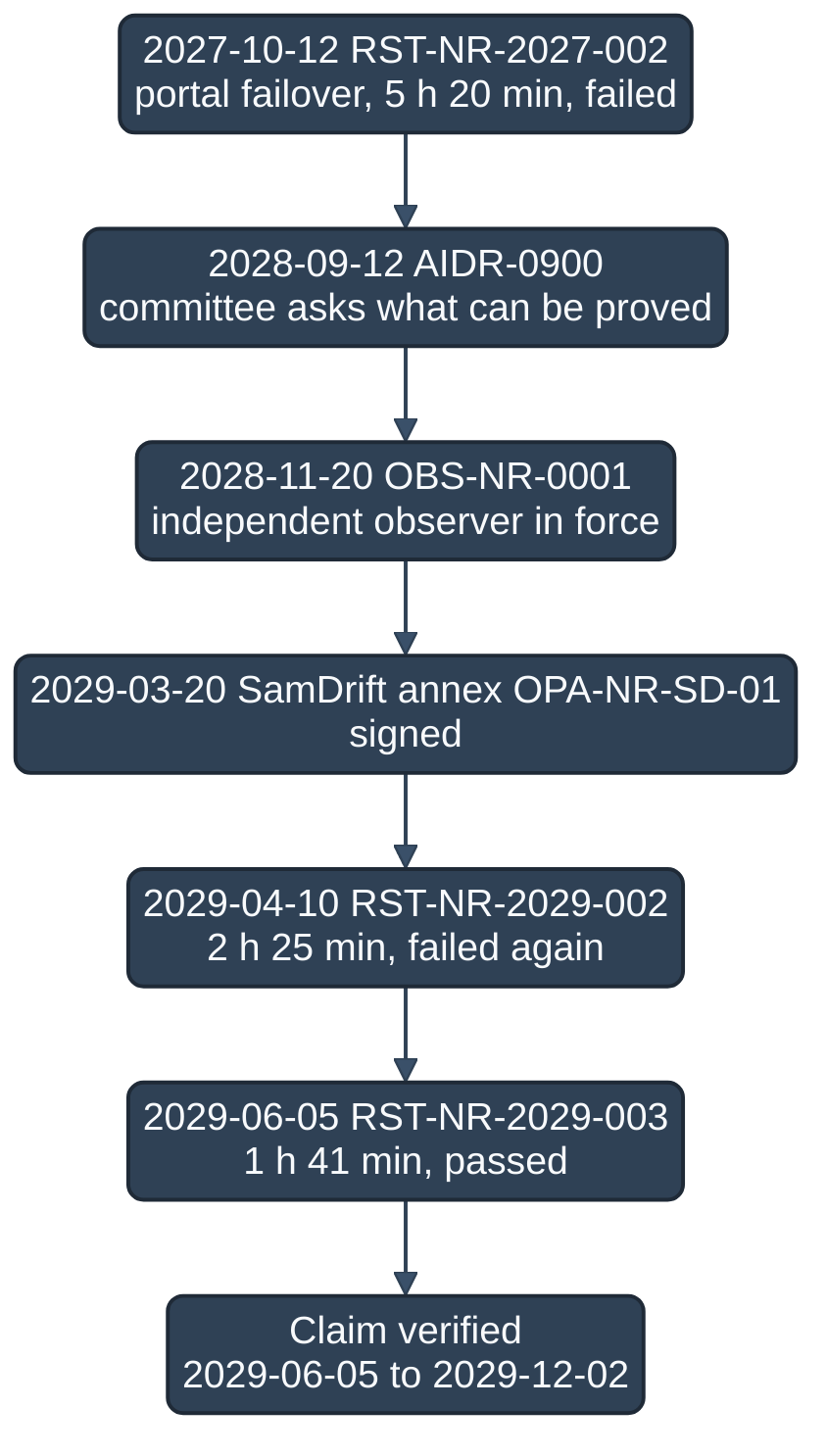
Figure 7.1: The path of the portal failover claim, illustrative. The first test failed on DNS time-to-live and an unrenewed certificate; the claim was not verified until the third.
| Test | Date | Result | Age or expiry |
|---|---|---|---|
RST-NR-2027-001 case-management restore |
2027-04-20 | 3 h 05 min against 4 h; RPO 11 min against 15; passed | 180-day clock ended 2027-10-17; 16 months 22 days old at AIDR-0900 |
RST-NR-2027-002 portal failover to SamDrift |
2027-10-12 | 5 h 20 min against 2 h; failed (DNS time-to-live and an unrenewed certificate) | No retest at the start of AI Operations |
RST-NR-2029-001 exit of staff assistant |
2029-02-27; retest 2029-04-24 | Quality 0.87 against 0.90; retest 0.91 | See Chapter 6 |
RST-NR-2029-002 portal failover |
2029-04-10 | 2 h 25 min against 2 h; failed (31 minutes in SamDrift's normal-priority queue) | |
RST-NR-2029-003 portal failover |
2029-06-05 | 1 h 41 min against 2 h; passed; claim verified 2029-06-05 to 2029-12-02; risk acceptance DRF-NR-001/RA-01 ended; PRB-NR-0007 closed |
180-day clock |
RST-NR-2031-0001 restore of the build |
2031-12-05 | 11 min against 30; Elin Berg ran it | Expires 2032-03-04 |
Table 7.5: Restore tests. The age of the claim is part of the claim. (10, Nordqvist, 2026) (13, Nordqvist, 2026)
The observer principle (the system that verifies an action must be independent of the system that performed it) is carried by OBS-NR-0001, in force 2028-11-20: placed at the hosting provider in a different network from Region Cloud and SamDrift, with a probe that resolves names directly against the authoritative servers; design target two failures at 60-second intervals. The first quarterly seeded fault, on 2029-03-19, was found in 2 minutes 41 seconds against a target of 2 minutes; the retest on 2029-04-30 took 2 minutes 4 seconds and was accepted (SDF-NR-2029-001). A break-glass test on 2029-02-07 (two people, 9 minutes against 15, valid to 2029-05-07) was retested on 2029-05-07 at 8 minutes, valid for 90 days. Stop drills of the citizen-service assistant on 2028-10-26 reached rung 2 of the fallback ladder in 41 seconds and rung 3 in 4 minutes, with a staffed handover at 12 minutes (CAP-NR-AI-001) (10, Nordqvist, 2026).
Stop paths in the series
A stop path outside the system being stopped is a recurring requirement. The tests recorded for the Region are collected below. The budgets differ because they stop different things.
| Stop | Date | Time against budget | Volume |
|---|---|---|---|
| Stop of benefits triage to date order | Standard design | 60 seconds (AI Governance); five minutes (AI Platform and Security) | Books 2, 3 |
| Rostering: first stop-path test | 2027-03-12 | "Within the hour"; achieved time not given | Book 7 |
| First out-of-hours stop drill | March 2027 (The Transformed Security Architect; the Landscape model) | 26 min against 15; remedy: provider break-glass for one action; re-drill October 2027 11 min | Book 6 and Landscape |
| First out-of-hours stop drill (provider's AI) | 2027-05-13, 20:10 | Provider paged in 3 min 50 s (requirement 5); on-call manager could not set isolation to observe-only (console role missing); deputy with the right reached after 14 min; repeat a week later 6 min 40 s | Book 8 |
| Stop drill of provider's AI | 2028-03-02, 01:30 | 21 min against 15 | Book 9 |
| Revocation of a test identity | 2028-03-16 and 03-17 | 190 s against 120; retest 95 s | Book 9 |
Nightly revocation (detection owner, CMP-NR-21) |
2028-03-30 | 7 min against 2 | Book 9 |
| Human-led halt of an exercise | RoE-NR-2027-001 |
5 min budget | Book 9 |
| Revert rehearsal of a coded change | 2030-11-04; 2031-01-08 | 9 min against 15; 11 min | Book 12 |
| Revert in the dark week | 2031-06-19 | 34 min against 30 | Book 12 |
| Rollback rehearsal of the build | 2031-12-05 | 6 min against 15 | Book 13 |
Stop path STOP-NR-ENV-01 of the citizen-service assistant (gateway route to a FAQ page and the telephone service) |
2032-11-16 | 14 min against 10; failed because the on-call could read but not change the gateway route table (permission since given) | Book 14 |
| Same, repeat | 2032-12-07 | 6 min 20 s | Book 14 |
| Same, further drills | 2033-03-02; 2033-08-29 | Passed; times not given in the extract | Book 14 |
Table 7.6: Stop-path tests and drills. All dates from 2027 are illustrative. (2, Nordqvist, 2026) (3, Nordqvist, 2026) (6, Nordqvist, 2026) (7, Nordqvist, 2026) (8, Nordqvist, 2026) (9, Nordqvist, 2026) (12, Nordqvist, 2026) (13, Nordqvist, 2026) (14, Nordqvist, 2026) (15, Nordqvist, 2026)
Assurance and verification loops
AI Purple (illustrative, January to April 2028) turns the loop into numbers. On 2028-04-26 coverage of nine prioritised ATT&CK techniques (PRI-NR-2028-01, ATT&CK v19, evidence expiring after 180 days) was: two verified within expiry (COV-NR-0001 T1110.003 and -0002 T1078, both 2028-02-09, expiring 2028-08-07), three tested and failed (-0003 T1566.002 on 2028-02-20; -0004 T1053.005 and -0005 T1059.001 on 2028-03-22), two asserted by the provider (T1685, T1098) and two untested (T1190, last passed 2027-04-02, expired 2027-09-29; T1486, last passed 2027-03-30, expired 2027-09-26). A draft report of 2028-01-20 had said "nine of nine mapped". It was rewritten as five with a result, two asserted and two untested. The target is seven of nine verified by 2028-12-31 and nine of nine, or a declared reason, by 2029-10-31 (9, Nordqvist, 2026).
The other loops are the independence conditions (MS-2-IND-1 and -2), the weekly sample of the provider's closures (14 of 15 seeded incidents handled correctly in the round of 2028-02-07 to 02-20), seeded errors in analyst work (7 of 9 caught in the first quarter of 2027, counted and not a rate) and the golden-dataset evaluation. The Transformed Security Architect adds a control catalogue (CTRL-*): 10 entries at the start (4 verified, 5 declared, 1 failed: CTRL-LOG-001), 24 in the briefing of November 2026 (9, 13, 2), 38 in February 2027 and 52 at the end of the year; the plan target is 60 percent verified. The recovery side has the restore-drill programme NR-SEC-004 (monthly drills; twelve experiment types weekly in test) with objectives RTO 8 hours and RPO 24 hours for the citizen-service assistant, against a hosting-provider commitment of 4 hours, measured at 7 hours in one example (NR-SEC-004-RD-07) (4, Nordqvist, 2026) (6, Nordqvist, 2026).
The reversibility tests complete the picture. In AI Threat, RVT-NR-2027-01 ran a month without the claims ranker, with one benefits team for four weeks and a desk exercise for the unit, and ended passed_with_conditions. Capacity was short by about a week of work a month, two caseworkers hired since 2025 had never triaged unranked claims, and the checklist referred to a form discontinued in 2025. The head of the benefits unit froze delegation until the conditions are met. In AI Boss, RVT-NR-ROS-2027-01 (5 to 16 April 2027) had Strandvik plan routes by hand for two weeks, found that the deputy had never planned a route by hand and that the manual template lacked the travel-time rule, and was met on 2027-06-30 (5, Nordqvist, 2026) (7, Nordqvist, 2026).
Across the usage modes
| Mode | Posture |
|---|---|
| Mode 0 | Blind spot: vendor AI that closes or acts without a stated rule; answered by sampling, declarations and notice clauses |
| Mode 1 | Analyst assistants self-hosted for alert data; closes no alert |
| Mode 3 | Platform team tools in isolated ranges at Level 1 (security) or drafting only (operations); no application of changes |
| Mode 4 | NR-SEC-001 Level 1, runbook runner Level 2, with observer OBS-NR-0001 required before Level 3 |
| Mode 5 | None. The first candidate named is automatic session revocation after confirmed credential theft, decided at the end of 24 months in AI Red Team; operations rules out Level 3 before the observer exists |
Table 7.7: Security and operations by usage mode. (4, Nordqvist, 2026) (8, Nordqvist, 2026) (10, Nordqvist, 2026)
What the posture shows and what is unresolved
By the end of AI Operations the Region can say "exactly how little" it can prove: Tier 1 services with a verified restore claim go from 0 of 4 at the baseline to a plan of 2 of 4 on 2029-09-30 and 4 of 4 on 2030-03-31 (planned dates for restores: case management 2029-08-31, staff identity 2029-10-31, benefits triage with TriageSoft 2029-11-30). In the answer to AIDR-0900, AI Operations sets five decisions for the committee: the register as a measure, levels raised only on evidence, funding of independent verification, supplier terms (OPA-NR-SD-01), and protection of the craft and the people. The key-person risk is explicit: the same senior platform engineer, Joakim Wester, carried the restore of 2028-11-21, the seeded fault of 2029-03-19 and most weekend on-call. The collective agreement MBL-NR-IT-2027-01 bars reporting shutdown counts or response times by person (10, Nordqvist, 2026).
Open threads for Chapter 27:
- The first out-of-hours stop drill is dated March 2027 (26 minutes against 15) in The Transformed Security Architect and the Landscape model, and 2027-05-13 (a different set of times) in AI Blue.
- Two reversibility tests have near-identical identifiers (
RVT-NR-2027-01in AI Threat,RVT-NR-ROS-2027-01in AI Boss); the Landscape profile uses the second name for both. NR-SEC-004is a monthly restore drill in the profile of AI Red Team and a weekly chaos catalogue of twelve experiment types elsewhere in that volume.- Patch targets: 48 hours to verified protection for tier 1 in AI Threat, against 24 hours to mitigation and 72 to fix in
DPD-NR-001of AI Red Team. - AI Operations Chapter 30 says no seeded fault had yet measured the observer, while Chapter 29 records one on 2029-03-19; and the Level 3 position (profile: scripted runbooks; Chapter 13: only automatic rollback of a gateway route; Chapters 4 and 30: none before N4).
- Risk record names:
NR-RISK-2027-014againstNR-RISK-AI-014and-016; finding namesNR-FND-2027-014andFND-NR-2027-007. MS-2is dated for 2027-07-01 in one chapter of AI Blue and for signature by 2028-03-31 in another; its status is unresolved at the end of that volume. The final test of 2027-12-15 finds the provider's closures "partly" shown and the provider's stop "not yet shown".- AI Environment adds the drilled stop of
STOP-NR-ENV-01: a first drill that failed (14 minutes against 10, 2032-11-16) and a repeat that passed (6 minutes 20 seconds), held by Henrik Dahl with the platform on-call outside the assistant. On 2033-01-24 the stop acted within a minute when a mid-January notice to about 38,000 households of changed benefit levels pushed resolved enquiries to 177,800 against a monthly quota of 160,650 (INC-NR-2033-0007, illustrative) (14, Nordqvist, 2026). - The pointer for the first out-of-hours drill is inexact in one place: Landscape's Chapter 13 refers to its Chapter 18, which gives only the other organisation's 17 and 5 minutes, while the profile points to Chapter 10 for the 26 and 15 minutes.
- Stop budgets of 5 minutes, 10 minutes, 15 minutes, 120 seconds and 60 seconds exist side by side, for different stops.
Summary
The Region's security posture is a small hybrid unit that owns the few things which decide quality (detection content, the isolation policy, the stop path) and makes the rest visible by contract. Its operations posture is a small owned loop of objectives, runbooks and an independent observer around a bought base. Its resilience position is honest and low: a Tier 1 service is "recoverable" only after a dated test, and for most of the series the tests failed first and passed on retest. Three lessons recur. Soft failures need no attacker: a provider's AI closing an alert, a drill that runs too long, a certificate that expires. The record of a failing test is the evidence that the loop measures something. And the same few people carry the year, which is the posture's largest risk.
Sources
- Nordqvist, G. AI Governance. (2, Nordqvist, 2026)
- Nordqvist, G. AI Platform and Security. (3, Nordqvist, 2026)
- Nordqvist, G. AI Red Team. (4, Nordqvist, 2026)
- Nordqvist, G. AI Threat. (5, Nordqvist, 2026)
- Nordqvist, G. The Transformed Security Architect. (6, Nordqvist, 2026)
- Nordqvist, G. AI Boss. (7, Nordqvist, 2026)
- Nordqvist, G. AI Blue. (8, Nordqvist, 2026)
- Nordqvist, G. AI Purple. (9, Nordqvist, 2026)
- Nordqvist, G. AI Operations. (10, Nordqvist, 2026)
- Nordqvist, G. AI Leader. (11, Nordqvist, 2026)
- Nordqvist, G. AI Developer. (12, Nordqvist, 2026)
- Nordqvist, G. Vibe to Dev. (13, Nordqvist, 2026)
- Nordqvist, G. AI Environment: Designing AI for the Greatest Benefit and the Least Environmental Harm in European Enterprises and Public Authorities. (14, Nordqvist, 2026)
- Nordqvist, G. Landscape. (15, Nordqvist, 2026)