Structure, People and Roles
This chapter sets out how Nordvik Region is governed and organised, who holds which decision right, who represents the employees, and which person or role owns which AI system. It also records how the structure grows across the series: the first volumes name only roles, and later volumes name people and add roles of their own. The chapter draws on the example-organisation profiles of AI Governance, AI Platform and Security, AI Red Team, The Transformed Security Architect, AI Boss, AI Blue, AI Purple, AI Operations, AI Leader, AI Developer and Vibe to Dev, and on the seats that Landscape assigns to each unit. The profile facts are established. The people, the dates and the records from 2027 onward are illustrative fiction, and the chapter marks them where it matters. Chapter 24 gives the full cast, grouped by function with the volumes in which each person appears.
The political level and the audit line
Nordvik Region is a regional public authority, so the highest level is elected. The regional council, with 61 members, decides questions of principle, the budget, the tax rate and the delegation order, which is a 38-page document adopted in 2019 and amended in 2023 that does not mention AI. The executive committee is the political executive, chaired in AI Leader by Lars-Erik Nyström in his second term, and its minutes are public. An audit committee and elected auditors, whose chair is Sigrid Berglund, examine the administration (11, Nordqvist, 2026) (2, Nordqvist, 2026).
| Body | What it does | Where the series uses it |
|---|---|---|
| Regional council | Principles, budget, tax rate, delegation order; decides the delegation clause on automated decisions in the plan of AI Leader (illustrative, 2031-02-28) | AI Threat (a group raised a motion in September 2026), AI Leader |
| Regional council, October 2032 | Debates a regional plan that would invite data-centre investment; residents ask the property and energy manager about it (illustrative) | AI Environment |
| Executive committee | The political executive; highest level of the AI escalation matrix; minutes are public | AI Governance, The Transformed Security Architect, AI Boss, AI Leader |
| Audit committee and elected auditors | Ask for reports on risk; receive the threat register at each half-year review; ask the question of AI Purple | AI Threat, AI Purple, AI Leader |
| Regional internal audit | Challenges the work of the threat assessment; reports on findings | AI Governance, AI Threat, AI Operations |
The regional director rules the administration and reports AI matters to the executive committee and risk to the audit committee (11, Nordqvist, 2026). In AI Threat the audit committee asked the Region for a report by the end of March 2027 after the council's motion to pause AI use, and the council later accepted the regional director's report and asked that the threat register return to the audit committee at each half-yearly review (5, Nordqvist, 2026). In AI Purple the committee asks what the first threat-led exercise had proved beyond a list of closed findings (AIDR-0800, 2028-01-11) (9, Nordqvist, 2026).
The administration
The professional administration is led by the regional director, who in AI Leader is Elisabet Holmgren, in post since 2024 and formerly an administrative director at a university hospital. She signs AI go-lives for high-risk systems and approved the AI governance policy v2.1 on 2026-03-18 (AI Governance) (2, Nordqvist, 2026) (11, Nordqvist, 2026).
The regional management group
The group has ten members: the regional director, six sector directors (health and care; primary care and home care; regional development; public transport; social services and benefits; central administration), the finance director Pär Lindgren, the HR director Ingrid Halvorsen and the Head of IT and Digitalisation, Henrik Dahl. The chief information security officer (CISO), the AI governance lead, the data protection officer and the regional counsel, Maria Åkesson, attend when needed. There is no chief AI officer, and the AI governance lead sits in the digitalisation unit under the Head of IT and Digitalisation (11, Nordqvist, 2026).
Levels and spans
There are six levels from the council to the front line. The regional director has nine direct reports, sector directors six to eight, and department and division heads eight to ten, about 45 in all. About 310 unit managers have a median of 28 employees each: about 12 in specialist clinics, about 35 in home care and up to 60 on some hospital wards. About 355 of the 6,000 employees hold a management post, one in 17. A reorganisation called "One Region" in 2024 reduced nine departments to six sectors, removed the heads of section and saved 31 posts. Two years later, in a survey, 41 per cent of the unit managers had spans above 35, sick leave had risen and coaching of new unit managers had stopped; the saving was never evaluated. A unit-manager post takes on average seven months to fill (11, Nordqvist, 2026).
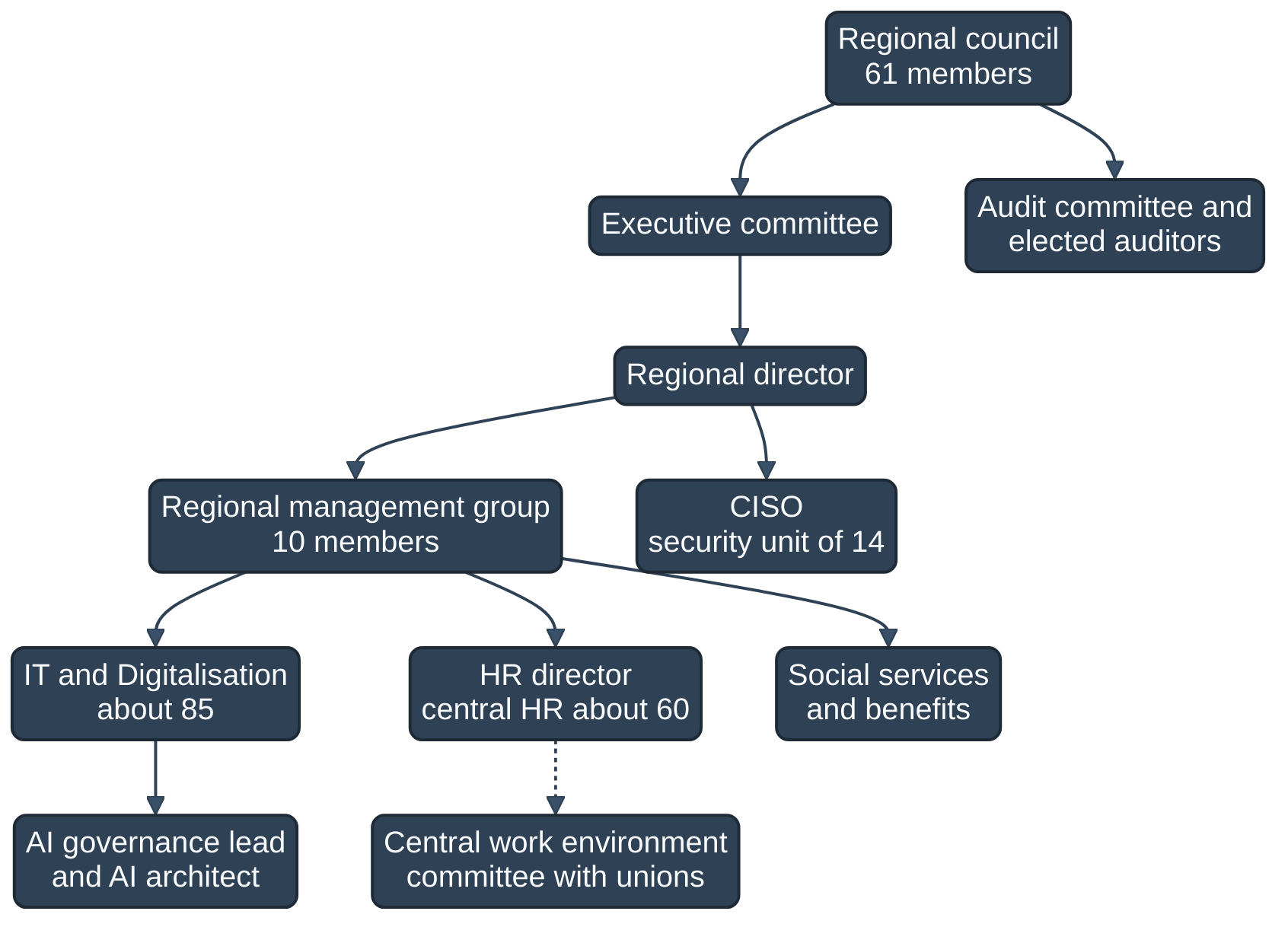
Figure 3.1: Structure of Nordvik Region. The political level, the audit line and the administration, with the units that carry AI decision rights.
Units and named roles
The tables below give the units that the series names, the named roles in each and the volume in which each first appears. Where a volume names a person, the person is given, and where it names only a role the role is given alone. The people are fictional and illustrative.
IT and Digitalisation Unit
The unit has about 85 people under the Head of IT and Digitalisation, Henrik Dahl, who reports to the regional director. It has infrastructure and hosting (22), a platform team (7 engineers), applications and integration (31), a service desk (12) and an IT management office (10). The CISO, the AI architect and the enterprise architect sit beside the unit. There is no site reliability function, and the platform team carries the practice without anyone holding the title (10, Nordqvist, 2026) (12, Nordqvist, 2026).
| Role or person | What the person or role does | First appears |
|---|---|---|
| Head of IT and Digitalisation (CIO), Henrik Dahl | Owns the service catalogue and the staff assistant; receives AIDR-0900; co-owns AIDR-1000; owns DLG-NR-DEV-01 |
AI Operations (named); earlier volumes use the titles Chief Digital Officer and Head of Digital Services, which the dossier does not assume to be the same office |
| Platform lead, Maja Lindqvist | Owns Region Cloud, the observability stack and the operations assistant; holds the stop right; owns the builder workspace | AI Operations |
| Senior platform engineer, Joakim Wester | Writes runbooks, takes most weekend on-call; ran the restore of 2028-11-21; reviews agent-drafted infrastructure code | AI Operations |
| Duty manager and incident commander, Oskar Berg | One of four duty managers; holds the stop in exercises | AI Operations |
| Service desk lead, Sara Ekdahl | Runs the service-management tool and the knowledge base | AI Operations |
| Head of Applications and Integration, Gunilla Roos | 31 people: 18 developers, four testers, five product owners and analysts, two designers, two managers; accountable for DLG-NR-DEV-01 |
AI Developer |
| Tech lead and head of integration and data, Anders Falk | Six people; ran the coding-assistant pilot | AI Developer |
| Senior developer Linnea Sjöberg; juniors Emil Nordgren and Frida Lund; quality engineer Saga Edvardsson; developer Sofia Hedlund | Case platform, e-services and quality roles with ROLE-NR-DEV-* charters |
AI Developer |
| Product owner Hanna Wikström; deputy Elin Berg; receiving developer Rasmus Holm | The builder, her deputy and the receiving developer of service-point-check |
AI Developer (Hanna), Vibe to Dev |
Security unit
The security unit has 14 people. The CISO reports to the regional director. Six are security analysts on office hours, and the other eight cover governance, identity, information-security policy, the security architect and the annual penetration test. The rest of the watch is bought from a European managed security service provider under framework agreement NR-2025-044 (4, Nordqvist, 2026) (8, Nordqvist, 2026).
| Role or person | What the person or role does | First appears |
|---|---|---|
| CISO | Owns security requirements, changes autonomy levels with the security board, approves notifications; owns the threat register and NR-SEC-PROG-2027 |
AI Platform and Security; AI Red Team |
| Duty security officer | Out-of-hours stop path holder with the MSSP shift lead; exercise controller ROLE-NR-SEC-XCT in AI Purple |
AI Red Team |
| Security architect | A post created in 2025 by converting a security coordinator post; ROLE-NR-SA-01 effective 2027-01-01 |
The Transformed Security Architect |
| Senior security analyst, Karin Lund | Eleven years in the unit; first detection owner (ROLE-NR-SEC-DET, from 2027-07-01); purple coordinator (ROLE-NR-SEC-PRP) |
AI Blue |
| CISO deputy | White-team lead in AI Purple; reporting roster; co-signs changes the detection owner authors | AI Blue, AI Purple |
| On-call manager rota | Five managers from the security and digitalisation units, each with a named deputy | AI Blue |
| Trainee analyst | A new post (AIDR-0726), taking the unit from 14 to 15 posts |
AI Blue |
| MSSP shift lead (external) | Stop-path holder out of hours | AI Red Team |
| Contracted tester, Elin Berglund (external) | Principal consultant at a European test firm; call-off NR-2026-071 |
AI Purple |
Benefits, social services and other units
| Role | What the role does | First appears |
|---|---|---|
| Head of Benefits Unit | Owns the benefits-triage system (ROLE-AI-OWNER, instance INV-0042); may stop the system and may not change evaluation thresholds, which model risk sets; owns HPR-NR-2026-01 and DEL-NR-BEN-01; approves RoE-NR-2027-001 |
AI Governance |
| Head of Benefits Operations | Business owner of the intake use case UC-2026-017 |
AI Governance |
| Director of Social Services and Head of Social Services | Senior responsible owner of the living-support triage (NR-ALG-2026-003); owner of the case-note summariser in the Landscape model |
AI Governance; Landscape |
| Senior caseworker and caseworker team leaders | Oversight, the right to stop and the Article 26(2) function; team leaders may suspend ranking | AI Governance; AI Platform and Security |
| Head of Administrative Services | Benefit owner of the staff assistant (UC-2026-061) |
AI Governance |
| Head of Payroll Services | Owner of the retired travel-reimbursement scoring | AI Governance |
| HR director, Ingrid Halvorsen | In post since 2023, formerly HR head at the Region's hospitals; central HR of about 60; owns AIDR-0600, the delegation register and DLG-NR-ROS-01 |
AI Boss (named) |
| Unit manager, Mikael Strand | Strandvik home-care unit, about 35 staff; approves every schedule; ROLE-NR-MGR-01 protects 35 per cent of his time |
AI Boss |
| Head of Policy Unit; Head of Communications; head of citizen service; head librarian | Own the work-assistant policy WA-NR-POL-2026-01, the content provenance plan CPP-NR-2026-01, the evaluation and safeguarding items EVAL-NR-SYC-001 and SG-NR-CSA-01, and LIB-NR-AIL-2027-01 |
AI Threat |
| Dr Sofia Berglund | Head of the gastroenterology department; author of LDR-NR-2029-0019 |
AI Leader |
The AI governance functions have their own roles. AI Governance names a Chief Architect who owns the principles (v1.2, 2026-05-14), a Chief Digital Officer who owns the AI governance policy, a Head of Internal Audit, a data protection officer, a model-risk function and legal counsel for the AI Act. Unit heads are the AI system owners, there are no agent operators, and a skills curator works part time (2, Nordqvist, 2026). The Transformed Security Architect adds an enterprise architect, who is the nearest colleague of the security architect, and an AI architect, an employee on the same salary scale, who owns the AI Decision Records (6, Nordqvist, 2026).
Decision rights, tiers and stop rights
The decision rights follow an escalation matrix with four steps and the political level above them. AIDR-0512 in The Transformed Security Architect sets the tier policy: tier 1 is the platform's gates, tier 2 is the CISO with the enterprise architect, tier 3 is the AI governance board with the regional director, and the political level is the executive committee (6, Nordqvist, 2026). Landscape uses the same ladder as decision seats: T1 for a user or operator, T2 for a system owner or architect, T3 for an executive or director, T4 for a board or elected body (15, Nordqvist, 2026). A waiver may not set aside a prohibition, a rights assessment or human oversight. AI Governance gives waivers of up to 90 days for low and limited risk, and a matrix allowing up to 180 days for high risk while the policy says at most 90. This is an open thread (Chapter 27) (2, Nordqvist, 2026).
A decision right is only as good as the right to stop. The series gives the Region a stop right for each system class, held by a named role and not by the supplier.
| System or class | Who may stop it | Within | Volume |
|---|---|---|---|
| Benefits triage | Head of Benefits Unit; caseworker team leaders may suspend ranking; return to date order | 60 seconds in AI Governance, five minutes in AI Platform and Security (open thread) | AI Governance; AI Platform and Security |
Security assistant NR-SEC-001 and own AI tools |
Security architect may stop or restrict the architect's own AI tools; CISO, duty security officer and MSSP shift lead stop under the programme charter | 15 minutes for the architect's tools | The Transformed Security Architect; AI Red Team |
Rostering (ShiftWise) |
Unit manager pauses open shifts; HR director stops the system region-wide; platform on-call stops it technically through the contract's stop path | 15 minutes; one hour | AI Boss |
Operations (DRF-NR-001) |
Duty manager, platform lead, platform engineer on call without approval; regional director as backstop | Not given as a single figure | AI Operations |
Environmental budget of a use (citizen-service assistant, EBG-NR-0001) |
Stop path STOP-NR-ENV-01, a gateway route to a FAQ page and the telephone service, held by Henrik Dahl with the platform on-call, outside the assistant; the regional director can order a stop (illustrative) |
Stop inside a minute at 110 per cent of the monthly quota; drilled 14 minutes against a target of 10 (failed 2032-11-16), then 6 minutes 20 seconds | AI Environment |
| Provider's AI in the night watch | The Region's named on-call manager, under annex MS-2, with a stop budget of 15 minutes |
15 minutes | AI Blue |
Employee representation
Employee representation follows a national co-determination regime of the Swedish pattern, which the series uses as its example. It requires information and negotiation before an important change, under the Co-determination Act sections 11, 12, 19 and 38, with section 64 giving four months to raise a dispute. Five sector unions are party to the collective agreements, and a central work environment committee meets every quarter, with sector committees and a safety representative at each workplace (7, Nordqvist, 2026). The central committee has the HR director as employer chair, and the chair of the union side is Birgitta Almqvist (11, Nordqvist, 2026). The two unions that are party to the rostering delegation profile represent nurses and midwives, and municipal and care staff. Other unions are a doctors' union, an academics' union and a white-collar union. Tomas Ekblad represents the IT unit and in June 2030 asked for negotiation before the coding pilot was extended (12, Nordqvist, 2026).
The agreements the series records are these.
| Agreement | What it settles | Volume |
|---|---|---|
DLG-NR-ROS-01 (2027-01-20) |
Delegation profile for rostering negotiated before go-live and a procedure for changing it (classes 1 to 3) | AI Boss |
| Union-negotiated rule on measures | Closure rates and similar measures never reported by name; extended to the AI use log AUS-NR-SOC-01, the weekly sample AIDR-0712 and competence records |
AI Blue |
MBL-NR-IT-2027-01 |
Shutdown counts and response times never reported by person; stand-by rotas negotiated; any tool that logs engineers' queries or commands is negotiated before it is switched on | AI Operations |
MBA-NR-2029-02 (2029-12-04) |
Information to staff representatives before an AI system prepares staff decisions; does not yet cover the staff assistant | AI Leader |
MBA-NR-2030-03 (opened 2030-09-15) |
Coding tools; prompt retention and consultants open | AI Developer |
The Region applied the high-risk information procedure voluntarily in AI Governance and set its commitments to staff representatives as controls with tests, one of which has no automatic test (2, Nordqvist, 2026). The unions were also consulted before MND-NR-01 version 2.0.0 and agreed the competence assessment rules with the security architect (6, Nordqvist, 2026). In AI Purple exercises that involve staff require written notice to the joint committee ten working days before the window, and results are shown in aggregate and never by name (9, Nordqvist, 2026).
Who owns which system
The table lists the owner or seat of each system as the volumes give it. Where two volumes give different owners, both are shown.
| System | Owner or seat | Source |
|---|---|---|
| Benefits triage | Head of Benefits Unit (T2) | AI Governance; Landscape |
| Staff assistant | Head of Administrative Services (benefit owner); Chief Digital Officer (owner); Head of Digitalisation (T2); Head of IT and Digitalisation | AI Governance; AI Platform and Security; Landscape; AI Leader |
| Citizen-service assistant | Head of citizen service (evaluation and safeguarding items); Head of Communications (T2) | AI Threat; Landscape |
| Correspondence classifier | Head of the registry (T2) | Landscape |
| Case-note summariser | Head of social services (T2) | Landscape |
| Rostering and the recruitment pilot | HR director (T3) | AI Boss; Landscape |
Security assistants NR-SEC-001, NR-SEC-003 |
CISO (T2) | AI Red Team; Landscape |
| Agentic work tools | CISO (T2) through MND-NR-01 |
The Transformed Security Architect; Landscape |
Operations assistant NR-OPS-001 |
Platform lead | AI Operations |
Council-paper summariser MND-NR-LDR-01 |
Head of IT and Digitalisation | AI Leader |
Coding assistant NR-DEV-001 |
Head of IT and Digitalisation, with the Head of Applications and Integration accountable for use | AI Developer |
service-point-check |
Builder (OWN-NR-2031-0001), with a named deputy and the unit head accountable |
Vibe to Dev |
Environmental register of the AI estate (register/environment-nr.yaml) |
Head of IT and Digitalisation (CIO), who answers to the regional director; Pär Lindgren owns the cost budget and the benefit claims on it; Maja Lindqvist owns the AI gateway and its telemetry | AI Environment |
| Ambient AI in licensed software | No seat until 2027-06-30; then the AI governance lead (T2) (illustrative) | Landscape |
Across the usage modes
The seat that is accountable changes with the mode, and the series adds a seat when a mode appears without one.
| Mode | Who is accountable | Note |
|---|---|---|
| Mode 0 Ambient AI | None at first; the AI governance lead from 2027-06-30 (illustrative) | The only mark without a seat on 2027-01-01 in Landscape |
| Mode 1 | The regional director signs the acceptable-use policy (T3) | Consumer endpoints are blocked at the proxy |
| Mode 2 | Head of Digitalisation (T2) | Pilot; tenant policies enforced from 2027-09-01 |
| Mode 3 | The CISO through MND-NR-01; the platform lead for platform-team tools |
A small team; the architect's tools capped at Level 1 from 2027 |
| Mode 4 | The unit head who owns the system (T2); the HR director for rostering (T3) | The core of the estate |
| Mode 5 | Not applicable; a committee decision would be required before any start | Not permitted |
(15, Nordqvist, 2026) (6, Nordqvist, 2026).
How the structure grows across the series
AI Governance names only roles. AI Platform and Security adds the head of case management, who approves champion steps and model promotion for high risk with the DPO, and a head of AI platform who owns the red team, and it contains one personal-name token in a registry example (model-risk/a.lind), which no other volume repeats (3, Nordqvist, 2026). AI Red Team adds the CISO's place under the regional director, the duty security officer, the MSSP shift lead, the contracted tester and the six analysts (4, Nordqvist, 2026). AI Threat adds the AI governance lead, the heads of policy, communications and citizen service and a social-care clinical lead, and names the partners the Region works with: a local police fraud-prevention officer, a pensioners' association and a parents' association (5, Nordqvist, 2026).
The roles that are new to the profile in later volumes are these.
| Volume | New roles and charters | Named people first appearing |
|---|---|---|
| The Transformed Security Architect | Security architect ROLE-NR-SA-01; AI architect; enterprise architect as peer; platform engineer as deputy (AIDR-0540); HR lead as reviewer |
None named |
| AI Boss | HR director as owner of algorithmic management; unit manager charter ROLE-NR-MGR-01; safety representatives |
Ingrid Halvorsen; Mikael Strand |
| AI Blue | ROLE-NR-SEC-01 (AIDR-0716, 2027-01-25); detection owner ROLE-NR-SEC-DET; shared agent operator ROLE-NR-SEC-AGO-01; trainee post |
Karin Lund |
| AI Purple | Purple coordinator ROLE-NR-SEC-PRP; exercise controller ROLE-NR-SEC-XCT; white-team lead |
Elin Berglund (external) |
| AI Operations | Duty manager rota; on-call rota of eleven | Henrik Dahl; Maja Lindqvist; Joakim Wester; Oskar Berg; Sara Ekdahl |
| AI Leader | ROLE-NR-DIR-01; ROLE-NR-MGR-01 (in force 2030-02-01); ROLE-NR-CLN-01 |
Elisabet Holmgren; Lars-Erik Nyström; Pär Lindgren; Maria Åkesson; Birgitta Almqvist; Sofia Berglund; Sigrid Berglund |
| AI Developer | ROLE-NR-DEV-01 to -03; ROLE-NR-TCL-01; ROLE-NR-QA-01 |
Gunilla Roos; Anders Falk; Linnea Sjöberg; Emil Nordgren; Frida Lund; Saga Edvardsson; Sofia Hedlund; Hanna Wikström; Tomas Ekblad |
| Vibe to Dev | The builder role; the receiving developer; a deputy | Elin Berg; Rasmus Holm |
| AI Environment | ROLE-NR-ENV-01 (environmental owner of an AI use, holders Sara Ekdahl and Gunilla Roos); the regional AI board as decider of environmental budgets (1,000 to 4,000 kWh a month; Henrik Dahl decides below, Elisabet Holmgren above 4,000 kWh); sustainability lead; procurement manager; property and energy manager |
Astrid Nyberg (climate and environment strategist, regional development unit, reports to the regional director); Ida Pettersson (procurement manager, central procurement, under Pär Lindgren); Mats Öberg (property and energy manager, runs nordvik-dc) |
(6, Nordqvist, 2026) (7, Nordqvist, 2026) (8, Nordqvist, 2026) (9, Nordqvist, 2026) (10, Nordqvist, 2026) (11, Nordqvist, 2026) (12, Nordqvist, 2026) (13, Nordqvist, 2026) (14, Nordqvist, 2026).
The bodies and roles of AI Environment are illustrative and dated 2032 to 2033, and its roles of existing people grow: Maria Åkesson reviews every public environmental claim, Birgitta Almqvist is the employee representatives' contact for telemetry that touches staff (the negotiation MBL-NR-IT-2027-01 comes before any per-person AI-use meter), and there is no chief AI officer and no sustainability role inside IT. The regional AI board is the body that earlier volumes call the AI governance board, convened by the AI governance lead; AI Environment names it the regional AI board, and the dossier does not assume that it is a new body (14, Nordqvist, 2026).
Open threads
- One identifier, two charters.
ROLE-NR-MGR-01is the unit-manager charter that protects 35 per cent of Mikael Strand's time, effective 2027-09-01, in AI Boss, and the unit-manager charter in force 2030-02-01 underAIDR-1016in AI Leader. The second may be a revision of the first, and neither volume says so (7, Nordqvist, 2026) (11, Nordqvist, 2026). Chapter 27. - Titles of the digital head. AI Governance names a Chief Digital Officer and a Head of Digital Services, AI Platform and Security a chief digital officer, Landscape a head of digitalisation, and AI Operations and later volumes a Head of IT and Digitalisation who is the CIO. The dossier does not assume that they are the same office. Chapter 27.
- The size of the unit. AI Operations gives the IT and Digitalisation Unit as about 85 posts with two vacant, and the five parts it lists add up to 82. Chapter 27.
- Who owns the citizen-service assistant and the staff assistant. The owners differ by volume, as the table above shows.
- Regional AI board and AI governance board. AI Environment convenes a regional AI board "by the AI governance lead of the earlier volumes"; the earlier volumes call the tier 3 body the AI governance board. The dossier treats them as the same body until a volume says otherwise. Chapter 27.
- Similar surnames. Elin Berglund (external tester), Elin Berg (deputy builder), Sofia Berglund (head of department) and Sigrid Berglund (chair of the elected auditors) are four different people, and Karin Lund (analyst) and Frida Lund (junior developer) are two. Chapter 24 keeps them apart.
- Negotiation before the security assistant. AI Threat says
NR-SEC-001is introduced only after negotiation with the unions, and the profile of AI Red Team does not mention it (5, Nordqvist, 2026) (4, Nordqvist, 2026). Chapter 27.
Summary
Nordvik Region has three lines that carry AI decisions: an elected line from the council through the executive committee, an audit line through the audit committee and the elected auditors, and an administrative line from the regional director through a ten-member management group to about 310 unit managers. Decision rights follow a four-tier matrix with a named stop right for each system class, and employee representation works through negotiation agreements that are made before a system goes live and that keep measures from being reported by name. Ownership follows the unit head who owns a system, with the HR director, the CISO and the Head of IT and Digitalisation owning the systems that cross units. The series names no person before AI Boss and adds roles and people volume by volume, which is why a reader of one volume sees only part of the cast. The dossier's own conclusion is that the structure is small at the points where AI decisions are made, and that a handful of named people carry many of the roles, which the later volumes record as a risk that falls on the platform team, the senior analyst and the builder.
Sources
- Nordqvist, G. AI Governance: Governing Artificial Intelligence in European Enterprises and Public Authorities. (2, Nordqvist, 2026)
- Nordqvist, G. AI Platform and Security: Building and Securing AI Platforms in European Enterprises and Public Authorities. (3, Nordqvist, 2026)
- Nordqvist, G. AI Red Team: AI as an Active Part of Cyber Defence in European Enterprises and Public Authorities. (4, Nordqvist, 2026)
- Nordqvist, G. AI Threat: Are the Dystopias Coming True? Evidence, Risk and Response for European Enterprises and Public Authorities. (5, Nordqvist, 2026)
- Nordqvist, G. The Transformed Security Architect: Role, Craft and Career in the Age of AI in European Enterprises and Public Authorities. (6, Nordqvist, 2026)
- Nordqvist, G. AI Boss: When Artificial Intelligence Manages People in European Enterprises and Public Authorities. (7, Nordqvist, 2026)
- Nordqvist, G. AI Blue: How Artificial Intelligence Transforms the Blue Team in European Enterprises and Public Authorities. (8, Nordqvist, 2026)
- Nordqvist, G. AI Purple: How Red and Blue Learn Together When AI Joins the Loop in European Enterprises and Public Authorities. (9, Nordqvist, 2026)
- Nordqvist, G. AI Operations: How Artificial Intelligence Transforms IT Operations in European Enterprises and Public Authorities. (10, Nordqvist, 2026)
- Nordqvist, G. AI Leader: How Leadership Roles Change When AI Is Used Broadly in European Enterprises and Public Authorities. (11, Nordqvist, 2026)
- Nordqvist, G. AI Developer: How the Developer Role Changes When AI Is Used Broadly in European Enterprises and Public Authorities. (12, Nordqvist, 2026)
- Nordqvist, G. Vibe to Dev: From Vibe Coding to Professional Software, Step by Step, for Builders Who Are Not Developers, in European Enterprises and Public Authorities. (13, Nordqvist, 2026)
- Nordqvist, G. AI Environment: Designing AI for the Greatest Benefit and the Least Environmental Harm in European Enterprises and Public Authorities. (14, Nordqvist, 2026)
- Nordqvist, G. Landscape: A Fact-Based Picture of Architecture and AI at Work, for Leaders, Architects and Citizens. (15, Nordqvist, 2026)