Book 8, AI Blue: The Blue Team
This chapter gathers what AI Blue (Book 8) establishes about Nordvik Region: its hybrid blue team, the managed security provider whose AI closes alerts at night, the records, roles and detections that the volume names, the blue team functions B1 to B5, and the plan for the year that follows. It draws on Book 8 and on the facts of AI Red Team and The Transformed Security Architect that Book 8 takes over. Book 8 is written in November 2026 and marks everything it places in 2027 as illustrative fiction. Established profile facts and illustrative events are separated in each section.
The volume in brief
AI Blue asks what happens to the blue team, the people and functions that defend an organisation, when AI takes part in their work and when adversaries use AI too. Its thesis is that the blue team is transformed, not abolished: work moves from the queue to the loop; autonomy is matched to reversibility, with a stop path outside the system it stops; the defenders' own AI is part of the estate that is defended; and the route by which analysts are made, and their wellbeing, are design questions. The work divides into five functions: B1 Anticipate, B2 Detect, B3 Investigate, B4 Respond and B5 Learn. Level 4 Autonomous is never used for an irreversible B4 Respond action (8, Nordqvist, 2026).
The volume's artefacts are detection records (DET-NR-*), case records (CASE-*), playbook manifests (PBK-*), hunt records (HNT-*), post-incident reviews, mandate manifests (MND-*), delegation profiles (DLG-*), role charters (ROLE-*) and AI Decision Records AIDR-0700 to AIDR-0799, of which Nordvik Region holds AIDR-0700 to AIDR-0749 (8, Nordqvist, 2026).
The role of Nordvik Region in the volume
Nordvik Region is the small, hybrid blue team: a security unit of 14 with six analysts on office hours and night monitoring bought from a European managed security service provider (MSSP) under framework agreement NR-2025-044. At the start of the volume there is no detection engineering, no intelligence analyst and no hunting practice. The volume's central Nordvik problem is a Mode 0 blind spot: the provider's AI closes a class of low-severity alerts at night under no stated rule, and the framework agreement says nothing about autonomy, sampling or notice of a model change (8, Nordqvist, 2026).
The leverage lies in the contract and in the few rules the Region owns itself, not in the platform. The response is a weekly sample, a list of requirements (AIDR-0722) for annex MS-2, a detection owner who takes over rules one at a time, a practised stop path, a trainee post as the only entry rung, and union rules that measures are never reported by name. The volume compares the two organisations: "Nordvik must create detection engineering; Hansa must keep its detection engineers from drowning in AI-drafted rules" (AI Blue, profile). Its conclusion in Chapter 27 is that a small hybrid organisation is transformed by owning the few things that decide quality and making the rest visible through the contract (8, Nordqvist, 2026).
What the volume establishes
The profile additions
| Element | What the volume states |
|---|---|
| Security unit | 14 posts, six analysts on office hours; the other eight cover governance, identity, information security policy, the security architect and the annual penetration test (Chapter 2) |
| SIEM | Senior security analyst Karin Lund in practice owns the SIEM and its local rules; the profile says "few local rules", Chapter 26 says twelve |
| Night monitoring | MSSP under NR-2025-044, EU/EEA processing and logs |
| Provider AI | A Mode 0 AI closes a class of low-severity alerts out of hours; no statement on autonomy, sampling or model-change notice (Chapters 1 and 7) |
Annex MS-1 (existing) |
The MSSP must page the Region's named on-call manager within 5 minutes; the Region owns detection content; quarterly injected test |
Annex MS-2 (new, Chapter 16, draft) |
Six terms: levels and actions, quarterly sampling, audit right, evidence, tuning and test rights, 20 working days' notice of model change |
MS-2 classes |
MS2-C1 reported bulk mail, MS2-C2 scanner noise on public hosts and MS2-ISO isolation of an end-user workstation at Level 3 Bounded; everything else Level 1 Assisted; stop within 15 minutes; at least 100 sampled closures per class per quarter returned within 5 working days; five seeded incidents per class per quarter; incident notice from the provider within 4 hours |
| Security AI | NR-SEC-001 SOC triage assistant, Mode 4, Level 1 Assisted on reserved capacity (AIDR-0301, mandate MND-NR-SOC-01, AIDR-0714); NR-SEC-003 exposure prioritisation, Level 0 Advisory; the phishing-report classifier in the email gateway (Mode 0, vendor); from 2027 a hunting query pack at Level 1 and a detection-drafting assistant at Level 1, first used on rules the Region takes over |
| Analyst AI | No agent team and no Mode 5 agents; a self-hosted Mode 1 assistant for alert data on reserved capacity beside NR-SEC-001; the SIEM vendor's built-in assistant stays off in the Region's tenant until MS-2 states processing location, retention and the vendor's own AI use |
| Alert data | Contains personal data and health data, so models are self-hosted or EU-hosted; a local-only rule for special-category data (AIDR-0711) |
| Employee representation | Public collective agreements and co-determination; the union has negotiated that closure rates and similar measures are never reported by name, extended to the AI-use log AUS-NR-SOC-01, the weekly sampling entry (AIDR-0712) and competence records |
| Regulation | NIS 2 (national transposition, "to the extent regional government entities fall within scope"), the data protection authority, public access and archive law for case records; whether the regional executive committee counts as a management body under NIS 2 is "confirmed with counsel" |
| Forensics | Forensic retainer with the MSSP under NR-2025-044 |
| Response | The isolation policy in the Region's endpoint console is owned by the Region; the provider AI may isolate only end-user workstations; anything on a server, an account or a citizen-facing service needs the named on-call manager or duty analyst |
| Hunting | No in-house hunting at the outset; at most two hunts a year with the provider's help |
| Constraints | Pay scales, procurement lead times, a preference for EU-hosted or self-hosted models, public access rules |
After AIDR-0719 and AIDR-0726 one analyst post is converted to detection engineering and a trainee post is created, taking the unit from 14 to 15 posts with five analysts left (Chapters 17 and 23) (8, Nordqvist, 2026).
People
Karin Lund, senior security analyst with 11 years in the unit, becomes the Region's first detection owner (ROLE-NR-SEC-DET, from 2027-07-01). She holds the intelligence function for one hour a week (AIDR-0705), owns hunt HNT-NR-0001, seeds errors (AIDR-0715) and reviews the weekly sample (AIDR-0712). A second senior analyst, not named, is reviewer and mentor to the trainee (4 hours a week protected, AIDR-0726) and shares sample review every second week. Other roles are the CISO (owner and grantor of levels), the regional director (asks the question in AIDR-0700; alone decides on ransom, D9; informs residents and municipalities, D8), the CISO's deputy (on the reporting roster of two), an on-call manager rota of five managers from the security and digitalisation units, each with a named deputy, a platform engineer holding ROLE-NR-SEC-AGO-01 (shared agent operator), a union representative as reviewer of AIDR-0724, the security architect of The Transformed Security Architect and the neighbouring region's security architect for peer exchange (8, Nordqvist, 2026).
Decisions and records
| Record | Date | Content |
|---|---|---|
| AIDR-0700 | 2026-11-23 | Commission: what the security unit becomes when AI enters its work; reviewers HR lead, AI architect, DPO; report due 2027-06-30 |
| AIDR-0729 | 2027-01-11 | Interim mandate letter |
| AIDR-0701 | 2027-01-18 | The Region takes over rules one at a time |
| AIDR-0716 | 2027-01-25 | ROLE-NR-SEC-01 |
| AIDR-0703 | RB-NR-ISOLATE-01 converted to PBK-NR-ISOLATE-01 |
|
| AIDR-0705 | Intelligence hour (Lund) | |
| AIDR-0706 | Acceptable-use sheet AUS-NR-SOC-01 |
|
| AIDR-0709 | Hunt programme | |
| AIDR-0711 | Local-only rule, source citation, case records under public access and archive law | |
| AIDR-0712 | Weekly sampling of the provider's closures | |
| AIDR-0713 | The conclusion (Chapter 27) | |
| AIDR-0714 | MND-NR-SOC-01 |
|
| AIDR-0715 | Seeding of errors | |
| AIDR-0717 | 2027-03-22 | Hybrid operating model; DLG-NR-SEC-01 v1.1.0 |
| AIDR-0718 | 2027-05-10 | Ceilings |
| AIDR-0719 | 2027-06-14 | Detection engineering post and shared agent operator |
| AIDR-0720 | 2027-05-10 | DRF-NR-SOC-01 |
| AIDR-0721 | 2027-03-29 | Reporting roster |
| AIDR-0722 | Requirement list (six terms) for MS-2 |
|
| AIDR-0723 | Board page | |
| AIDR-0724 | 2027-04-06 | Load review |
| AIDR-0725 | 2027-05-25 | LP-NR-SOC-2027-01; SOC-CF-NR v2027.1 (12 identifiers, no AGT-03) |
| AIDR-0726 | 2027-06-21 | Trainee post |
| AIDR-0727 | Horizon register HZN-NR-BT-01 |
|
| AIDR-0728 | 2027-10-14 | Anti-patterns |
| AIDR-0730 | 2027-03-15 | Sample size |
| AIDR-0731 | Stop budget | |
| AIDR-0732 | 2027-06-28 | Answer to the regional director; junior post funded for 2028 |
| AIDR-0733 | 2027-09-06 | Hunt finding |
| AIDR-0734 | 2027-10-12 | On-call and MS-2 requirements |
| AIDR-0735 | 2027-12-13 | Annual review |
| AIDR-0736 | Plan | |
| AIDR-0737 | 2027-12-15 | Final test |
Further artefacts: DET-NR-0001 (password spray then success, ATT&CK T1110.003, adopted 2027-02-08 from the supplier rule SIEM-DEFAULT-AUTH-007); DET-NR-0002 and DET-NR-0003, opened 2027-09-06 for gaps (sign-ins from managed devices at unusual times; a re-run service account); HNT-NR-0001 (valid-account abuse, T1078, on the benefits triage administration path; no compromise, two gaps); PBK-NR-ISOLATE-01; DLG-NR-SEC-01; ROLE-NR-SEC-01; ROLE-NR-SEC-DET v1.0.0; ROLE-NR-SEC-AGO-01; DRF-NR-SOC-01; LP-NR-SOC-2027-01; SOC-CF-NR; CMP-NR-02 to CMP-NR-07; EX-NR-2027-01; HZN-NR-BT-01; anti-patterns AP-NR-SOC-01 (the provider's black box), -02 (unowned detection) and -03 (an empty entry rung); PLAN-NR-BT-2027; and CBR-NR-BEN-01 from Book 6 (8, Nordqvist, 2026).
Four non-delegable items
The Region stays hybrid. Four things cannot be delegated: decisions on severity, actions above AC-1, irreversible actions, and the content of the Region's own detections (Chapters 4 and 16) (8, Nordqvist, 2026).
Events and figures
Established: the profile above and the commission AIDR-0700 dated 2026-11-23. Illustrative: every date from 2027 and every figure marked below.
The case of CASE-NR-0231
On 2027-03-06 at 02:09 the email gateway classified a user-reported phishing message (T1566.002) as low-risk bulk mail. At 02:14 the provider's AI closed the alert, with delegated_by: none recorded. One recipient had clicked once on 2027-03-06, with no use of a credential. On 2027-03-08 at 08:40 the weekly sample reopened the closure; at 09:25 sessions were revoked and the password reset for one recipient; the case was closed at 11:10. The exposure was two days on one account. Chapter 25 gives the same times. The introductory scene of Chapter 1, a caseworker in social services, is a composite without case identifier and is distinct from this case, which belongs to the benefits unit (8, Nordqvist, 2026).
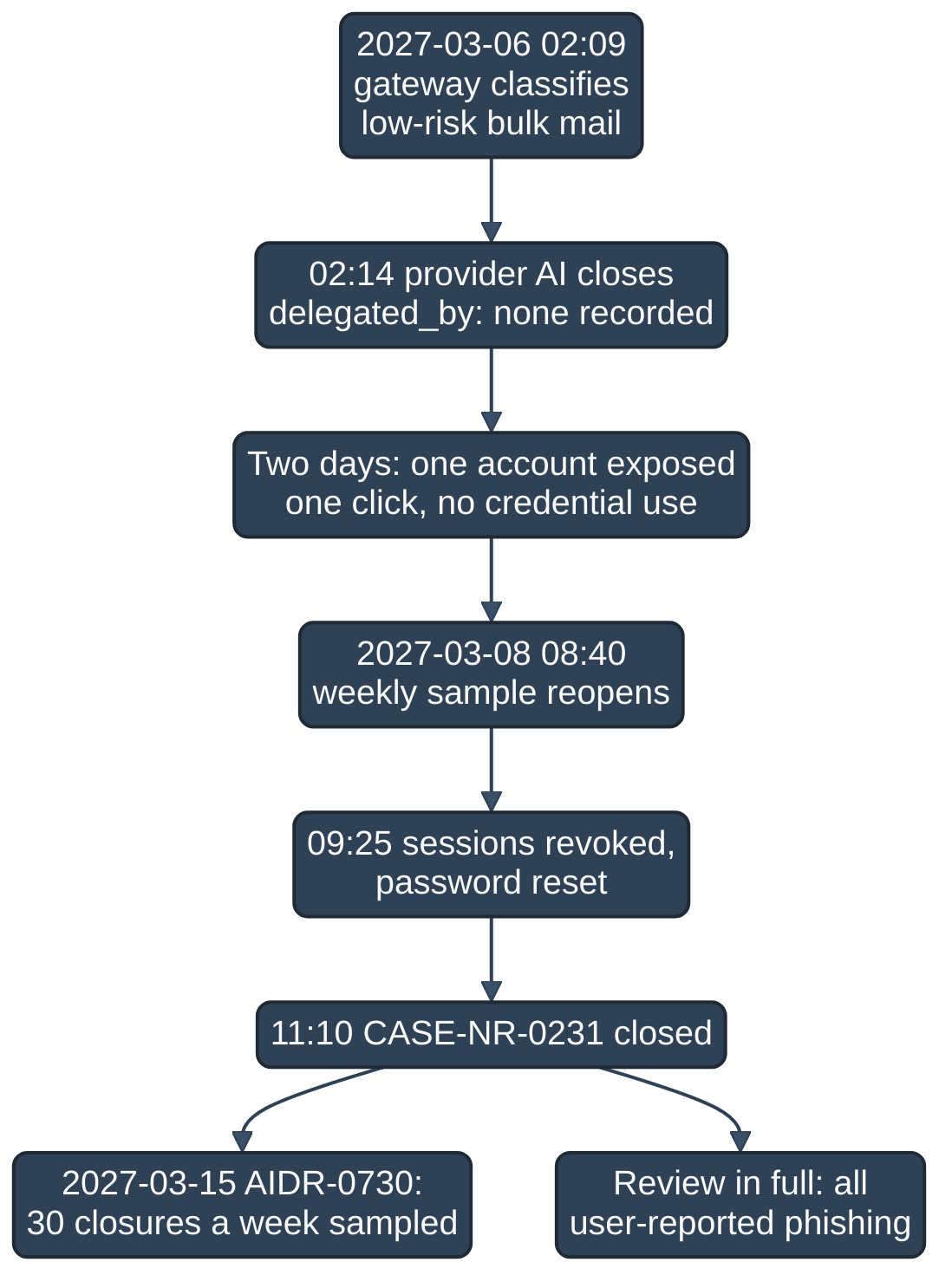
Figure 14.1: CASE-NR-0231, 6 to 8 March 2027, and the two rules that followed. All times illustrative.
Timeline
| Date | Event |
|---|---|
| Autumn 2026 | After the July 2026 incident and ATA-NR-2026-01, the regional director asks the CISO; AIDR-0700 dated 2026-11-23 |
| 2027-01-11 / 01-18 / 01-25 | Interim mandate letter; AIDR-0701; ROLE-NR-SEC-01 |
| 2027-02-08 | DET-NR-0001 adopted; detection-drafting assistant at Level 1 the same week |
| 2027-03-06 to 03-08 | CASE-NR-0231 |
| 2027-03-15 | AIDR-0730: sample 30 closures a week or all; full review of user-reported phishing |
| 2027-03-22 / 03-29 | AIDR-0717; AIDR-0721 |
| First quarter | 7 of 9 seeded errors caught |
| 2027-04-06 | AIDR-0724 |
| 2027-05-10 | AIDR-0718 and AIDR-0720 |
| 2027-05-13 (Thursday 20:10) | First out-of-hours stop drill: provider paged in 3 minutes 50 seconds (requirement 5 minutes); the on-call manager could not put isolation into observe-only mode because the console role was missing; the deputy with the right was reached after 14 minutes; a repeat a week later took 6 minutes 40 seconds |
| 2027-05-25 | AIDR-0725 |
| 2027-06-09 | Exercise EX-NR-2027-01 |
| 2027-06-14 / 06-21 / 06-28 | AIDR-0719; AIDR-0726; AIDR-0732; the report is delivered two days before 2027-06-30 |
| 2027-07-01 | ROLE-NR-SEC-DET in force |
| 2027-09-06 | AIDR-0733 |
| 2027-10-12 / 10-14 | AIDR-0734; AIDR-0728 |
| 2027-11-15 | Horizon register review date |
| 2027-12-13 / 12-15 | AIDR-0735; final test AIDR-0737 |
Planned: plan period 2027-10-01 to 2029-09-30; MS-2 signed by 2028-03-31; re-test of AP-NR-SOC-01 on 2028-01-31; trainee in post by 2028-06-30; junior post funded 2028 (8, Nordqvist, 2026).
Figures
| Figure | Value |
|---|---|
| Posts | 14, six analysts; 15 after the trainee |
| Assumed load (illustration, not Region data, Chapter 3) | 600 alerts per day, 300 in staffed time against a capacity of 225 (1.3 times), 8 minutes per alert; "one alert in four" |
| Seeding | 7 of 9 caught (counted, not a rate) |
| Weekly sample | 30; after 26 weeks of 30, two reopened alerts and no significant incidents |
| On-call pages, third quarter | 37, of which 9 needed action |
| Unassisted share | 1 in 10 (AUS-NR-SOC-01) |
| Stop budgets | 10 minutes own (AIDR-0731); 15 minutes the provider's (MS-2); the first drill took 14 minutes to reach the deputy |
| Local rules | Of twelve, seven had an owner, a test and a review date at the end of the year |
| Protected time | 10 % for each analyst (AIDR-0725); trainee 20 % in the first year |
| On-call | One week in six (Chapter 21) or one week in five (AIDR-0734, Chapter 26) |
| Horizon register | Six trends; trigger "fewer than 12 owned detection records by 2028-06"; sampled reopen rate above 0.05 |
Across the usage modes
| Mode | Use at Nordvik | Delegation |
|---|---|---|
| Mode 0 Ambient AI | Provider AI closing alerts at night; email gateway classifier | Not delegated in any record; made visible by sampling and MS-2 |
| Mode 1 | Self-hosted assistant for alert data | Local-only rule for special-category data |
| Mode 4 | NR-SEC-001 triage assistant; NR-SEC-003 |
Level 1 Assisted; Level 0 Advisory |
| Mode 5 | None; no agent team | Excluded by the plan |
Across the degrees of delegation
| Function | Treatment at Nordvik |
|---|---|
| B1 Anticipate | Intelligence one hour a week; exposure prioritisation at Level 0 |
| B2 Detect | Region owns detection content; detection-drafting assistant at Level 1; detections taken over one by one |
| B3 Investigate | Case records under public access law; local-only rule for health data |
| B4 Respond | PBK-NR-ISOLATE-01; provider AI may isolate end-user workstations only (Level 3 Bounded in MS2-ISO); server, account and citizen-facing actions need a named person |
| B5 Learn | Seeding, weekly sample, drills, anti-patterns, trainee |
What the volume concludes for Nordvik Region
Chapters 26 and 27 conclude that documents must be written before they are needed; that errors are found by design (sample and drill) and not by accident; and that scale changes the shape of the problem, from volume in large organisations to dependence on a provider and on few people in a small one. A stop path that exists only on paper is "declared", not "verified". The plan PLAN-NR-BT-2027 has measures N1 to N6: two hunts a year, twelve rules owned, MS-2 signed (by 2028-03-31), stop drills, findings closed on re-test and the trainee. Three decisions go to management: make MS-2 a condition of renewing NR-2025-044 (accepting a re-tender), fund 2028 (a second maintainer and the trainee at 20 %), and accept the cost of two stop drills a year. The plan excludes an agent team and Mode 5 and sets no closure target; "it does not ask the provider to be better; it asks the provider to be visible" (Chapter 27). The final test on 2027-12-15 found the provider's closures "partly" shown and the provider stop "not_yet_shown" (Chapter 28) (8, Nordqvist, 2026).
Open threads
Gathered in Chapter 27.
- Local rules. The profile says "few local rules"; Chapter 26 gives twelve.
- Order of instruments.
DLG-NR-SEC-01v1.1.0 is dated 2027-03-22, yetPBK-NR-ISOLATE-01was in force in January. MS-2dates. Chapter 16 draft gives effect 2027-07-01; the correction is to sign by 2028-03-31, as Chapters 26 and 27 say. Chapter 26 describes the negotiation on model-change notice as unfinished. Chapter 10 says thatMS-2will make levels visible "until it is in force". At the end of the volume the status ofMS-2is undecided.- On-call rota. One week in six (Chapter 21) against one in five (AIDR-0734, Chapter 26).
- Stop budgets. 10 minutes, 15 minutes and 14 minutes are three distinct numbers; the profile explains them as different measures.
- Karin Lund's role. Chapters 21 and 23 say she does not mentor; Chapters 17 and 26 say she holds the converted post. AIDR-0713 (the conclusion) has a lower number than AIDR-0716 but a late date.
- Trainee. Appointment depends on vetting and pay scale.
Summary
In AI Blue Nordvik Region is the hybrid blue team that buys its night and must create what it lacks: a detection owner, an owned set of rules, a practised stop path and an entry post. The facts are a unit of 14 with six analysts, the NR-2025-044 framework, annexes MS-1 and MS-2, a provider AI at Mode 0 that closes alerts without a recorded delegation, and a record series from AIDR-0700 to AIDR-0737. The illustrative year shows the weaknesses (CASE-NR-0231, a drill that took 14 minutes to reach a person with the right) and the remedies (a weekly sample of 30, seeded errors, a requirement list for MS-2). The conclusions are three: own the few things that decide quality, make the rest visible through the contract, and keep the stop path practised. The open items are gathered in Chapter 27.
Sources
- Nordqvist, G. AI Blue: How Artificial Intelligence Transforms the Blue Team in European Enterprises and Public Authorities. (8, Nordqvist, 2026)