The Real Counterparts: Method and Evidence
Nordvik Region is fictional. No external source can establish a fact about it, and none is used for that purpose in this book: every fact about the Region comes from the fourteen volumes of the series. This chapter does the reverse. It gathers what public sources say about real organisations of the same kind, so that Chapter 26 can judge whether the fiction is plausible. It states the question, the criteria and the method, names the comparators and why they were chosen, and sets out the facts found, each with its source and the date on which the source was read. Nothing in this chapter is a fact about Nordvik Region, and none of the facts about Nordvik Region in the volumes is taken from the organisations named here. They appear only as comparators (AI Governance, Chapter 1) (2, Nordqvist, 2026) (AI Leader, Chapter 1) (11, Nordqvist, 2026).
All external sources in this chapter were fetched and read on 2026-11-16, the date of writing, and the six or more most important figures were checked a second time against the primary document (annual reports and the supervisor's decision) and not against summaries. Where a figure could not be confirmed it is not used, and Section "What could not be established" lists the gaps.
The question and the criteria
The question is narrow: is the fiction plausible? Plausible means that a reader who knows the real counterparts would find the scale, the structure, the use of AI, the supervision and the incidents of Nordvik Region within what such organisations show. It does not mean that Nordvik Region is accurate, because there is nothing to be accurate about. A fictional fact can be plausible and untrue, and the check cannot make it true.
Eight dimensions were chosen before any source was read, so that the sources could not choose the dimensions.
| Dimension | What is compared |
|---|---|
| Scale | Residents, staff, staff per 1,000 residents |
| Mandate | What the organisation is responsible for in law |
| Financial assistance | Whether a regional body handles needs-based assistance, and the national volume |
| Case volume | Applications per month against national statistics |
| AI use and governance | Strategy, policy, pilots, assistants, risk descriptions |
| Supervision | Which authorities supervise, what they have done, what is proposed |
| Security and incidents | Security organisation, outsourced services, reported incidents at suppliers |
| Teams | Size of platform and security functions |
Three rules govern the evidence. A figure is used only if it was read on the fetched page or document. A figure the author of this chapter computed from two source figures is marked as a calculation. A comparison of unlike measures (employees, average employees, annual work units) is made in order of magnitude only, because the regions report staff in different ways.
Selection of the comparators
The mandate of Nordvik Region is unusual. The profile states that it is responsible for regional health and social-care coordination, regional development and public transport, and that it administers needs-based financial assistance on behalf of its municipalities, with about 6,000 employees and about 450,000 residents (AI Governance, Chapter 1) (2, Nordqvist, 2026). The series keeps the member state unnamed. Several volumes nevertheless describe arrangements that follow a Swedish pattern, such as a national co-determination regime and a national transposition of NIS 2 (AI Operations, Chapter 23) (10, Nordqvist, 2026) (AI Developer, Chapter 22) (12, Nordqvist, 2026). That is why the comparators are Swedish regions, for which public annual reports in the original language were available for the year 2025. This does not make Nordvik Region Swedish, and nothing below says it is.
Four regions were chosen because they were the closest in resident numbers for which a complete annual report for 2025 could be read, and because each shows something about AI.
| Region | Why chosen |
|---|---|
| Region Uppsala | Closest in residents; regional public transport authority and regional development role; an AI centre being established in 2026 and an AI Act compliance process. |
| Region Jönköpings län | Mid-sized; a clear annual report with staff counted on 31 December; an AI competence group. |
| Region Halland | Mid-sized; explicit work on AI assistants and simple AI agents; a risk description for AI. |
| Region Örebro län | Smaller than Nordvik Region, but the one for which a decided AI strategy, a Copilot pilot and a procured security operations centre could all be read. |
No comparator matches the mandate. These regions run hospitals and primary care as their largest activity, and none of the four annual reports read for this chapter describes the handling of needs-based financial assistance as a regional task; a search of the Uppsala, Halland, Örebro and Jönköping reports for the term returned nothing relevant. In the country whose statistics are used, financial assistance is handled by the municipalities. Whether a regional body handles it anywhere in the Nordic countries could not be established, and Danish regions and Finnish wellbeing services counties were not read, because primary sources for them were not retrieved in time. The comparison of the mandate is therefore a comparison with the closest real thing and not with a twin.
The four regions in numbers
The table gives the facts read in the annual reports for 2025. Amounts are in millions of kronor (mnkr). The ratios in the last two rows are calculations by the author of this chapter.
| Fact | Uppsala (17, Region Uppsala, 2026) | Jönköping (18, Region Jönköpings län, 2026) | Halland (19, Region Halland, 2026) | Örebro (20, Region Örebro län, 2026) |
|---|---|---|---|---|
| Residents | 410,676 | 369,935 (1 November) | 346,090 | 308,357 |
| Staff measure | 13,808 employees | 11,812 employees (31 December) | 9,247 average employees | 11,311 annual work units (group, 31 December) |
| Operating income | 8,268 mnkr | 3,292 mnkr | 2,843 mnkr | 17,100 mnkr total income |
| Operating costs | 23,377 mnkr | 17,786 mnkr (excluding depreciation) | 16,188 mnkr | not stated in this form |
| Result for the year | 449 mnkr | 188 mnkr | 433 mnkr | 679 mnkr |
| Staff per 1,000 residents (calculation) | 33.6 | 31.9 | 26.7 | 36.7 |
| Cost per resident (calculation) | about 56.9 thousand kronor | about 48.1 thousand kronor | about 46.8 thousand kronor | about 55.5 thousand kronor (income basis) |
Three notes follow from the table. First, the staff measures differ and the ratios are comparable only in order of magnitude: the real regions employ between 27 and 37 people per 1,000 residents. Second, the Uppsala report gives 14,461 for the regional group against 13,808 for the region, and states that 8,769 of its 13,093 permanent staff work at the university hospital (17, Region Uppsala, 2026); the hospital is therefore the largest single part of the workforce. Third, a staff figure per resident means little without the hospital, and Section "Reading the numbers" returns to that.
Other facts in the same reports bear on the series. Region Uppsala is governed by a regional assembly of 101 members that met five times in 2025, runs a traffic and community development committee that is the regional public transport authority and partly responsible for the regional development strategy, adopted a policy for digitalisation, IT and AI in June 2025, has a process for compliance with the EU AI Act and planned and recruited during 2025 for an AI centre to be established in 2026. It also lists the risk of interruption in critical operations through weaknesses in IT security as a material risk and formed a security and preparedness department with four units in 2025 (17, Region Uppsala, 2026). Region Jönköpings län describes preparedness, protective security, IT security and information security as a continued high priority and names a region-wide group for data-driven development and an AI competence group (18, Region Jönköpings län, 2026). Region Halland states that it has "accelerated its focus on AI and information-driven tools such as AI assistants and simpler AI agents", has begun an AI assistant for equality and child-impact assessments, has new hardware infrastructure for AI that so far serves research, and lists security risks, discrimination risks and ethical risks of AI together with a need for ethical guidelines, rules and limits (19, Region Halland, 2026). Region Örebro län decided to establish a security operations centre "responsible for improving the region's cyber security status and preventing, identifying and responding to threats", has a procured centre being introduced, carried out a Copilot pilot in autumn 2025 that continues in 2026, has a guideline for AI chatbots at work, and is introducing an AI tool for coding supplier invoices; its service committee points to "a large number of more or less unmanaged IT solutions" as a risk (20, Region Örebro län, 2026). Its regional board decided the AI strategy on 2025-01-29, and the strategy applies to all activities (21, Region Örebro län & regionstyrelsen, 2025).
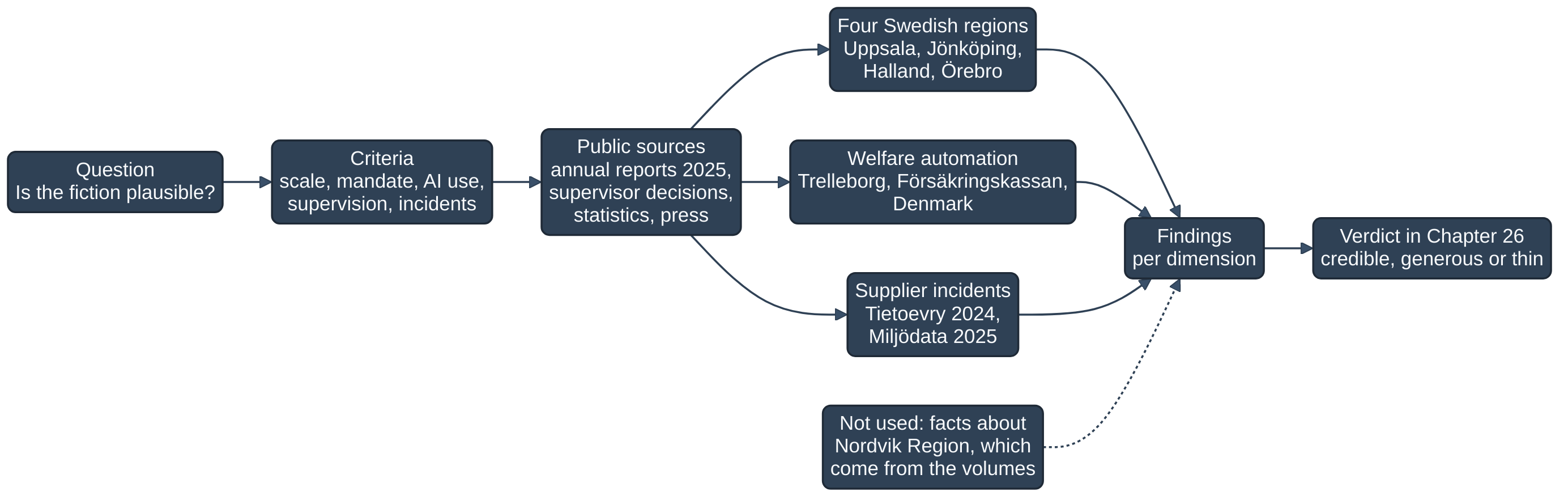
Figure 25.1: The method of the credibility check. Public sources feed three groups of comparators; their findings are set against the eight dimensions, and Chapter 26 gives the verdict. Facts about Nordvik Region enter only from the volumes.
Financial assistance: the national picture
Needs-based financial assistance (ekonomiskt bistånd) is the part of the mandate that has no regional counterpart in the sources. The national statistics page of the National Board of Health and Welfare states that around 142,000 households received financial assistance at some point during 2025. The page does not state the number of applications (31, Socialstyrelsen, 2026). The calculation in Chapter 26 therefore compares the volume of applications in the series with the number of households in the real country, which are different units, and says so.
Algorithmic support and automation in assistance and benefits
Three real cases bear on the one system that makes Nordvik Region a deployer of a high-risk AI system: the ranking of applications for assistance, with a caseworker deciding each one (AI Governance, Chapters 8 and 10) (2, Nordqvist, 2026). They are cited as reference points for design and oversight. They are not models for Nordvik Region.
Trelleborg. AlgorithmWatch reported in March 2020 that the municipality of Trelleborg had, about three years earlier, become the first municipality to introduce fully automated decision-making in its social services, and that the "Trelleborg model" was introduced in Kungsbacka in 2018. The software handled about one in three reapplications, and decisions that previously could have taken two days could be reached in less than a minute. In Kungsbacka 12 of 16 social workers left their work in protest (22, Lind & AlgorithmWatch, 2020). The sources read are from 2020 and describe the situation then; the present state was not established.
The Swedish Social Insurance Agency. Amnesty International reported on 27 November 2024, on the basis of an investigation by Lighthouse Reports and Svenska Dagbladet, that the agency had used a machine-learning system since at least 2013 that gave applicants risk scores. According to the report it flagged women, people with a foreign background, low-income earners and people without a university degree disproportionately, and the applicants with the highest scores were investigated automatically by the agency's fraud controllers. The Inspectorate for Social Security had concluded in 2018 that the algorithm in its design then did not meet equal treatment, which the agency disputed (23, Amnesty International, 2024). The Authority for Privacy Protection (IMY) opened supervision in June 2025 of the agency's risk-based selection for temporary parental benefit. The agency answered on 5 September 2025 that it had used a machine-learning risk profile and had taken it out of use a little over a month earlier, and IMY closed the case on 2025-11-18 (IMY-2025-11828) because the processing it had intended to examine had ceased. The decision does not rule on whether the use was lawful (24, Integritetsskyddsmyndigheten (IMY), 2025).
Denmark. Amnesty reported on 12 November 2024 that the Danish agencies Udbetaling Danmark and ATP use up to 60 algorithmic models to flag people for possible benefit-fraud investigation. Amnesty's research suggested that the system functions as social scoring under the AI Act and should therefore be prohibited; Udbetaling Danmark rejected that assessment (25, Amnesty International, 2024). The statement is Amnesty's and is disputed by the agency; the chapter reports it as such.
What the three cases share is that the ranking or scoring step is not the dispute. The disputes concern what follows from the score: automatic decisions in Trelleborg, automatic referral to control in the Social Insurance Agency, investigation in Denmark. Nordvik Region's design, in which the system ranks and the caseworker decides, with a blind sample and override alarms, is a milder one than all three, and Chapter 26 treats it that way (AI Governance, Chapters 10 and 23) (2, Nordqvist, 2026).
Governance and supervision of AI in the public sector
Four public sources describe the setting in which a real regional body works.
| Source | Fact read |
|---|---|
| National guidelines (29, Integritetsskyddsmyndigheten (IMY), 2025) | Issued by the Agency for Digital Government (Digg) and IMY, launched in January 2025, covering management and accountability, cyber security, the GDPR, ethics, labour law and procurement. |
| Government report on agencies' AI use (28, Regeringskansliet, 2025) | Published 2025-10-24; 25 agencies reported. Copilot is mentioned for the Institute for Economic Research, the Legal, Financial and Administrative Services Agency, the Post and Telecom Authority (a pilot alongside ChatGPT) and the National Board for Consumer Disputes. |
| Proposed supervision under the AI Act (30, Setterwalls Advokatbyrå, 2025) | SOU 2025:101 proposes the Post and Telecom Authority as the coordinating market surveillance authority and single point of contact; the complementary law is intended to apply from 2026-08-02; administrative fines and reprimands could be directed at authorities. Whether the proposal has been enacted could not be established. |
| The regional annual reports above (17, Region Uppsala, 2026) (19, Region Halland, 2026) (20, Region Örebro län, 2026) | Policy, strategy, pilots and an AI Act compliance process; no regional report read mentions a fundamental rights impact assessment or registration in the EU database. |
The AI Act provisions that the series applies to Nordvik Region are as the volumes state them: a ranking of applications for essential public assistance benefits falls under Annex III point 5(a), and the Region, as deployer and public body, has duties under Articles 26, 27 and 49 (AI Governance, Chapters 1 and 10) (2, Nordqvist, 2026). They are cited here only to show which obligations the comparison concerns. The text of those articles was not re-read for this chapter, and nothing in it is legal advice. No procurement framework for generative AI by the central purchasing bodies could be found on the pages read, so the contract pattern of Nordvik Region could not be compared with a real framework agreement.
Incidents at suppliers
Two real incidents show the type of event that hits public bodies that depend on shared suppliers.
| Incident | Facts read |
|---|---|
| Tietoevry, January 2024 (27, Martin & The Record from Recorded Future News, 2024) | A Swedish data centre of Tietoevry was partly hit by ransomware (Akira), discovered on a Friday evening, which the article dated 22 January 2024 places on 2024-01-19. The payroll and HR service Primula, used by most universities and more than 30 government agencies, was affected; the State Service Centre, which handles payroll for nearly 170 agencies, is a customer. The article gives no confirmed count of agencies affected. |
| Miljödata, August 2025 (26, Paganini & Security Affairs, 2025) | Detected on Saturday 2025-08-23; the supplier serves about 80 percent of Swedish municipalities with HR and rehabilitation systems; over 200 municipalities were affected; IMY had received about 70 incident reports; police said the attackers demanded 1.5 bitcoin. The article does not say which regions were affected or how many individuals. |
In both, a shared supplier of HR or operations platforms disrupted many public bodies at once, and HR data is among the most sensitive a body holds. The pattern, not the particular event, is what the credibility check uses.
What could not be established
The following were looked for and not found, and are not used in Chapter 26 as findings.
- Any regional body that handles needs-based financial assistance, and the number of applications for it anywhere.
- Team sizes of IT, platform or security functions in the regions; the four reports give organisational facts (a preparedness department with four units, a procured security operations centre) but no head counts.
- Costs of licences or per-document costs of AI assistants in a real region.
- Red teaming in regions; the Örebro report supports only the procurement of a security operations centre.
- Framework agreements for generative AI at Swedish central purchasing bodies.
- Danish regions and Finnish wellbeing services counties.
- The present state of the Trelleborg model, and whether the SOU 2025:101 proposal has been enacted.
Summary
The comparison rests on four Swedish regions of 308,000 to 411,000 residents, three real welfare-automation cases, four public sources on governance and supervision, and two supplier incidents, all read on 2026-11-16, with the main figures verified against the primary documents. The real regions employ between 27 and 37 people per 1,000 residents and run hospitals as their largest activity, they are at the stage of strategies, policies, pilots and a first AI centre, and none of them handles financial assistance. The welfare cases agree that the contested step is what follows a score. The incidents show shared suppliers as the usual source of simultaneous disruption. These are the book's own conclusions from the evidence gathered, and they are carried into Chapter 26 together with the gaps listed above.
Sources
- Nordqvist, G. AI Governance: Governing Artificial Intelligence in European Enterprises and Public Authorities. (2, Nordqvist, 2026)
- Nordqvist, G. AI Operations: How Artificial Intelligence Transforms IT Operations in European Enterprises and Public Authorities. (10, Nordqvist, 2026)
- Nordqvist, G. AI Leader: How Leadership Roles Change When AI Is Used Broadly in European Enterprises and Public Authorities. (11, Nordqvist, 2026)
- Nordqvist, G. AI Developer: How the Developer Role Changes When AI Is Used Broadly in European Enterprises and Public Authorities. (12, Nordqvist, 2026)
- Region Uppsala. Årsredovisning 2025. (17, Region Uppsala, 2026)
- Region Jönköpings län. Årsredovisning 2025. (18, Region Jönköpings län, 2026)
- Region Halland. Årsredovisning 2025. (19, Region Halland, 2026)
- Region Örebro län. Årsredovisning 2025. (20, Region Örebro län, 2026)
- Region Örebro län, regionstyrelsen. AI-strategi. (21, Region Örebro län & regionstyrelsen, 2025)
- AlgorithmWatch. Central authorities slow to react as Sweden's cities embrace automation of welfare management. (22, Lind & AlgorithmWatch, 2020)
- Amnesty International. Sweden: Authorities must discontinue discriminatory AI systems used by welfare agency. (23, Amnesty International, 2024)
- IMY. Beslut efter tillsyn: Försäkringskassan (IMY-2025-11828). (24, Integritetsskyddsmyndigheten (IMY), 2025)
- Amnesty International. Denmark: AI-powered welfare system fuels mass surveillance. (25, Amnesty International, 2024)
- Security Affairs. 200 Swedish municipalities impacted by a major cyberattack on IT provider. (26, Paganini & Security Affairs, 2025)
- Recorded Future News. Tietoevry ransomware attack. (27, Martin & The Record from Recorded Future News, 2024)
- Regeringskansliet. Myndigheters AI-användning ökar. (28, Regeringskansliet, 2025)
- IMY. National guidelines for generative AI in public administration are launched. (29, Integritetsskyddsmyndigheten (IMY), 2025)
- Setterwalls. A brief update on Sweden's adaptations to the AI Act (SOU 2025:101). (30, Setterwalls Advokatbyrå, 2025)
- Socialstyrelsen. Statistik om ekonomiskt bistånd. (31, Socialstyrelsen, 2026)