Book 2, AI Governance: The Foundations
AI Governance is the volume in which Nordvik Region first appears, and every later volume builds on what it fixes: the legal setting, the three Mode 4 systems, the benefits-triage decision chain, the first inventory, the supplier requirements and the governance bodies. This chapter gathers those facts so that a reader who has not read the volume can use them. It draws on AI Governance alone (2, Nordqvist, 2026); the later volumes that change or contradict it are named where they do, and Chapter 27 collects the disagreements. The profile of the organisation is established. The worked-example records, identifiers and figures that the volume labels as illustrative are marked so in the tables, and the dates after November 2026 are illustrative fiction.
The volume in brief
AI Governance argues that AI governance succeeds when it can be run, checked and proved: governance as code, with policies that execute, registers that are queried and evidence that is produced as a by-product of work. It sets out the usage modes from Mode 0 Ambient AI to Mode 5 Autonomous production agents, the risk classification under the AI Act, the decision records (AIDR), the governance bodies and the roles, and it ends with a conclusion for each of its two organisations and a comparison of them. Its method is to take every chapter's subject and show how it plays out for Nordvik Region and for Hansa Mutual in a short subsection of that name placed before the Summary (2, Nordqvist, 2026).
The role of Nordvik Region in the volume
Nordvik Region is the volume's buyer and deployer. It is a regional public authority in a Nordic member state of the European Union, with about 6,000 employees and about 450,000 residents, responsible for regional health and social-care coordination, regional development and public transport, and it administers needs-based financial assistance on behalf of its municipalities. It works under one legal order, but one with demanding public-law duties: the duty to give reasons, the right to be heard, case handling by an accountable official, public access to documents, archives law and public procurement law (Directive 2014/24/EU as transposed). Its central system is a procured benefits-triage system that ranks applications for financial assistance by urgency while a caseworker decides every case (AI Governance, Chapter 1) (2, Nordqvist, 2026).
The volume uses Nordvik Region as the contrast to Hansa Mutual, which builds, operates in seven jurisdictions and runs Mode 5 agents. Nordvik Region's difficulty is the depth of its public-law duties and not their number. Two theses follow from that position and run through the volume: for an organisation that mostly buys, the lever is the contract, and the main risk is to residents' rights and to public trust, together with supplier lock-in (AI Governance, Chapters 1 and 7) (2, Nordqvist, 2026).
The legal setting is as follows.
| Instrument | What it means for the Region |
|---|---|
| AI Act, Annex III point 5(a) | The benefits-triage system is high-risk (access to essential public assistance benefits). |
| AI Act, Articles 26, 27 and 49 | Deployer duties, fundamental rights impact assessment and registration as a public-authority deployer. |
| AI Act, Articles 4 and 50 | AI literacy; transparency for the assistants. |
| GDPR, Article 6(1)(e) and Article 9 | Public-task legal basis; special-category data in health and social care. |
| National administrative law | Duty to give reasons, right to be heard, accountable official. |
| Public-access and archives law | Public registers and minutes; retention of AI-generated notes, drafts and transcripts. |
| Directive 2014/24/EU | Procurement; the tender is where the leverage sits. |
| NIS 2 as transposed | Applies to the extent regional government entities fall within scope. |
What the volume establishes
The estate and the usage modes
The volume gives the Region three Mode 4 systems, a narrow use of Mode 3 and a prohibition of Mode 5. The usage-mode register usage-modes/nordvik-region.yaml, version 2026.11.1, is reviewed every 90 days, and the policy states modes_not_permitted: [5]. Mode 3 is limited to a small platform team (AI Governance, Chapters 2 and 23) (2, Nordqvist, 2026).
| System | Mode | Risk class | Provider and hosting | Records |
|---|---|---|---|---|
| Benefits-triage system with the claims ranker | 4 | High-risk (Annex III point 5(a)) | TriageSoft (fictional), tender NR-2026-117, run in the Region's regional data centre |
AIDR-0007, AIDR-0011, AIDR-0018, FRIA-2026-002, EUDB-DEP-2026-004213 |
| Internal staff assistant | 4 | Not high-risk | Open-weight model at a European cloud provider, contract NR-2026-031, EEA only, customer-held keys |
AIDR-0211, portfolio entry UC-2026-061, use-case descriptor UCD-2026-022 |
| Citizen-service assistant | 4 | Transparency duty (Article 50) | Open-weight models, prompt citizen-service/v7 |
AIDR-0014 |
| Correspondence classifier | 4 | Not stated | Fine-tuned open-weight classifier | AIDR-0042 |
| Case-note summariser for 180 social-services caseworkers | 4 | Not stated | On premises, because of special categories | UC-2026-017, legal mandate LM-2026-009 |
| Code agent of the platform team | 3 | Not stated | Head of Platform is owner | NR-UC-017 |
| Ambient AI in licensed software | 0 | Not stated | Suppliers | Usage-mode register |
The first inventory in 2026 found eleven AI services in use, three of them without review. An origin and hosting policy was adopted the same year, and its approval matrix is published together with the algorithm register (AI Governance, Chapter 6) (2, Nordqvist, 2026). The register entries are NR-UC-001, NR-UC-004, NR-UC-017, NR-UC-020 and NR-UC-021.
The benefits-triage system
The system is provided by TriageSoft under tender NR-2026-117, which had 22 questions, some marked mandatory. It runs in the Region's regional data centre and handles about 40,000 applications a month. The claims ranker is retrained quarterly by the provider on the Region's own case register inside the Region's platform, so applicants' personal data does not leave the authority. The system ranks; the caseworker decides, which is how the volume fits the system to administrative law. The volume concludes that oversight has to be a designed mechanism and not a hope: a blind sample, both override-alarm limits and a stop that returns the queue to date order (AI Governance, Chapters 10 and 23) (2, Nordqvist, 2026).
The Head of Benefits Unit owns the system (ROLE-AI-OWNER, instance INV-0042). The owner may stop it and may not change the evaluation thresholds, which are set by model risk (AI Governance, Chapters 8, 12 and 14) (2, Nordqvist, 2026).
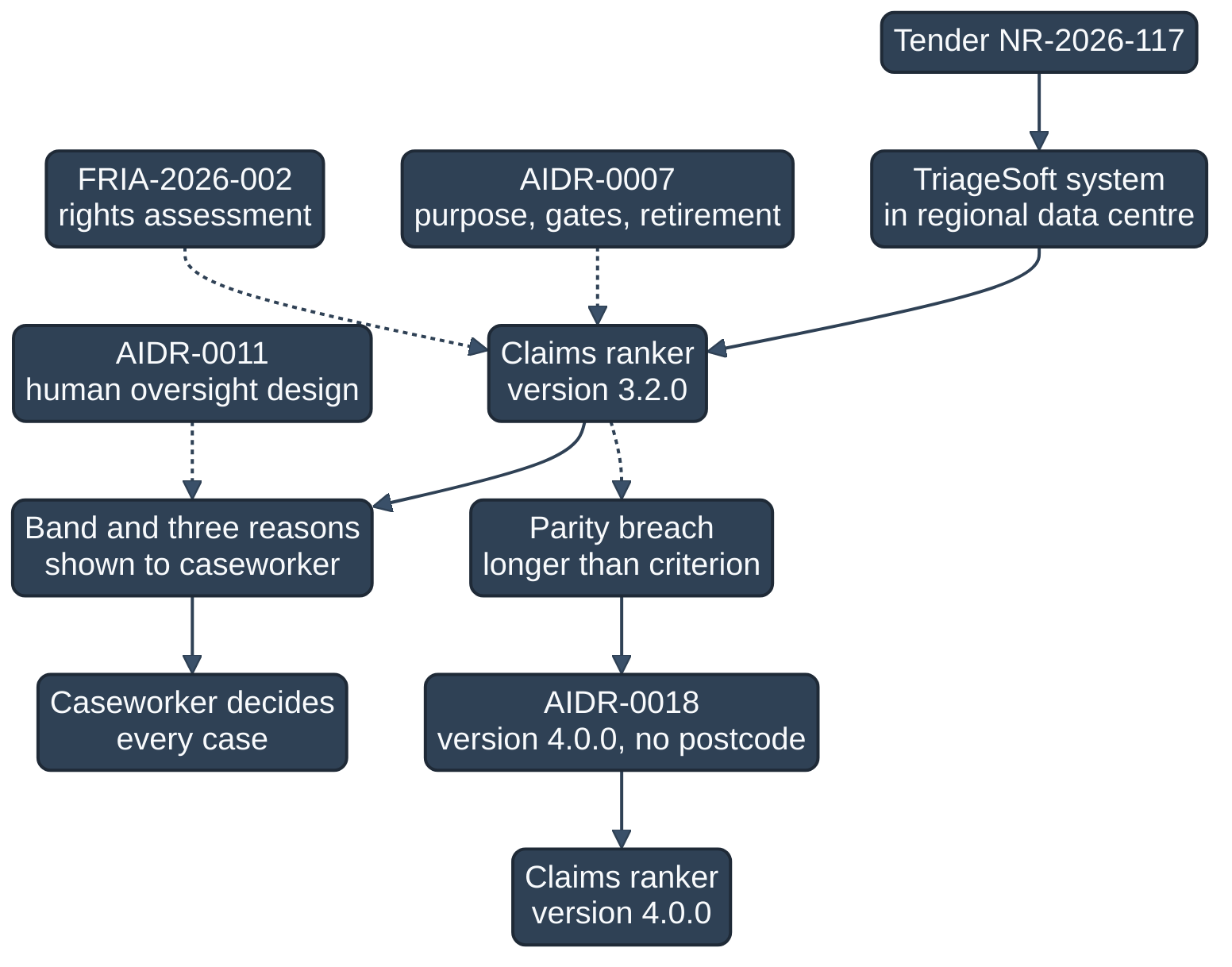
Figure 8.1: The benefits-triage decision chain. The tender and the system sit on the left; the three records bind the ranker; AIDR-0018 replaces version 3.2.0 with 4.0.0 after a parity breach. Records and identifiers are those of the volume.
Data, retention and suppliers
The data standard STD-AI-002 version 1.3 sets the rule by data class. Public data may be used in any approved tool. Internal data only in the Region's tenant nordvik-eu. Confidential data only in the staff assistant, with pseudonymised logs retained for at most 183 days (the text says "six months"). Sensitive data in no system without a data protection impact assessment and a system-specific approval. Supplier terms require no training on customer data and processing in the EU or EEA (AI Governance, Chapter 9) (2, Nordqvist, 2026). The retention schedule names AI-generated notes, drafts and transcripts explicitly (Chapter 17).
Contract requirements, adopted as a result of the origin analysis, oblige a supplier to name all subprocessors, to report requests from authorities as far as the law allows, and to give 180 days' notice before a model version is withdrawn (AI Governance, Chapter 6) (2, Nordqvist, 2026). The service agreement with Eastby Municipality, SA-AI-2026-007, shows the Region as a platform provider to municipalities: log retention of at least 180 days, 60 days' notice of a model change and logs delivered within five working days. The Region's digital service unit runs the AI platform for departments and offers it to municipalities as a service, and the customer remains deployer (Chapter 12).
Governance bodies and roles
The regional executive committee, made up of elected politicians, is the highest level, and its minutes are public. Unit heads are AI system owners; the Region has no agent operators and one part-time skills curator. The Article 4 literacy programme reaches about 6,000 employees in one language, with 45 minutes of AI-literacy training before access and an annual repeat. At least two trained oversight persons are required per high-risk system, and the oversight training is about nine hours over three weeks in five modules (AI Governance, Chapters 9, 13 and 14) (2, Nordqvist, 2026).
| Role | What the volume gives it |
|---|---|
| Regional Director | Approved AI governance policy v2.1 (2026-03-18); signs go-live for high-risk systems. |
| Chief Digital Officer | Owns the policy; owner of several register entries; owner of the staff assistant in the platform volume. |
| Chief Architect | Owns the principles (v1.2, 2026-05-14). |
| Head of Benefits Unit | AI owner of the benefits-triage system. |
| Director of Social Services | Senior responsible owner for living-support triage (NR-ALG-2026-003). |
| Head of Administrative Services | Benefit owner of the staff assistant (UC-2026-061). |
| Head of Payroll Services | Owner of the retired travel-expense scoring. |
| Head of Platform | Owner of the Mode 3 code agent NR-UC-017. |
| Head of Digital Services | Signed UCD-2026-022. |
| Head of Benefits Operations | Business owner of the intake use case UC-2026-017. |
| Head of Internal Audit, DPO, model risk, legal counsel | Control and challenge functions. |
| Caseworker team leaders, senior caseworker | Oversight, stop and Article 26(2) duties. |
The only person-level identifier is a caseworker team leader recorded anonymously as NR-EMP-20417 in a competence record (AI Governance, Chapter 14) (2, Nordqvist, 2026).
Decisions and records
The volume's decision records for Nordvik Region fit together as a chain. AIDR-0007 states the purpose of the benefits-triage system, its fairness thresholds and its retirement criterion. AIDR-0011 designs the human oversight (oversight design v1.2). AIDR-0018 records the replacement of the model by version 4.0.0 after a parity breach that lasted longer than the retirement criterion of AIDR-0007; it was handled as a planned decision with a shadow period and an updated impact assessment. Other records are AIDR-0211 (staff assistant: choice of model origin and hosting, prompt, changes routed to the data protection officer), AIDR-0042 (the fine-tuned classifier for incoming correspondence), AIDR-0014 (citizen-service assistant), AIDR-0002 (the reference-architecture overlay) and AIDR-0188 (the 0.70 threshold for living-support triage) and AIDR-0203 (replacement of the travel-expense scorer) (AI Governance, Chapters 17, 19, 21 and 23) (2, Nordqvist, 2026).
| Record | Subject | Status in the volume |
|---|---|---|
| AIDR-0007 | Benefits-triage v3.2.0: purpose, thresholds, retirement criterion | Illustrative |
| AIDR-0011 | Human oversight design v1.2 | Illustrative |
| AIDR-0018 | Replacement by v4.0.0 without postcode features | Illustrative |
| AIDR-0211 | Staff assistant: origin, hosting, prompt | Illustrative |
| AIDR-0042 | Fine-tuned correspondence classifier | Illustrative |
| AIDR-0014 | Citizen-service assistant, prompt citizen-service/v7 |
Illustrative |
| AIDR-0002 | Reference-architecture overlay | Illustrative |
| AIDR-0188 | Threshold 0.70 for living-support triage | Illustrative |
| AIDR-0203 | Replacement of the travel-expense scorer | Illustrative |
| FRIA-2026-002 | Fundamental rights impact assessment, benefits-triage | Complete 2026-06-20, notified 2026-07-02 |
| DPIA-2026-007 | Data protection impact assessment | Referenced |
| TP-AI-014, CTRL-OVR-001 | Audit test of the oversight control | Referenced |
| EP-2026-011 | Evidence pack, period 2026-09-01 to 2026-10-31 | Referenced |
| OVR-TRIAGE-101 | Oversight training module | Referenced |
| LM-2026-009 | Legal mandate for UC-2026-017 (2026-09-22) |
Referenced |
The register entries of the algorithm register are NR-ALG-2026-003 (living-support triage, the "claims ranker", with reasons log RL-2026-0481733 and EU database entry EUDB-2026-NR-00412), NR-ALG-2026-007 (consultation on the staff assistant) and NR-ALG-2026-009 (replacement of NR-ALG-2022-011, travel-expense scoring, whose planned retirement date is 2026-11-30). The volume's governance rules are that an unknown risk level is treated as high and that a waiver may never lift a prohibition, an impact assessment or human oversight. Commitments to staff representatives are written as controls with tests (C1 to C5); C4 has no automatic test, and the Region applied the high-risk information procedure voluntarily (AI Governance, Chapters 9, 15 and 21) (2, Nordqvist, 2026).
Events and figures
Events
The dates up to November 2026 belong to the profile; the 2027 dates are the volume's forward schedule and are illustrative.
| Date | Event |
|---|---|
| 2026 | First inventory finds eleven AI services, three unreviewed; origin policy adopted. |
| 2026-02-11 / 2026-02-18 | FRIA summary for NR-ALG-2026-003 complete / notified. |
| 2026-03-03 | Living-support triage in use. |
| 2026-03-18 | AI governance policy v2.1 approved. |
| 2026-04-01 to 2026-06-30 | Staged rollout comparison for the staff assistant. |
| 2026-04-03 | UCD-2026-022 signed; 2026-04-22 consultation agreement on the staff assistant signed. |
| 2026-05-12 / 2026-05-14 | Risk-classification questionnaire for benefits triage / principles v1.2. |
| 2026-06-01 | Staff assistant generally available. |
| 2026-06-20 / 2026-07-02 | FRIA-2026-002 complete / notified to the market surveillance authority. |
| 2026-08-28 | Deployer checklist last verified. |
| 2026-09-08 / 2026-09-22 | UC-2026-017 intake / LM-2026-009. |
| 2026-11-15 | 90-day plan approved. |
| 2026-11-19 | Committee paper on the staff assistant for 2027. |
| 2026-11-30 | Planned retirement of NR-ALG-2022-011. |
| 2026-12 | Re-test of parity (living-support); 2027-02 FRIA review. |
| 2027-03-31 | Review of the governance policy. |
| 2027-04-22 | First joint annual review of the staff assistant's commitments. |
| 2027-05-12 | Review due for benefits triage. |
| 2027-12-02 | Annex III requirements apply (Digital Omnibus, Regulation (EU) 2026/1744). |
The volume sets a roadmap NR-GOV-RM-2026 for 2026-11 to 2028-10, with a decision point in October 2027 ahead of 2028 (AI Governance, Chapters 9, 15, 16A, 17 and 23) (2, Nordqvist, 2026).
Figures
| Figure | Value | Status |
|---|---|---|
| Applications to benefits triage | About 40,000 a month | Established |
| Living-support applications | About 31,000 a year (FRIA summary) | Illustrative |
| FRIA-2026-002 groups | Incomplete digital records 18 %, paper applicants 9 %, households with children 41 %, limited language skills 22 %, protected identity under 1 % | Illustrative |
| Fairness gate | False-negative-rate gap at most 0.03 | Illustrative |
| Oversight persons trained | 6 of 6 | Illustrative |
| Oversight limits | At most 40 rankings an hour, at least 45 seconds a case, blind sample 5 %, override alarm 2 % to 30 %, stop to date order within 60 seconds, tested quarterly | Illustrative |
| Living-support model | Precision at queue capacity 0.64 against 0.21 for random selection; single parents flagged at 1.3 times; threshold 0.70; a flag gap above 1.25 times triggers review | Illustrative |
| Staff assistant time saving | 21.5 against 27.0 minutes per standard letter (measured); a staff survey reported larger savings (not counted) | Illustrative |
| Staff assistant quality | Second-line questions up 6 %; 91 % correct section link on 1,200 questions; 64 pilot reports gave 41 fixes and 15 corrected documents; comparison group about 800 | Illustrative |
| Champions | One per 40 to 60 employees, 4 hours a month | Illustrative |
| Consultation commitments | Logs deleted after 90 days; adoption reported for groups of at least ten | Illustrative |
| Review frequency | High-risk 6 months, limited 12, minimal 24 | Illustrative |
The staff assistant's 2026 budget is given in euro and every amount is illustrative: outcome EUR 395,000 against a ceiling of 440,000 (hosting and use 160,000, integration and support 170,000, evaluation and training 65,000), a 2027 ceiling of 480,000 with a forecast of 390,000 to 470,000, a cost of about EUR 2.30 per approved letter at the median and 4.10 at the ninetieth percentile, a stop rule if second-line questions run more than 10 % above 2026 for two months, and a reduced scope (letter writing only) that would save about EUR 60,000. The benefit counts only measured time; no cash saving is claimed and no posts are withdrawn (AI Governance, Chapters 10, 15, 16 and 16A) (2, Nordqvist, 2026).
Across the usage modes
| Mode | At Nordvik Region in the volume |
|---|---|
| Mode 0 Ambient AI | AI in licensed software; counted in the first inventory (a gap the plan closes). |
| Mode 1 Conversational assistants | Only through the approved enterprise tool. |
| Mode 2 Embedded workplace assistants | A controlled pilot of an embedded assistant. |
| Mode 3 Agentic work tools | A small platform team only (NR-UC-017). |
| Mode 4 Applications with AI | Benefits triage, staff assistant, citizen-service assistant, classifier, summariser. |
| Mode 5 Autonomous production agents | Not permitted by policy; not started without containment, a stop mandate, evaluation and a committee decision. |
What the volume concludes for Nordvik Region
Chapter 23 of the volume draws four conclusions. The lever is the contract: the volume finds no documented exercise of exit from TriageSoft, and a weak exit clause becomes lock-in for years. Oversight must be designed. Mode 5 is not started until containment, a stop mandate, evaluation and a committee decision exist. And the Region should work to a 24-month plan: an inventory that includes ambient AI, a test of the stop function, closure of the Article 26 evidence gap before 2027-12-02 and literacy for 6,000 staff (AI Governance, Chapter 23) (2, Nordqvist, 2026).
Open threads
The volume leaves several matters that other volumes later touch; Chapter 27 collects them.
- Open thread: two FRIA records. FRIA-2026-002 (complete 2026-06-20, version 1.0, notified 2026-07-02) is the benefits-triage assessment in Chapter 10; Chapter 17 describes a FRIA summary for
NR-ALG-2026-003(version 2, complete 2026-02-11, notified 2026-02-18) and a separate "lsb-triage" version 2.3.0, although the profile says the same claims ranker orders the living-support queue. Whether these are one system is unclear. - Open thread: what the caseworker sees: a band and three reasons (Chapters 10 and 25), an
urgency_score(the YAML of Chapter 10) or, in Chapter 17, no raw score. - Open thread: EU database identifier
EUDB-DEP-2026-004213(Chapter 9) againstEUDB-2026-NR-00412(Chapter 17); model version 3.2.1 in the inventory against 3.2.0 in AIDR-0007. - Open thread:
NR-UC-020gives the staff assistantai_act_role: provider, whileUCD-2026-022gives deployer; andNR-ALG-2026-007serves the staff assistant while the profile usesNR-ALG-2026-003for living support. - Open thread: waiver length: the policy allows at most 90 days, the escalation matrix up to 180 days for high-risk.
STD-AI-002retention is 183 days, while its text says six months. - Open thread: AIDR-0042 is a correspondence classifier in the profile and a fine-tuning pipeline in Chapter 19.
Summary
AI Governance gives Nordvik Region its foundation: one legal order with deep public-law duties, three Mode 4 systems, a prohibition of Mode 5, a high-risk benefits-triage system that ranks while a caseworker decides, and a chain of records (AIDR-0007, AIDR-0011, AIDR-0018, FRIA-2026-002) that every later volume reuses. The volume's own conclusion is that the contract is the lever and that oversight, exit and evidence have to be exercised and not merely written down. The unresolved items are mostly inconsistencies of identifier and version that do not change the picture but need a working value, which Chapter 27 records. The figures that matter later are the 40,000 applications a month, the 3,200 staff-assistant users, the 6,000-person literacy programme and the dates 2026-11-30 and 2027-12-02.
Sources
- Nordqvist, G. AI Governance: Governing Artificial Intelligence in European Enterprises and Public Authorities. (2, Nordqvist, 2026)