How Credible Is the Fiction?
Nordvik Region is fictional, and this chapter does not make it less so. It sets what the series says about the Region against what Chapter 25 found about real organisations of the same kind, dimension by dimension, and gives each a verdict: credible (inside the range the real counterparts show), generous (the fiction is more mature, larger or better resourced than the evidence shows for real organisations) or thin (the fiction is smaller than the real counterparts or lacks a component they have). The check is plausibility, not accuracy. A verdict of generous is not an error in the series: a case study may legitimately be more advanced than the average, so long as it says so. The comparators are named only as comparators; the volumes did not take any fact from them (17, Region Uppsala, 2026) (18, Region Jönköpings län, 2026) (19, Region Halland, 2026) (20, Region Örebro län, 2026). The series-side facts come from the volumes named in each row, and the evidence date of the external sources is 2026-11-16.
How to read the verdicts
Three rules keep the verdicts honest. First, a verdict rests only on a fact read in a cited source; where no source was found the verdict is "not verifiable" and the row says what would settle it. Second, the series-side figures carry the label the volume gives them: most 2027 to 2031 events and all budgets of the Region are illustrative, written in November 2026, and are judged for plausibility only. Third, a verdict on a dimension is not a judgement on the volume that states it; several of the findings below are already acknowledged as risks by the volume itself, and the table says so.
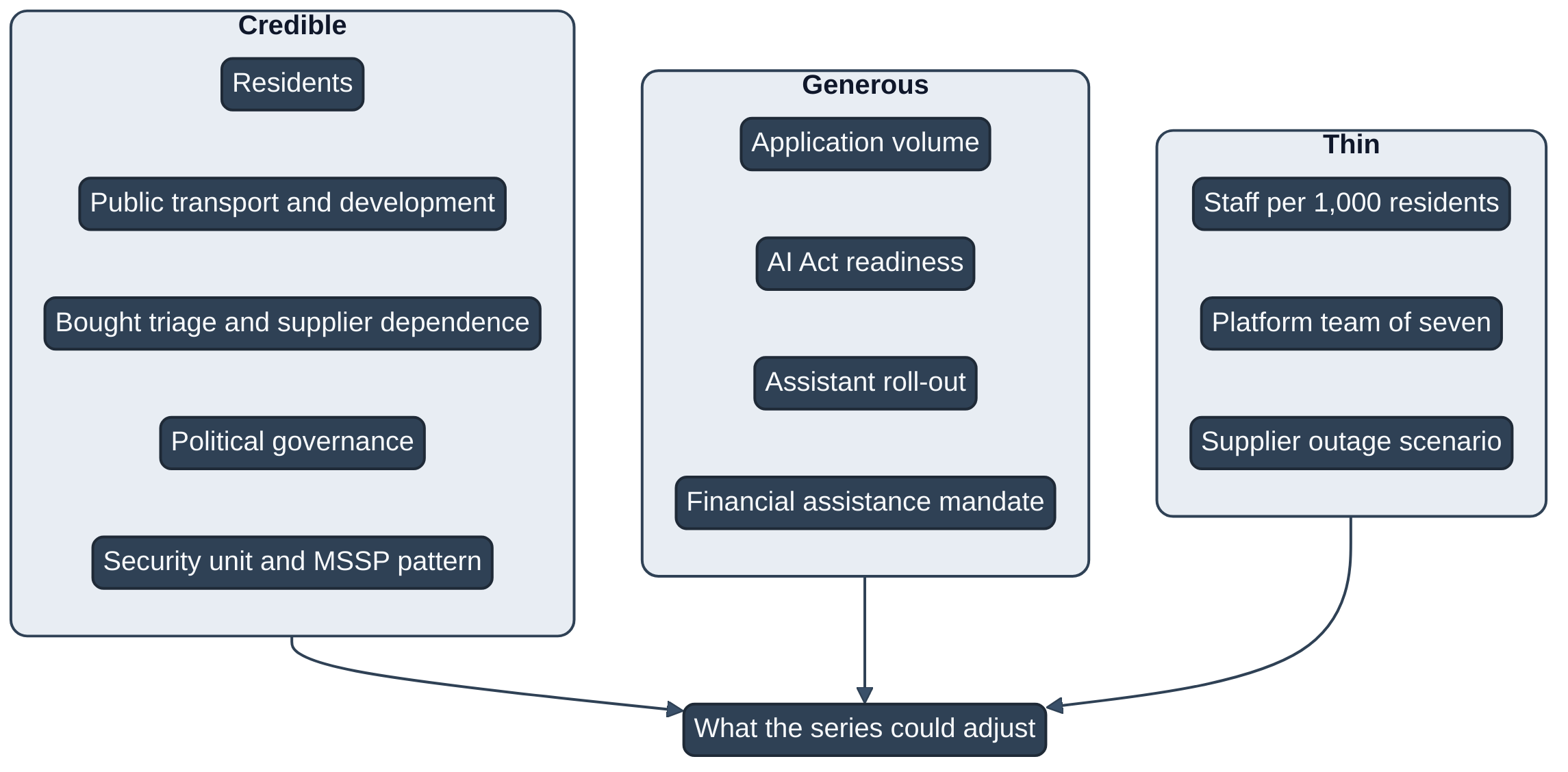
Figure 26.1: The verdicts of the credibility check, grouped. Rows are the dimensions of the table below; each group points to the adjustments the series could make.
The verdict table
| Dimension | What the series says (volume) | Real reference (cited) | Verdict | What the series could adjust |
|---|---|---|---|---|
| Residents | About 450,000 residents (AI Governance, Chapter 1) (2, Nordqvist, 2026) (11, Nordqvist, 2026) | Four regions with 308,357 to 410,676 residents (17, Region Uppsala, 2026) (18, Region Jönköpings län, 2026) (19, Region Halland, 2026) (20, Region Örebro län, 2026) | Credible | Nothing. Slightly larger than the largest comparator, inside the order of magnitude. |
| Staff | About 6,000, of whom about 1,900 on wards at two local hospitals, about 700 in primary care, about 1,100 in regional home care for five smaller municipalities, about 350 in public transport and about 1,950 in development, benefits, social services, digitalisation, security and central administration; specialist care bought from the neighbouring region's university hospital (7, Nordqvist, 2026) | 26.7 to 36.7 staff per 1,000 residents in the four regions (calculation from the annual reports); the Uppsala university hospital alone has 8,769 permanent staff (17, Region Uppsala, 2026) | Thin | Nordvik Region has about 13 staff per 1,000 residents (6,000 divided by 450,000, calculation). At the real ratios the figure would be about 12,000 to 16,500. The profile of the first volume, which says "coordination", should state that the Region runs two local hospitals and primary care but buys specialist care, so that the low ratio explains itself. |
| Mandate: health and social care | "Coordination" of health and social care in the profile (AI Governance, Chapter 1) (2, Nordqvist, 2026); two hospitals, primary care and home care are run by the Region in the profile of a later volume (7, Nordqvist, 2026) | The regions run hospitals and primary care as their largest activity (17, Region Uppsala, 2026) | Thin as a coordination mandate; credible as a hospital-running region | Choose one wording. The volumes disagree on whether the Region coordinates or runs; Chapter 27 records the open thread. |
| Mandate: transport and development | Public transport and regional development; transport operation procured, about 350 staff in planning, traffic control and customer service (7, Nordqvist, 2026) | The regional public transport authority and the development strategy sit in a committee of Region Uppsala (17, Region Uppsala, 2026); Region Halland has an operating committee for public transport (19, Region Halland, 2026) | Credible | Nothing. |
| Mandate: financial assistance | The Region administers needs-based financial assistance on behalf of its municipalities; a service agreement with Eastby Municipality, SA-AI-2026-007, shows the Region as a platform provider to municipalities (AI Governance, Chapters 12 and 23) (2, Nordqvist, 2026) |
No real region handles financial assistance in the sources read; the national statistics describe a municipal task (31, Socialstyrelsen, 2026); the Trelleborg case is a municipality (22, Lind & AlgorithmWatch, 2020) | Generous (atypical) | State the legal basis: a delegation, a joint arrangement or a purchase of administration by the municipalities. Without it the mandate has no anchor, but nothing in the real sources excludes it. |
| Application volume | About 40,000 applications a month, which is 480,000 a year (calculation) for the benefits-triage system; about 31,000 a year for the living-support triage in its fundamental rights summary (AI Governance, Chapters 17 and 23) (2, Nordqvist, 2026) | About 142,000 households in the whole real country received assistance during 2025; applications are not stated (31, Socialstyrelsen, 2026) | Generous | 480,000 applications a year is about 3.4 times the number of households receiving assistance in the whole real country (calculation). Either the unit is not an application for assistance (partial decisions, supplements, renewals) or the figure is too high. The two figures in the same volume also differ by a factor of about 15 (calculation). Define "application" and reconcile the figures; or lower the figure. |
| Ranking with a human decision | The system ranks; the caseworker decides every case; blind sample, override alarms and stop to date order (AI Governance, Chapters 10 and 23) (2, Nordqvist, 2026) | Trelleborg: software handled about one in three reapplications (22, Lind & AlgorithmWatch, 2020); Social Insurance Agency: highest scores sent to control automatically (23, Amnesty International, 2024); Denmark: up to 60 models flag people (25, Amnesty International, 2024) | Credible, and milder than the real cases | The series should say that the design is a deliberate and milder one, and why. It already does in the oversight design; no change to the facts. |
| Bought triage and supplier terms | Product bought from TriageSoft under tender NR-2026-117; retrained quarterly inside the Region's platform; no documented exit exercise (AI Governance, Chapters 7 and 23) (2, Nordqvist, 2026) |
Danish agencies refused an external review of code and data (25, Amnesty International, 2024); source code of the Trelleborg system was ruled a public document (22, Lind & AlgorithmWatch, 2020) | Credible | Nothing; the missing exit exercise is the series' own finding. |
| Staff assistant roll-out | General availability on 2026-06-01; about 2,400 and then about 3,200 users of 6,000 staff; open-weight model at a European cloud provider (AI Governance, Chapters 15 and 16A) (2, Nordqvist, 2026) (11, Nordqvist, 2026) | Örebro ran a Copilot pilot in autumn 2025 that continues in 2026 (20, Region Örebro län, 2026); Halland describes assistants and simple agents (19, Region Halland, 2026); four state agencies piloted or tested Copilot (28, Regeringskansliet, 2025) | Generous in extent, credible in kind | Half of the staff within a year of the real pilots is advanced. Say that Nordvik Region is an early adopter, and keep the measured basis (measured drafting time, no cash saving) that already sets it apart. |
| Assistant cost | Illustrative 2026 outturn of EUR 395,000 against a ceiling of EUR 440,000; about EUR 2.30 per approved letter at the median (AI Governance, Chapter 16A) (2, Nordqvist, 2026) | No real licence or per-document cost found | Not verifiable | Keep the label illustrative. The figure is about EUR 123 to 165 per user per year at 3,200 to 2,400 users (calculation), which a reader can test against real price lists. |
| AI Act readiness | A fundamental rights impact assessment (FRIA-2026-002) completed 2026-06-20 and notified 2026-07-02; EU database identifier EUDB-DEP-2026-004213; the high-risk duties applied voluntarily early (AI Governance, Chapters 9 and 10) (2, Nordqvist, 2026) |
Uppsala has a process for compliance with the AI Act (17, Region Uppsala, 2026); no region read mentions an assessment or registration; the Swedish supervision law was only proposed (30, Setterwalls Advokatbyrå, 2025) | Generous | Describe the assessment and registration as early and voluntary, with the dates on which the series says the duties apply, and name the authority notified. Two inconsistent identifiers for the same registration are an open thread (Chapter 27). |
| Supervision | Market surveillance, data protection and procurement supervision; public minutes (AI Governance, Chapter 1) (2, Nordqvist, 2026) | A proposed coordinating authority and sanctions on authorities (30, Setterwalls Advokatbyrå, 2025); a supervisory case at the Social Insurance Agency closed because the processing had ceased (24, Integritetsskyddsmyndigheten (IMY), 2025); national guidelines (29, Integritetsskyddsmyndigheten (IMY), 2025) | Credible | Nothing. A reader should not be led to expect that supervision of public deployers has already produced decisions on the merits. |
| Political governance | A regional executive committee at the top, with public minutes; a council of 61 members (AI Governance, Chapter 13) (2, Nordqvist, 2026) (11, Nordqvist, 2026) | Uppsala: an assembly of 101 members; Örebro: the regional board decided the AI strategy on 2025-01-29 (17, Region Uppsala, 2026) (21, Region Örebro län & regionstyrelsen, 2025) | Credible | Nothing. |
| Security organisation | A security unit of 14, six analysts in office hours, night watch from a European managed security provider under NR-2025-044 (6, Nordqvist, 2026) (8, Nordqvist, 2026) |
Uppsala formed a department with four units in 2025; Örebro procured a security operations centre (17, Region Uppsala, 2026) (20, Region Örebro län, 2026) | Credible in pattern; size not verifiable | No head counts were found. The pattern of a small in-house unit and a bought night watch matches the evidence. |
| Platform team | Seven platform engineers in an IT unit of about 85, no site reliability function, carrying Mode 3 tools and a regional cloud (10, Nordqvist, 2026) (12, Nordqvist, 2026) | No real team size found | Not verifiable, and thin on the series' own reading | The volume names "seven engineers are not enough" as a trigger. Keep it, and make the load visible: the number of services, on-call weeks and tools per engineer. |
| Bought red teaming | No internal red team; an annual penetration test and a contracted tester under call-off NR-2026-071 (9, Nordqvist, 2026) |
The Örebro report supports the procurement of a security operations centre only (20, Region Örebro län, 2026) | Not verifiable; credible by analogy | Nothing to change. |
| Supplier incidents | A DNS fault at the national shared-service supplier made the e-services unreachable for 70 minutes (INC-NR-2027-0298); the triage supplier changed ranking before the announced window in 2028 (10, Nordqvist, 2026) |
Tietoevry 2024: payroll and HR for most universities and more than 30 agencies (27, Martin & The Record from Recorded Future News, 2024); Miljödata 2025: HR and rehabilitation systems of over 200 municipalities (26, Paganini & Security Affairs, 2025) | Credible, with a gap | The real incidents hit HR and payroll platforms. The series has a national HR and payroll framework supplier but no incident on it. An HR-platform outage would test the leadership and people volumes the way the DNS fault tests operations. |
| Total budget | The IT unit about EUR 38 million a year (illustrative); no total budget for the Region (10, Nordqvist, 2026) | Operating costs of 16,188 to 23,377 mnkr in the four regions | Not verifiable | Add an illustrative total, so that the IT share can be judged. |
Reading the numbers
Three findings carry most weight.
The first is the staff figure. A reader who meets 6,000 employees and 450,000 residents in AI Governance takes the Region to be a coordinating authority. A reader of AI Boss learns that it runs two local hospitals, primary care and home care, which makes it one of the large employers of the real regions' kind, with a workforce far below theirs. The reconciliation is in the volumes: specialist care is bought from the neighbouring region's university hospital, and a university hospital is what makes the real regions large. The verdict "thin" is therefore a finding about presentation as much as about size, and the adjustment is a sentence in the profile (7, Nordqvist, 2026).
The second is the volume of applications. This is the one dimension where the series and the evidence cannot both be right unless a definition is added. The national statistics count households, the series counts applications, and the ratio of 3.4 between the series' yearly applications and all real households is too large to be explained by renewals alone; it would require that every household in the whole country applied more than three times a year to a single region of 450,000 residents. The living-support figure of about 31,000 a year in the fundamental rights summary is of a plausible order. The two figures in the same volume differ by a factor of about 15 and cannot both describe the same population (AI Governance, Chapters 17 and 23) (2, Nordqvist, 2026) (31, Socialstyrelsen, 2026).
The third is the AI Act readiness. The series is written in November 2026 and states that the Annex III duties apply from 2027-12-02 under the Digital Omnibus; it also states that the Region applied them early. The real regions read are at the stage of policies and compliance processes (17, Region Uppsala, 2026). The Region is therefore ahead of the real counterparts by design, which is acceptable if it is labelled as such.
Across the usage modes
The comparison differs by mode. The real regions show Mode 0 and Mode 1 (ambient features, enterprise assistants) and the beginning of Mode 4 (assistants, a coding tool for invoices) (19, Region Halland, 2026) (20, Region Örebro län, 2026). The series places the Region at Mode 4 for three systems and Mode 3 for one team.
| Mode in the series | Real evidence | Verdict |
|---|---|---|
| Mode 0 Ambient AI in licensed software | Vendors add AI to products; the state agencies' reports and the regions mention tools | Credible |
| Mode 1 and Mode 2 enterprise assistant and pilots | Örebro Copilot pilot in autumn 2025 (20, Region Örebro län, 2026); state agency pilots (28, Regeringskansliet, 2025) | Credible |
| Mode 3 agentic tools for a small team | Halland names simple AI agents (19, Region Halland, 2026) | Credible, limited evidence |
| Mode 4 three production systems, one high-risk | Assistants in Halland; no real regional ranking of assistance applications | Generous |
| Mode 5 autonomous production agents | None; the Region prohibits it in its policy | Not applicable |
What the series could adjust
The adjustments follow from the table and are proposals for the author, not changes made by this book. A change to a volume is made in that volume's repository.
- State in the first volume's profile that the Region runs two local hospitals and primary care and buys specialist care, so that the staff figure can be read.
- Name the legal basis on which a region handles financial assistance for its municipalities, and define "application" for the triage figure; reconcile 40,000 a month with 31,000 a year.
- Describe the early application of the AI Act duties as voluntary, with the dates, and make the two registry identifiers consistent.
- Add an illustrative total budget for the Region.
- Add an HR or payroll platform outage to the incident record, drawing on the national framework supplier already named.
- Keep the platform team's size and the security unit's size as stated, and make the load visible, because no real head counts could be found to support or challenge them.
Summary
Of eighteen dimensions, six are credible without reservation, two are credible with a qualification (the security organisation by pattern, and the supplier incidents with a gap), four are generous (application volume, the financial assistance mandate, the staff assistant roll-out and AI Act readiness), two are thin (staff per 1,000 residents and the coordination wording of the mandate) and four are not verifiable because no public figure was found (assistant cost, platform team size, bought red teaming and total budget). The generous verdicts are those where the Region is ahead of the real counterparts, which suits a case study if it is declared. The thin verdicts arise from the way the profile is worded and are cured by a sentence. The one finding that needs a number to change is the application volume. These are the book's own conclusions from Chapter 25 and from the volumes; nothing in them is a fact about a real organisation beyond what the cited sources state, and none is a statement of accuracy about a fictional one.
Sources
- Nordqvist, G. AI Governance: Governing Artificial Intelligence in European Enterprises and Public Authorities. (2, Nordqvist, 2026)
- Nordqvist, G. The Transformed Security Architect: Role, Craft and Career in the Age of AI in European Enterprises and Public Authorities. (6, Nordqvist, 2026)
- Nordqvist, G. AI Boss: When Artificial Intelligence Manages People in European Enterprises and Public Authorities. (7, Nordqvist, 2026)
- Nordqvist, G. AI Blue: How Artificial Intelligence Transforms the Blue Team in European Enterprises and Public Authorities. (8, Nordqvist, 2026)
- Nordqvist, G. AI Purple: How Red and Blue Learn Together When AI Joins the Loop in European Enterprises and Public Authorities. (9, Nordqvist, 2026)
- Nordqvist, G. AI Operations: How Artificial Intelligence Transforms IT Operations in European Enterprises and Public Authorities. (10, Nordqvist, 2026)
- Nordqvist, G. AI Leader: How Leadership Roles Change When AI Is Used Broadly in European Enterprises and Public Authorities. (11, Nordqvist, 2026)
- Nordqvist, G. AI Developer: How the Developer Role Changes When AI Is Used Broadly in European Enterprises and Public Authorities. (12, Nordqvist, 2026)
- Region Uppsala; Region Jönköpings län; Region Halland; Region Örebro län. Årsredovisning 2025. (17, Region Uppsala, 2026) (18, Region Jönköpings län, 2026) (19, Region Halland, 2026) (20, Region Örebro län, 2026)
- Region Örebro län, regionstyrelsen. AI-strategi. (21, Region Örebro län & regionstyrelsen, 2025)
- AlgorithmWatch; Amnesty International; IMY. Welfare automation sources. (22, Lind & AlgorithmWatch, 2020) (23, Amnesty International, 2024) (24, Integritetsskyddsmyndigheten (IMY), 2025) (25, Amnesty International, 2024)
- Security Affairs; Recorded Future News. Supplier incident sources. (26, Paganini & Security Affairs, 2025) (27, Martin & The Record from Recorded Future News, 2024)
- Regeringskansliet; IMY; Setterwalls; Socialstyrelsen. Governance, supervision and statistics. (28, Regeringskansliet, 2025) (29, Integritetsskyddsmyndigheten (IMY), 2025) (30, Setterwalls Advokatbyrå, 2025) (31, Socialstyrelsen, 2026)