The Companions: Landscape and Tools
Two books of the series are companions and not numbered volumes: Landscape and Tools. Neither is a numbered volume, and the series does not depend on them. Landscape refers to Books 1 to 7 (cites_up_to: 7) and Tools to Books 1 to 13, and neither mentions Book 14, AI Environment, which appeared after both; the dossier therefore takes nothing about the footprint of the estate from them, and Chapter 19A takes it from the volume alone. Each uses Nordvik Region, and each gives it something the fourteen volumes do not: a single picture of its whole AI estate in Landscape, and a single account of the toolbox it would keep in Tools. This chapter sets out what each companion establishes about Nordvik Region, which of it restates the volumes and which is the companion's own modelling, and where the companions differ from the volumes or from each other. It draws on Landscape (15, Nordqvist, 2026) and Tools (16, Nordqvist, 2026), and through them on the volumes whose facts they restate.
The status of the facts needs care. Landscape renders everything about Nordvik Region from a landscape model and labels it illustrative; its year 2027 is a modelled scenario year in a book written in November 2026, not a forecast. Tools states that it adds no new facts to the profiles: every tool and identifier is quoted from Books 1 to 13, and the year in its Chapter 24 is illustrative, with an order the book proposes. Where this chapter gives a fact from a volume as restated in a companion, it says so. The companions are cited for what they say; for a fact about the organisation the volume that establishes it remains the authority, and Chapters 8 to 19 give that volume.
The two companions in brief
Landscape is a fact-based picture of architecture and AI at work, modelled on Hans Rosling's Factfulness. It offers a unified visual notation, Contour, nine instincts that distort how people read the landscape of AI in large organisations, a rule of thumb for each instinct, and a stance in which every statement about the future is labelled observable, expected or speculation. It draws the same landscape twice, for Nordvik Region and for Hansa Mutual, from two models that validate against one schema (15, Nordqvist, 2026).
Tools collects every tool that Books 1 to 13 describe, in four kinds (artefact, own tool, third-party tool and method), organised by activity. Each chapter of Parts II to VII ends with a subsection on Nordvik Region and Hansa Mutual. Its Chapter 24 follows both organisations through an illustrative year of building a toolbox and concludes that the order of a toolbox follows the gap and not the catalogue (16, Nordqvist, 2026).
| Landscape | Tools | |
|---|---|---|
| Kind | Companion, not a numbered volume | Companion, not a numbered volume |
| Form of the picture | One landscape per organisation, drawn in Contour from a model | One toolbox per organisation, chosen over a year |
| Nordvik Region's part | The cautious buyer: an authority under one jurisdiction, with no Mode 5 agent, mostly procured, whose lever is the contract | The cautious buyer: "buys under public procurement law", whose lever is contract and drill |
| Standing of its facts | All about Nordvik Region illustrative; year 2027 modelled | Facts quoted from the volumes; the year in Chapter 24 illustrative |
| New facts about Nordvik Region | A dated 2027 timeline, mark positions, strips, scale thresholds | None by its own rule; selection, order and omission as design |
| Where it appears most | Opening scene and counter-picture to Hansa Mutual, a worked case in each chapter of Part II and Part III | Chapter 24 and the closing subsection of Chapters 4 and 7 to 23 |
Both companions treat Nordvik Region as the organisation that is careful by position. It is an authority answerable to elected members, with limited budget and competence and a dependence on suppliers, and with the advantages of one regime and a tradition of openness. The companions use the profile of the volumes: about 6,000 employees and about 450,000 residents, a deployer of high-risk AI systems under Annex III point 5(a) of the AI Act for its needs-based financial assistance, and a platform team of seven (15, Nordqvist, 2026) (16, Nordqvist, 2026).
Landscape: the Contour notation
Contour draws one AI use, called a unit, as one mark with seven dimensions. The scales are fixed, and the dossier uses them exactly as the companion gives them (15, Nordqvist, 2026).
| Dimension | Drawn as | Scale |
|---|---|---|
| Autonomy level | Column | Level 0 Advisory to Level 4 Autonomous, per action class |
| Reversibility tier | Row | R1 Reversible at once, R2 with effort, R3 hard (weeks), R4 Irreversible |
| Reach | Size of the mark | S under 100, M 100 to 999, L 1,000 to 9,999, XL 10,000 or more people, not transactions |
| Usage mode | Colour | Mode 0 Ambient AI to Mode 5 Autonomous production agents |
| Identity | Shape | Circle for a person's identity, rounded square for an identity of its own |
| Control | Diamond and seat | Policy point (enforced, planned or none) and a decision seat: T1 user or operator, T2 system owner or architect, T3 executive or director, T4 board or elected body; T0 means no one is named |
| Evidence | Baseline | Solid for automatic evidence (logs, tests, gates), dashed for attested |
Three rules of drawing matter for reading the Nordvik Region landscape. A mark is drawn at the highest level of any action that changes something outside the unit, and at the hardest reversibility of those actions. A Level 3 unit without an enforced policy point is drawn with a red outline, as a Level 4 mark with a misleading label, a point taken from AI Red Team, Chapter 6. Reach counts the people touched in a year, so that a benefits system with about 40,000 claims a month is XL because of the residents it affects and not because of the number of transactions (15, Nordqvist, 2026).
Three frames arrange the marks (boundary, time and comparison), and six standard views are rendered from the model by the companion's own script: V1 the one-page landscape, V2 time, V3 supply and sovereignty, V4 decision rights, V5 evidence and V6 comparison (15, Nordqvist, 2026).
Nordvik Region in Landscape
The role of Nordvik Region
Landscape uses Nordvik Region in four ways. It is the opening scene and the counter-picture to Hansa Mutual in Part I. It appears in the closing subsection "Nordvik Region and Hansa Mutual" of each chapter in Part II, one instinct per chapter. It is the worked case of Part III: in Chapter 14 an AI architect draws the first landscape from registers, in Chapter 15 the time view follows the year with one track moving right, one moving left, two new and one retired, in Chapter 16 the supply view is drawn from contracts, and in Chapter 17 the evidence view makes the contract visible. Chapter 18 follows a modelled 2027 against Hansa Mutual, and Chapters 19 and 20 carry the architect's rostering proposal, the council's "rogue AI" question and the closing picture of 31 December 2027 (15, Nordqvist, 2026).
The persons are roles only. Landscape names no individual of Nordvik Region in its chapters. The roles that carry the model are the regional director, who receives the one-page landscape on 1 January 2027 and signed the acceptable-use policy for conversational assistants; the HR director, seat for rostering and recruitment screening; the Head of Benefits Unit, owner of the benefits-triage system; the head of digitalisation, the head of communications, the head of the registry and the head of social services, each the owner of one unit; the CISO, seat for the security units and for the agentic work tools under mandate manifest MND-NR-01; and the AI governance lead, owner of the inventory. A single security architect and an AI architect in the digitalisation unit appear in the worked cases (15, Nordqvist, 2026).
The units
Landscape has since changed in text and not in model: its current text corrects its Chapter 5 from thirteen to eleven units on 1 January, renamed the series from "The Architecture as Code Series" to "The Transformed Architecture", and left the models and the schema unchanged. The model for the year 2027 holds thirteen entries. Two of them, the SOC triage assistant and the exposure prioritisation, are marked planned on 1 January 2027, so the picture of that day has eleven marks. The table gives the model's state on 1 January 2027; "then" marks a change the model dates later in the year. Everything in it is illustrative and was rendered from the model, not observed.
| Id | Unit | Mode | Identity | Level | Tier | Reach | Policy point | Seat |
|---|---|---|---|---|---|---|---|---|
| NR-BT | Benefits-triage system (high-risk, Annex III 5(a)) | 4 | Own | 0 (rank the queue) | R3 | XL | Enforced | T2 Head of Benefits Unit |
| NR-SA | Internal staff assistant, with a casework variant | 4 | Person | 1 | R1 | L | Enforced | T2 Head of digitalisation |
| NR-CS | Citizen-service assistant | 4 | Own | 4 (answer a resident); 3 (escalate to a person) | R2 | XL | Enforced | T2 Head of communications |
| NR-CR | Correspondence classifier (fine-tuned open-weight model) | 4 | Own | 3 | R1 | L | Enforced | T2 Head of the registry |
| NR-CN | Case-note summariser (180 caseworkers; special category data) | 4 | Person | 1 | R2 | M | Enforced | T2 Head of social services |
| NR-SW | Rostering and shift allocation (high-risk, Annex III 4(b)); pilot | 4 | Own | 2, then 3 on 11 March | R2 | L | Planned, then enforced 20 January | T3 HR director |
| NR-TL | Recruitment screening pilot (high-risk, Annex III 4(a)); paused | 4 | Own | 1 | R3 | M | Planned | T3 HR director |
| NR-AMB | Ambient AI in licensed software | 0 | Own | 4 | R2 | L | None, then planned 30 June | T0, then T2 AI governance lead on 30 June |
| NR-EWA | Embedded workplace assistant (pilot) | 2 | Person | 1 | R1 | S, then M on 1 September | Planned, then enforced 1 September | T2 Head of digitalisation |
| NR-CA | Conversational assistants (enterprise tool; consumer endpoints blocked at the proxy) | 1 | Person | 1 | R1 | L | Enforced | T3 Regional director (acceptable-use policy) |
| NR-AWT | Agentic work tools (platform team and security architect) | 3 | Person | 2, then 1 on 1 May | R2 | S | Enforced | T2 CISO (MND-NR-01) |
| NR-SOC | SOC triage assistant (six analysts; self-hosted) | 4 | Own | 1 | R1 | S | Enforced | T2 CISO |
| NR-EXP | Exposure prioritisation (internet-exposed services) | 4 | Own | 0 | R1 | S | Enforced | T2 CISO |
The model carries the register identifiers of the volumes beside the marks, so that a mark can be traced back: NR-ALG-2026-003, AIDR-0007, AIDR-0011, AIDR-0018 and FRIA-2026-002 for the benefits-triage system; UC-2026-061 and AIDR-0211 for the staff assistant; AIDR-0014 for the citizen-service assistant; AIDR-0042 for the correspondence classifier; AIDR-0602, AIDR-0603, DLG-NR-ROS-01 and FRIA-2026-007 for rostering; AIDR-0601 for the paused recruitment pilot; MND-NR-01, AIDR-0511 and AIDR-0503 for the agentic work tools; NR-SEC-001 and AIDR-0301 for the SOC assistant; and NR-SEC-003 for exposure prioritisation. The start dates are 1 January 2026 for the benefits-triage system, 1 March 2026 for the staff assistant, 1 May for the citizen-service assistant, 1 June for the classifier and for the agentic work tools, 1 September for the case-note summariser and the workplace assistant, 1 October for rostering, and 1 April 2026 for the recruitment pilot, which was paused on 18 September 2026 (15, Nordqvist, 2026).
Reading the picture
The one-page landscape on 1 January 2027 is read in four sentences. No mark stands in the corner of Level 4 by R4, the corner of irreversible action at full autonomy. Two marks stand in the Level 3 column, the classifier and, from 11 March, rostering. The usage modes are distributed as one mark each in Modes 0, 1, 2 and 3 and seven in Mode 4, with none in Mode 5. One mark, the ambient AI in licensed software, has no seat; by 31 December 2027 every mark has one (15, Nordqvist, 2026).
The strips that summarise a landscape change over the year as follows.
| Strip | 1 January 2027 | 31 December 2027 |
|---|---|---|
| Filled policy-point diamonds | 7 of 11 | 11 of 13 |
| Marks with a named seat | 10 of 11 | 13 of 13 |
| Solid (automatic) evidence baselines | 6 of 11 | 8 of 13 |
| Mode 4 marks | 7 | 9 |
| Mode 5 marks | 0 | 0 |
The thirteen at year end includes the retired recruitment pilot, which stays on the time view as a hollow mark with a cross. The hollow diamonds on 1 January belong to rostering, recruitment screening and the workplace assistant, and four baselines are dashed: rostering, recruitment screening, the workplace assistant and the conversational assistants. The ambient AI has no baseline at all (15, Nordqvist, 2026).
The year 2027
The modelled year is a sequence of dated changes. It is the only account of Nordvik Region over 2027 that sets the changes against each other, and it is illustrative throughout. The events that the volumes themselves date in 2027 are in the chapters of Part III.
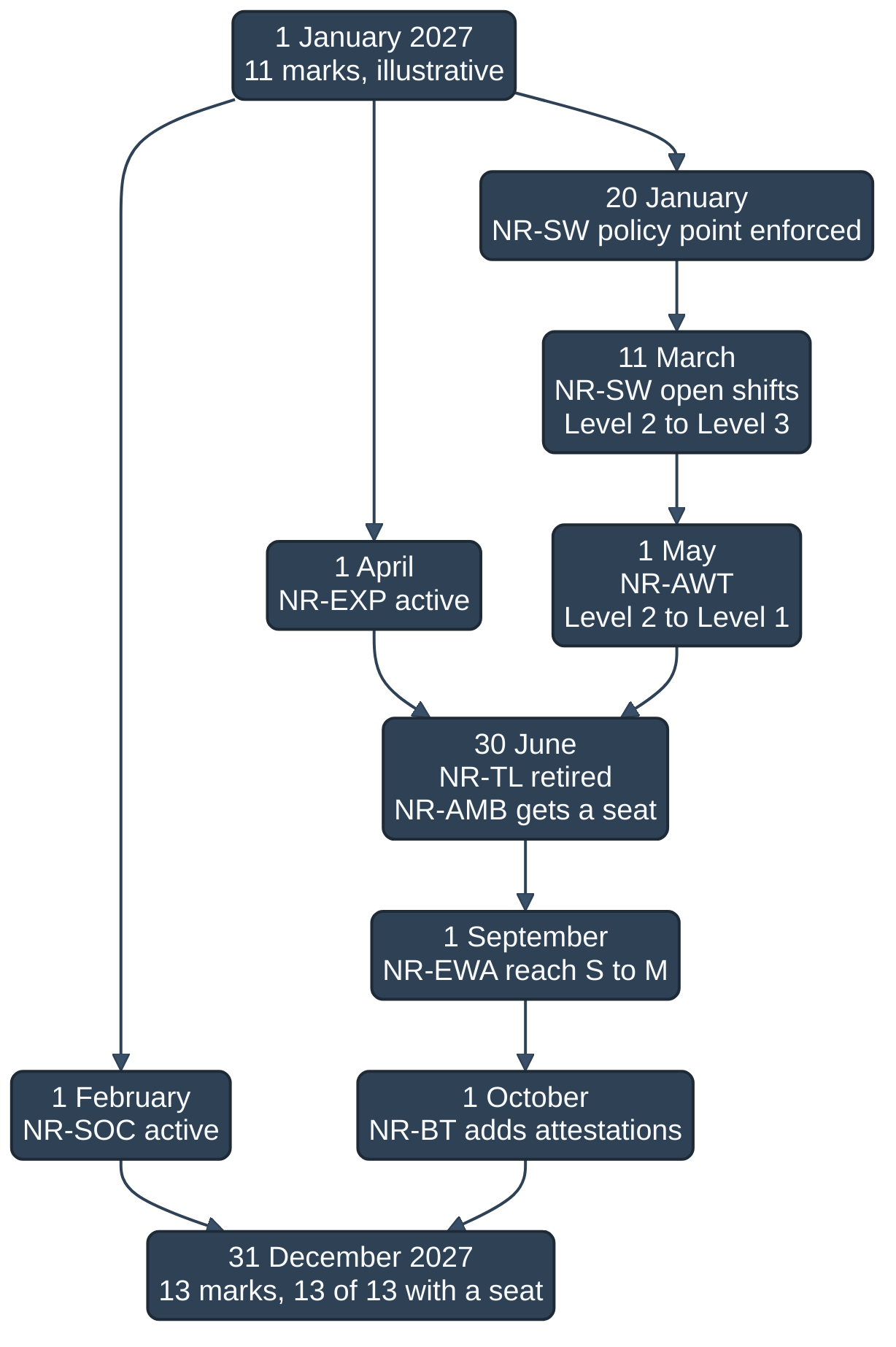
Figure 20.1: The modelled year 2027 of Nordvik Region in Landscape (illustrative).
| Date (2027) | Change | What the picture shows |
|---|---|---|
| 1 January | Eleven marks; the one-page landscape goes to the regional director | Empty corner, one mark without a seat |
| 20 January | Delegation profile DLG-NR-ROS-01 agreed with the unions; rostering policy point enforced; pilot becomes active |
The model's note on DLG-NR-ROS-01 now reads that the first daily routes follow in Strandvik home care on 25 January (earlier: routes live) |
| 1 February | SOC triage assistant active after the first cycle of the exercise programme | New mark, Level 1 |
| 11 March | Travel time and rest become hard conditions; open-shift offers rise from Level 2 to Level 3; evidence moves from attested to automatic | Policy point filled about seven weeks before the level rose |
| 1 April | Exposure prioritisation active | New mark, Level 0 |
| 5 to 16 April | Reversibility test: the Strandvik unit plans routes by hand for two weeks | Conditions met on 30 June |
| 1 May | Agentic work tools fall from Level 2 to Level 1; the security architect's mandate manifest (version 3.0.0) is aligned with the role charter's ceiling | The only track that moves left in either landscape |
| 30 June | HR director reports to the regional executive committee on the governance of algorithmic management; recruitment pilot retired; ambient AI gets a seat (AI governance lead) | Pilot stays on the time view as a hollow mark with a cross |
| 1 September | Workplace assistant pilot grows from S to M; tenant policies enforced and audit logs kept | Diamond filled |
| 1 October | Benefits-triage system adds attestations; external stop drill rerun within budget; supplier's evidence schedule in force | Baseline gains an attested layer |
| 2 December | Obligations for Annex III systems (Chapter III, Sections 1 to 3, Articles 26 and 27) apply under Article 113 of the AI Act as amended by Regulation (EU) 2026/1744; Article 49 is not named there | Labelled observable |
| 31 December | Thirteen marks, every one with a seat | Closing picture |
The reversibility test of April is the part of the year that tests what the picture claims. Strandvik planned its routes by hand for two weeks. The findings were that the deputy had never planned a route by hand, that the manual template lacked the travel-time rule, and that the departments' competence rules could not be exported from the system. The supplier's shift-swap function was frozen during the test, and the remedy was a managerial craft programme in which one week a month is planned by hand. The test affected no row of the roster, since none failed. The model holds no record of the test and gives no identifier for it, while the example profile gives RVT-NR-ROS-2027-01 as the identifier used in AI Boss (15, Nordqvist, 2026) (7, Nordqvist, 2026).
Supply, evidence and decision rights
The supply view V3 draws the boundary of the organisation and puts each unit in the container of its supplier. At the end of 2027 four marks stand within Nordvik Region's own boundary (the benefits-triage system, the case-note summariser, the correspondence classifier and exposure prioritisation), three in EU or EEA supplier containers and three in containers of non-EU suppliers. On 1 January the hosting count, excluding the two planned units, was three on own premises, three at European hosting providers, one at a European application supplier and four outside the EU. The model names the suppliers by role: the benefits-triage application (tender NR-2026-117), a European cloud provider (contract NR-2026-031, EEA only, customer-held keys), a Nordic hosting provider that reserves accelerators for open-weight models, a managed security service provider (framework agreement NR-2025-044), a rostering supplier (tender NR-2025-089), a payroll and HR system under a national framework agreement that no unit refers to, a recruitment screening supplier outside the EU, a global workplace suite with an EU region at a non-EU provider, an enterprise-tier general model provider outside the EU, and licensed software with vendor-enabled AI features (15, Nordqvist, 2026).
The evidence view V5 is where the contract becomes a picture. Four units rest on attestations alone and can therefore be documented only by the supplier's word. The lesson drawn is that attestation is not evidence, a point from AI Governance, Chapter 11, and that a hatched cell standing alone at R3 is the question to ask (15, Nordqvist, 2026) (2, Nordqvist, 2026). The decision-rights view V4 shows seats as names, and adds that a name is necessary and not sufficient, a conclusion that AI Boss, Chapters 4 and 33, develops (7, Nordqvist, 2026).
Lessons the model records
The companion draws a short set of lessons from the Nordvik Region landscape, and they are its own conclusions.
- Control before autonomy. The rostering policy point was filled on 20 January and the level rose on 11 March; a rise without an enforced policy point would have drawn the red outline.
- A track can move left. Autonomy is taken back when a charter sets a ceiling, as with the agentic work tools on 1 May.
- Retirement is a decision someone held. The recruitment pilot stays on the time view as a hollow mark with a cross until the decision to retire it on 30 June.
- The fear concerned the wrong mark. The council's "rogue AI" question led to the observation that Nordvik Region runs no Mode 5 agent and that the benefits-triage system sits at Level 0 but R3, so that what needs watching is the order of the queue.
- The lever is the contract. The tender fields are the model's fields, so that V3 can be drawn from the contract, and a stop path outside the supplier's system is a contract requirement.
- The blind spot has an owner. The ambient AI in licensed software had none until 30 June, when the AI governance lead was named after supplier-enabled features that process personal data had been inventoried and notice clauses requested.
Tools: the toolbox of a cautious buyer
The selection
Tools does not add to the profile; it selects from it. For each activity it records which tool Nordvik Region takes up and why, and describes the resulting toolbox as small, one that a team of seven and a team of six can keep current (16, Nordqvist, 2026). The table condenses the tools and records named for Nordvik Region; the identifiers are those of the originating volumes.
| Activity | Tool and Nordvik Region's reason | Identifiers |
|---|---|---|
| Inventory, tiering, decisions | AI inventory entry, risk tiering and AI Decision Record with retirement criteria; the first tool, because nothing else can be applied to a system the Region has not listed | AIDR-0007, AIDR-0011, AIDR-0018, AIDR-0211, EXC-NR-0007 (90-day exception on supplier key rotation) |
| Decision log | Validated front matter in a continuous-integration flow; accepted records are not edited, only superseded | AIDR-0002 |
| Reference architecture | Reduced form (gateway, registry, evaluation, control plane); the Region buys the training and feature machinery | AIDR-0018, AIDR-0014 |
| Obligations and controls | Obligation register, ten-entry control catalogue nordvik-controls, control test TP-AI-014 for the override control CTRL-OVR-001; a claim was withdrawn until retest because the portal failover failed |
RST-NR-2027-002, OQM-NR-ROS-01 |
| Policy engine | Rego policies extended one team at a time, from pilot to dashboard to expansion when the exception rate is healthy | AIDR-0501 (20 November 2026), EP-2026-011, CPP-NR-2026-01 |
| Change and restore | Agent drafts infrastructure but does not apply it; releases pushed in windows; read-only drift detector; runbooks at Level 2 with the duty manager's approval | CHG-NR-2028-0007 |
| Procurement | Sovereignty requirements profile; exit price in the option comparison | NR-2026-031, SECREQ-NR-2026-117, NR-2025-044, NR-2026-088, AIDR-1118, AIDR-1126 |
| Service records | Open-source observability in the Region's own cloud, deterministic correlation; supplier groupings accepted only after measurement on the Region's golden set | SLO-NR-002, AIDR-0906 |
| Threat modelling | Threat model as code, ATT&CK prioritisation starting with benefits triage and citizen service | PRI-NR-2028-01 (nine techniques) |
| Red teaming | Bought: a contracted tester, and no Mode 5 agent run against Nordvik Region systems | NR-2026-071, RoE-NR-2027-001, EMU-NR-2027-02, NR-SEC-002-C01 |
| Detection | Detection as code: a supplier rule taken into the repository first, then a benefit-payee Sigma rule; triage assistant at Level 1 | DET-NR-0001 (adopted 8 February 2027, AIDR-0701, alert budget 8 a week), NR-DET-0007, NR-SEC-001, DPD-NR-001 |
| Incident and recovery | Contract plus drill as lever; monthly drills and an annual exercise; AI incident record in use | NR-REQ-HOST-RC, RST-NR-2027-001 (pass), RST-NR-2027-002 (fail), INC-NR-2028-0163 |
| Verification | Coverage page with nine techniques (five tested, two provider-asserted, two untested); regression case; chaos programme with twelve experiment types | REG-NR-0004, NR-SEC-004, LOOP-NR-2028-01 |
| Capacity and cost | GPU capacity plan with renewal date, cost and latency budget; sustainability record that declares hosted energy use unavailable until measured | CAP-NR-AI-001 |
| Mandates and delegation | Writes down what cannot be enforced; runbook runner in Mode 4 under mandate, every executable class at Level 2 | NR-OPS-003, MND-NR-OPS-003 (AIDR-0916, from 14 November 2028), DRF-NR-001 (AIDR-0922), DLG-NR-ROS-01, DLG-NR-SEC-01, DLG-NR-DIR-01 |
| Observer and independence | Lightweight golden-set evaluation for the SOC triage; independence written into the supplier annex because the Region cannot instrument the supplier's service | EVAL-NR-SEC-001, PLAN-NR-OPS-2029-01, MS-2-IND-1, MS-2-IND-2 |
| Agent defence | No Mode 5; basic credentials first | AIDR-0918, CBR-NR-BEN-01, MND-NR-01 |
| Threat and evidence registers | Nine threat entries owned by the CISO, published under the principle of public access, with the controls of two in a confidential annex | THR-NR-01 to THR-NR-09, CRX-NR-2026-01, AIDR-0401, HZN-NR-BT-01, HZN-NR-PL-01, HZN-NR-OPS-01 |
| Roles and competence | Subsets of the group frameworks (SOC-CF-NR with 12 identifiers, OPS-CF-NR with 8); one post only for the security architect, so a deputy from the platform team and an external mentor |
ROLE-NR-SA-01 (AIDR-0500), CMP-NR-01, LP-NR-2027-01, ONC-NR-2029-01, MBL-NR-IT-2027-01 |
| Leadership (Book 11) | Ceiling before use: every class at Level 1 | DLG-NR-EXE-01 (AIDR-1002, 1 October 2029), BRD-NR-2029-01, MND-NR-LDR-01, DRR-NR-001, SPN-NR-2029-01, ROLE-NR-MGR-01 (AIDR-1016) |
| Development (Book 12) | Ceiling over practice: generate, refactor and test at Level 1, document at Level 2, review at Level 0 | DLG-NR-DEV-01 (AIDR-1101, 23 September 2030), NR-DEV-001 (AIDR-1102), MND-NR-DEV-01 (AIDR-1108, then AIDR-1116), ROLE-NR-DEV-01 (AIDR-1114) |
| Builders (Book 13) | Workspace, sandbox, secret store and scheduled-job template; tier sweep; builder lane | LANE-NR-2031-01, BREG-NR, AIDR-1200, AIDR-1201, AIDR-1203, MND-NR-BLD-2031-01 |
| People management (Book 7) | Small, sequenced tool set; ceilings stricter than the book's default; an appeal path forced by the first contest | DRF-NR-01 (AIDR-0607, 1 April 2027), AIDR-0631, AIDR-0629, DLG-NR-VAL-01 (AIDR-1025) |
Two details from the table are worth setting out. In the chapter on agent defence the problem found is basic: an automation account with production administrator rights whose key had been unchanged for 26 months. AIDR-0918 removed the standing credentials and gave each run a token of ten minutes, and the break-glass path was tested at nine minutes against a target of fifteen. In the chapter on recovery the benefits ranking was switched off at the Region's gateway in INC-NR-2028-0163, with 212 claims ranked and no decision taken on a changed ranking (16, Nordqvist, 2026).
The illustrative year
Tools Chapter 24 orders the toolbox in four quarters: know and decide in the first, map and gate in the second, buy and operate in the third, delegate at Level 2 in the fourth. The first quarter puts the AI inventory entry, tiering and decision record in place, with retirement within the quarter; the risk named is the model nobody retires, which is why AIDR-0018 carries retirement criteria. The second adds the obligation register with control mapping and extends the policy engine one team at a time. The third covers procurement tools and the service record. The fourth writes mandates and delegation profiles and the threat and evidence registers. The roadmap is illustrative, and the dated records of 2027 to 2032 are not placed in its quarters (16, Nordqvist, 2026).
The companion adds three measures that decide whether the toolbox works: the age of evidence, adoption, and retirements. Nordvik Region supplies the example of evidence that ages in front of the reader. The figure of 61 per cent weekly active use of the staff assistant (3,200 licences, sessions longer than a minute) was last checked in February 2029, so that its evidence is seven months old, and AIDR-1020 orders a new measurement by 30 November. The IDE pilot NR-DEV-001 has twelve developers, a 31 per cent acceptance rate and about four hours a week saved, from a survey with nine answers out of twelve, at an age of five months; the statement that work was "a third faster" had no measured lead time. The clocks of the series for Nordvik Region are 180 days for a Tier 1 restore test, 90 days for a delegation profile and 90 days for an exception (16, Nordqvist, 2026).
What Tools leaves out, on purpose
Omission is part of the design. Nordvik Region has no emulation agent, no Mode 5 agent and no continuous red teaming, and these would come back if the Region gave an agent write access to production. It adds no Level 3 tools before there is need for them. The companion also records two findings that came from testing and not from the tools: the first exit test of the staff assistant (RST-NR-2029-001) met the time but not the quality gate and passed on a second run, and no exit test exists for the benefits-triage system (16, Nordqvist, 2026).
Across the degrees of delegation
The two companions state delegation in different units. Landscape gives a level per action class on each mark, for 2027; Tools gives the ceiling written in the delegation profile or mandate, for 2027 to 2031. The table sets them side by side with the values the companions give; it does not reconcile them.
| Subject | Landscape (2027) | Tools (2027 to 2031) |
|---|---|---|
Rostering (DLG-NR-ROS-01) |
Level 2, then Level 3 for open-shift offers from 11 March; flag rest breach Level 1 | Level 2 (supervised) in the people-management chapter; DRF-NR-01 sets M1 Direction to Level 3, bounded; M2 to M4 not delegated |
| Agentic work tools | Level 2, then Level 1 from 1 May (MND-NR-01, the security architect's tools) |
Platform team: Level 1, later Level 2 from 18 November 2030 (MND-NR-DEV-01, AIDR-1116); a different mandate, so not a clash |
| SOC triage assistant | Level 1 (NR-SEC-001) |
Level 1 (NR-SEC-001, DET-NR-0001) |
| Runbook runner | Not in the model | Mode 4, every executable class at Level 2 (MND-NR-OPS-003) |
| Leaders | Not in the model | Level 1 in every class (DLG-NR-EXE-01) |
| Developers | Not in the model | Level 1 for generate, refactor and test; Level 2 for document; Level 0 for review (DLG-NR-DEV-01) |
(15, Nordqvist, 2026) (16, Nordqvist, 2026)
What the companions add and where they differ
Landscape adds the common drawing. A reader can see on one page that Nordvik Region's weight lies in Mode 4 and in few marks of high autonomy, and that its risk concentrates in the benefits-triage system at R3 and XL, not in an agent. Tools adds order and omission: which tool to take first, which to leave, and what to measure. Neither adds a new person, system or decision to the profile of Nordvik Region beyond what the volumes establish, except for the dated 2027 events of the landscape model, which are the companion's own illustration (15, Nordqvist, 2026) (16, Nordqvist, 2026).
The companions differ from the volumes, and from each other, in ways visible in the tables of this chapter. The staff assistant is about 3,200 users in the landscape, while the example profile gives about 2,400 at first and 3,200 later. The model counts the case-note summariser, the SOC assistant and the exposure prioritisation as units, which the volumes treat in their own chapters.
Open threads
Chapter 27 collects these. Each is stated with both values and the working value of the dossier.
- Number of units on 1 January 2027. The model file holds thirteen entries, two of them planned, so the day has eleven marks. Landscape Chapter 5 used to say thirteen units in five modes; it now says eleven throughout, with the two planned units named, and the earlier discrepancy is closed. What remains is a nuance: the register of the AI estate in that chapter lists thirteen entries, and thirteen marks are drawn on 31 December including the retired pilot, so the number depends on the day counted. The working value is eleven marks on the day, thirteen entries in the model, and thirteen at year end including the retired pilot. The factcheck of Landscape confirms eleven of thirteen counted, with levels 0 to 4 in the numbers 1, 5, 2, 1 and 2, and modes 0 to 5 in the numbers 1, 1, 1, 1, 7 and 0, the security assistants excluded on 1 January.
- Level of the ambient AI. The model gives Level 4 for
NR-AMB; AI Red Team, Chapter 8, gives Level 3, bounded. The companion leaves the canonical value open. - Recruitment pilot supplier. The model puts a non-EU supplier (TalentLens) on Nordvik Region's pilot; the profile of AI Boss has Nordvik Region's pilot as a module of an applicant tracking system and TalentLens as Hansa Mutual's supplier. The payroll and HR system is defined in the model and referred to by no unit.
- Hosting of the benefits-triage system. The model has the Region operating it on its own premises with the supplier
triagesoft; the profile has the supplier running it in the Region's data centre. Landscape draws it inside the own boundary. - Stop drill. Landscape Chapter 3 states a first out-of-hours drill of 26 minutes against a budget of 15, then 11 minutes on rerun; Chapter 18 does not repeat it (it has only the other organisation's 17 and 5 minutes) and the model has no drill record, only the attestation of 1 October. The factcheck of Landscape marks the pointer to Chapter 18 in its Chapter 13 as inexact for this reason, while the profile points to Chapter 10.
- Claims per month. The example profile gives about 40,000 claims a month for the benefits-triage system. Landscape Chapter 10 first said that its own profile does not record the figure and now says only that the figure "also" serves AI Threat for illustration, so the earlier discrepancy is closed. AI Environment also gives about 40,000 claims ranked a month (
FPR-NR-0004). - Rostering level. Tools has Level 2 for rostering in one chapter and Level 3, bounded, for M1 Direction in
DRF-NR-01; the model moves open-shift offers to Level 3 on 11 March 2027. - Identifiers. Several are used twice or defined once:
AIDR-1002for bothDLG-NR-EXE-01andMND-NR-LDR-01,NR-SEC-004for a chaos programme and for a restore-drill programme,EXIT-NR-01, and the reversibility test, which isRVT-NR-ROS-2027-01in the profile of AI Boss and has no identifier in Landscape. - Failover test.
RST-NR-2027-002of 12 October 2027 gives 5 hours 20 minutes against a target of 2 hours; the action planAP-NR-OPS-03gives 5 hours 20 minutes, 2 hours and 3 hours 40 minutes in different records, without saying which test each belongs to. - Small changes of wording. Landscape now cites Annex III point 5(a) as "essential public assistance benefits and services"; the glossary treats the fundamental rights impact assessment "like the deployer duties of Article 26" and no longer groups it with the registration of Article 49; the mark
NR-AMBis a grey-blue square without the word "small", since the model gives it reach L. The legal reading is Chapter 4. - Missing author's notes. Two chapters of Landscape carry a note that a real case from practice is needed; none has been written, and the dossier invents none.
(15, Nordqvist, 2026) (16, Nordqvist, 2026)
Summary
The two companions give Nordvik Region a picture and a toolbox. The picture, drawn in Contour, has eleven marks on 1 January 2027 and thirteen on 31 December, seven of them in Mode 4 at the start and none in Mode 5, with the weight of risk at the benefits-triage system at R3 and XL, not at any agent. The toolbox is small by design, ordered by the gap and measured by the age of its evidence, and it leaves out the agent tools that Nordvik Region has no reason to run.
Three conclusions follow for the dossier. First, the companions confirm the character of Nordvik Region that the volumes establish: a cautious buyer whose lever is the contract and the drill. Second, the 2027 timeline of Landscape is a modelled year and is kept apart from the events of the volumes. Third, the differences between the companions and the volumes are few, concern counts, levels and identifiers, and are recorded as open threads in Chapter 27 without a silent choice.
Sources
- Nordqvist, G. Landscape: A Fact-Based Picture of Architecture and AI at Work, for Leaders, Architects and Citizens. (15, Nordqvist, 2026)
- Nordqvist, G. Tools: A Reference to the Templates, Software and Methods of The Transformed Architecture for European Enterprises and Public Authorities. (16, Nordqvist, 2026)
- Nordqvist, G. AI Governance: Governing Artificial Intelligence in European Enterprises and Public Authorities. (2, Nordqvist, 2026)
- Nordqvist, G. AI Boss: When Artificial Intelligence Manages People in European Enterprises and Public Authorities. (7, Nordqvist, 2026)