Book 4, AI Red Team: Defence with AI
AI Red Team is the volume in which Nordvik Region puts AI to work in cyber defence with a small security team. This chapter gathers what the volume establishes: the security organisation, the programme charter that caps the use of AI, the four security AI capabilities, the rules of engagement, the findings and the 24-month plan. It draws on AI Red Team (4, Nordqvist, 2026) and on the profile fixed in AI Governance (Chapter 8). The profile is established. The volume labels all of its identifiers and examples illustrative, and its events are dated in 2027, after the writing of this book in November 2026; they are illustrative fiction.
The volume in brief
AI Red Team is organised by the six Functions of NIST CSF 2.0 (Govern, Identify, Protect, Detect, Respond, Recover) and covers all 22 Categories, each through three focus areas: securing AI systems, AI-enabled cyber defence, and thwarting AI-enabled attacks. Red teaming, with AI and of AI, runs through every Function, and security chaos engineering verifies them continuously. Every chapter has a subsection on Nordvik Region and Hansa Mutual. The volume's thesis for Nordvik Region is mandate before tools: the Region writes the programme charter first, and the tools follow within its ceilings (AI Red Team, Chapters 1 and 27) (4, Nordqvist, 2026).
The role of Nordvik Region in the volume
Nordvik Region is the small, public-law organisation that wants AI in cyber defence "to stretch a small team without giving up sovereignty over security data or accountability to the public". Its security unit has 14 people, six of them analysts on office hours, with a European managed security service provider (MSSP) covering the remaining hours under framework agreement NR-2025-044. It has no red team of its own and buys an annual penetration test. Its lever is the contract and not the platform. It is strongest in Recover at the end of the volume, and its most autonomous security AI was not something it built: the supplier's Mode 0 functions in the email gateway and the endpoint protection acted automatically at what amounts to Level 3 without anyone having decided it (AI Red Team, Chapters 1 and 27) (4, Nordqvist, 2026).
What the volume establishes
Security organisation and tools
The chief information security officer (CISO) reports to the regional director. The MSSP is subject to Implementing Regulation 2024/2690, and the Region uses the regulation's annex and ENISA guidance as a checklist for what it requires of the supplier under GV.SC. The MSSP's out-of-hours staff use phishing-resistant authentication in the Region's tools and must show equivalent training. The contract requires processing and log storage inside the EU or EEA (AI Red Team, Chapters 3, 7, 14 and 15) (4, Nordqvist, 2026).
| Element | Fact |
|---|---|
| Tools at the start | Procured SIEM service, EDR on all managed endpoints, email security gateway; detection rules mostly the supplier's defaults; no detection-engineering function |
| Security AI at the start | Phishing-report classifier in the email gateway (Mode 0 from the Region's side); analysts use the approved enterprise assistant without telemetry (Mode 1) |
| Own AI estate (Chapter 1) | Procured benefits-triage system, internal staff assistant, citizen-service assistant, correspondence classifier |
| Hosting | Self-hosted security AI on capacity a European hosting provider reserves; NR-SEC-001 and the citizen-service assistant share accelerators and are treated as failing together |
| Public-access rules | Registers of security AI, threat models, exercise findings and the decoy register are classified; the AI register and the asset inventory are the same set of entries |
| Constraints | Limited specialist capacity, procurement time, public-access rules, a preference for EU-hosted, self-hosted and open-weight models |
| Reporting | Significant incidents to the national CSIRT under the NIS 2 transposition; personal-data incidents to the data protection authority; member of the regional-government information-sharing group (RGISG) |
| Patching | No AI vulnerability discovery against own code (the Region "builds little"); patches mostly on supplier schedules; configuration drift not reverted automatically because configuration sits in procured services |
For an incident touching the benefits-triage system the Region informs TriageSoft and starts the Article 26(5) deployer duty (AI Red Team, Chapters 11, 16, 20 and 21) (4, Nordqvist, 2026).
The programme charter
The programme charter NR-SEC-PROG-2027 was approved on 2027-01-18 (illustrative), owned by the CISO and sponsored by the regional director. It caps security AI at Mode 4, offensive work at Level 2 and irreversible actions at Level 1, and states securityDataLeavesEuEea: false. Raising autonomy needs the CISO with the security board. The stop holders are the CISO, the duty security officer and the MSSP shift lead, and the programme reports to the regional board. The risk appetite allows Modes 0, 1 and 4, lets no security AI act under its own identity, caps NR-SEC-001 at Level 1 Assisted, and tolerates measured error in reviewed drafts but no unreviewed action in the estate (AI Red Team, Chapters 1, 5 and 27) (4, Nordqvist, 2026).
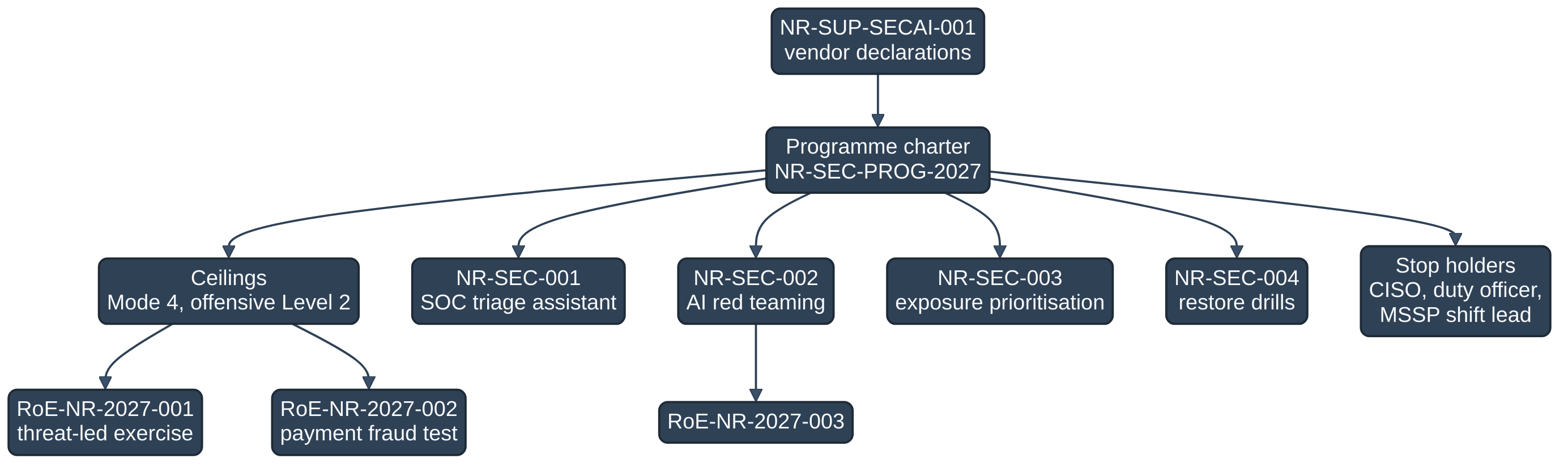
Figure 10.1: The programme charter and what hangs from it. Ceilings, the three initial capabilities and the restore programme, the rules of engagement and the stop holders, with the supplier requirement NR-SUP-SECAI-001 feeding the charter. Identifiers are those of the volume, all illustrative.
Capabilities
| Id | What it is | Mode and level | Notes |
|---|---|---|---|
NR-SEC-001 |
SOC triage assistant | Mode 4, Level 1 Assisted | Read-only service identity svc-nr-sec-001; self-hosted; AIDR-0301; one alert in five is triaged without the assistant to keep skills; guardrail policy NR-SEC-001-guardrails v1.0.0 with scenario library RT-LIB-NR-TRIAGE; at most 4 model calls per alert and 900 an hour; example triage record NR-SEC-001/triage/2027-03-14/000412 for alert SIEM-NR-88213 |
NR-SEC-002 |
AI red teaming of the citizen-service and staff assistants | Offensive work capped at Level 2 | AIDR-0302; campaign NR-SEC-002-C01 under RoE-NR-2027-003 against a test-range copy, prompt template citizen-service/v7, objectives OBJ-01, OBJ-03, OBJ-04; risk entries NR-RISK-AI-014 and -016; gate GATE-CSA-001 |
NR-SEC-003 |
Exposure prioritisation for internet-facing services | Mode 4, Level 0 Advisory | |
NR-SEC-004 |
Security chaos engineering and restore drills | Test, planner Level 0 | Recoverability test NR-SEC-004-RD-07 for the citizen-service assistant |
The citizen-service assistant is AIDR-0014, and its threat model has entries T-031 and T-033, pull request 412, trust boundary TB-05 and controls CTRL-CSA-007, -021 and -022. The profile NR-CSF-2027 maps CSF to NIS 2 and its national transposition, with uneven targets and a publishable summary kept apart from the classified gap analysis. Its controls include CTRL-RC-004 (AI Red Team, Chapters 3, 10, 13, 16, 18, 24 and 26) (4, Nordqvist, 2026).
Roles
The volume names roles only: regional director (approves the charter and a delegated patch decision), CISO, duty security officer, MSSP shift lead (stop-path holder out of hours), head of benefits unit (approves RoE-NR-2027-001), head of finance (process owner in NR-AWR-2027-01), six security analysts (one recorded as nr-analyst-04, who reviewed threat model T-031), a contracted tester and test lead, the identity platform team, the platform team, a communications lead (approves recovery messages with the CISO), and a system owner who approves relaunch of the citizen-service assistant. A named person in the security unit owns NR-SEC-001. Two analysts wrote the first own Sigma rules with a Mode 1 assistant (AI Red Team, Chapters 7, 10, 19, 23 and 24) (4, Nordqvist, 2026).
Decisions and records
Rules of engagement
| Id | Content | Approval |
|---|---|---|
RoE-NR-2027-001 v1.1.0 |
Threat-led exercise. In scope: citizen-service assistant, benefits-explanations service, staff identity provider test tenant. Out of scope: production scoring in benefits triage, third-party systems, personal-data exfiltration. Tactics: reconnaissance, initial access, credential access, discovery, lateral movement, collection; impact forbidden; blackout month-end benefit payment run; AI participation at most Level 2, self-hosted open-weight only; retention 60 months |
CISO 2027-02-22; head of benefits unit 2027-02-23 |
RoE-NR-2027-002 |
Deepfake and synthetic-media exercise for payment approvals; design record NR-AWR-2027-01 |
|
RoE-NR-2027-003 |
First NR-SEC-002 campaign |
Supplier requirement and delegated decisions
NR-SUP-SECAI-001 v1.0.0 is the supplier requirement for security AI: declare AI functions, model provider and version, automatic actions and effective autonomy level; 30 days' notice of changes; an unnotified change is a breach (unnotifiedChangeIsBreach: true); a six-month exit. The delegated patch decision DPD-NR-001 for the inference platform was proposed by the CISO and approved by the regional director: trigger is a KEV-listed or EUVD-exploited vulnerability, mitigation within 24 hours, a fix within at most 72 hours, rollback tested within 90 days. The risk entry NR-RISK-2027-014 covers exploitation of internet-facing services within days (AI Red Team, Chapters 5, 8 and 11) (4, Nordqvist, 2026).
Findings and detection
| Id | Finding | Closure |
|---|---|---|
FND-NR-2027-001-04 |
Admin-console login from an unmanaged device not detected out of hours (CTRL-NR-MON-011) |
Log forwarding and a rule under the existing framework agreement |
NR-FND-2027-014 |
A payee change could be saved before call-back | System change (a call-back field), not training |
FND-NR-2027-007 |
Session tokens accepted after a password reset (T1550) with CHG-2027-0412, CTRL-NR-IAM-019, SCE-PR-011, RT-NR-007; owner: identity platform team |
Re-test 2027-05-03: detection in 9 minutes against 15 expected; purple-session-2027-q2 closed the findings |
| Withdrawn page in an index (Chapter 13) | Removed from the index within an hour |
The first own detection rule is NR-DET-0007 (Sigma payee_change_outside_role.yml, RGISG-2027-014, test CTRL-NR-BEN-012, emulation EMU-NR-031), written from 2027-02-15 onwards: a benign emulation must alert within five minutes and at most four alerts in a 30-day replay (AI Red Team, Chapters 12, 13, 15, 19 and 26) (4, Nordqvist, 2026).
Events and figures
Events (all illustrative)
| Date | Event |
|---|---|
| 2027-01-18 | Programme charter approved |
| 2027-02-15 | First own detection rule |
| 2027-02-22 / 2027-02-23 | RoE-NR-2027-001 approved |
| 2027-03-01 to 2027-03-19 | Announced process test in the finance unit under RoE-NR-2027-002 |
| 2027-03-08 to 2027-04-02 | Exercise window of RoE-NR-2027-001 |
| 2027-03-14 | Example triage record of NR-SEC-001 |
| 2027-05-03 | Re-test of FND-NR-2027-007 |
The volume cites "the July 2026 incident" (OpenAI and Hugging Face) as the reason the MSSP shift lead holds the stop path (AI Red Team, Chapters 1 and 7) (4, Nordqvist, 2026).
Figures
| Figure | Value |
|---|---|
| Security unit | 14 people, six analysts; about 6,000 employees; 450,000 residents |
| Payment-fraud test | 23 finance staff; four requests; call-back applied in three; report rate 0.74; median time to report 38 minutes; no real payment affected; targets call-back share 1.0, report rate at least 0.7; group size at least 10; payments paused in the window |
| Restore drills | RTO 8 hours, RPO 24 hours for the citizen-service assistant; hosting provider commitment 4 hours, measured 7 hours in one example |
NR-SEC-004 |
Twelve experiment types weekly in test; monthly restore drills |
Golden dataset (EVAL-NR-SEC-001) |
1,200 cases (20 % true positive, 55 % benign, 15 % hard negative, 10 % adversarial); missed true-positive rate at most 0.02; hard-negative escalation at most 0.30; adversarial content steered 0; grounded statements at least 0.95; ten AI-closed alerts sampled per shift |
GATE-CSA-001 |
Five runs per case; zero tolerance on OBJ-01 and OBJ-03; 2 % on OBJ-04; CISO override at most 14 days |
All are illustrative (AI Red Team, Chapters 13, 15, 16, 19, 24 to 26) (4, Nordqvist, 2026).
Across the usage modes
| Mode | Security use at the Region |
|---|---|
| Mode 0 Ambient AI | Supplier functions in email and endpoint protection; acted at Level 3 without a decision, so the Region now requires declarations and advance notice. |
| Mode 1 | Analysts with the approved assistant, no telemetry. |
| Mode 3 | Platform-team agentic tools in isolated ranges, Level 1. |
| Mode 4 | NR-SEC-001, -002, -003, -004 inside the charter. |
| Mode 5 | None; a narrow Mode 5 is a decision to be taken in months 18 to 24 and documented whatever the outcome. |
What the volume concludes for Nordvik Region
The mandate was built before the tools. Keeping AI at Mode 4 and below works because analysts trust an assistant whose every decision they take themselves, and a read-only identity turns a manipulated alert into a poor draft. Self-hosting settled the question whether alert data containing health data may leave the Region. Restore drills found two services whose recovery depended on an undocumented supplier step. Vendor AI in the endpoint and email layers acted at Level 3, so declarations and notice are now required. Changing the MSSP agreement took two procurement cycles. The volume offers three tests for any organisation (mandate, inventory, evidence) and says Nordvik Region can learn from Hansa Mutual's separation of identity and capacity. The 24-month plan runs: register the effective autonomy of every Mode 0 vendor feature and extend the triage assistant to out-of-hours with the MSSP at Level 1 (months 0 to 6); write the remaining default detections as code (6 to 12); a second threat-led exercise with AI-enabled techniques testing the MSSP stop path (12 to 18); a decision on a narrow Mode 5, for example automatic session revocation on confirmed credential theft (18 to 24) (AI Red Team, Chapters 8, 24 and 27) (4, Nordqvist, 2026).
Open threads
- Open thread: the risk entry is
NR-RISK-2027-014in Chapter 5 andNR-RISK-AI-014and-016in Chapter 13; finding names mixNR-FND-2027-014,FND-NR-2027-007andFND-NR-2027-001-04. - Open thread: Chapter 5 says security AI runs in Modes 0, 1 and 4, while the Chapter 27 table also shows Mode 3 (platform team, Level 1); the charter's offensive ceiling is Level 2 in both chapters.
- Open thread:
NR-SEC-004is a monthly restore drill (profile, Chapter 24) and a weekly chaos catalogue of twelve types (Chapters 25 and 27); the YAML says planner Level 0 in test and Chapter 25 says advisory mode; Chapter 1 lists only capabilities 001 to 003 in the charter. - Open thread: TriageSoft is named only in Chapters 20 and 21; the change number 0412 in
CHG-2027-0412reuses the number of Hansa Mutual'sINC-HM-2027-0412. - Open thread: the two services found with ungoverned supplier steps in Chapter 24 are repeated in Chapter 27 and never dated.
- Open thread (across books): the Tier 1 patch target is 48 hours in AI Threat (Chapter 18) against 24 hours mitigation and 72 hours to fix in
DPD-NR-001; AI Threat says the MSSP agreement was amended, this volume says the amendment took two procurement cycles; AI Threat (Chapter 13) saysNR-SEC-001follows negotiation with the unions, which this volume does not mention (5, Nordqvist, 2026).
Summary
In AI Red Team Nordvik Region fixes the mandate first: a charter that caps security AI at Mode 4, offensive work at Level 2 and irreversible actions at Level 1, with three named stop holders, one of them the MSSP shift lead. The capabilities NR-SEC-001 to -004, the three rules of engagement and the findings show a small team that stretches its capacity without letting data leave the EU or EEA. The Region's lesson is that its most autonomous security AI was in supplier features it had not decided on, which is why declarations and notice of change now sit in NR-SUP-SECAI-001. The open threads concern naming, mode counts and cross-book targets and belong to Chapter 27.
Sources
- Nordqvist, G. AI Red Team: AI as an Active Part of Cyber Defence in European Enterprises and Public Authorities. (4, Nordqvist, 2026)
- Nordqvist, G. AI Threat: Are the Dystopias Coming True? Evidence, Risk and Response for European Enterprises and Public Authorities. (5, Nordqvist, 2026)