Conclusions: What the Series Shows Through Nordvik Region
This chapter states the dossier's own conclusions. It draws on the findings of Chapters 1 to 27 and cites no volume for a new fact: every statement below is a conclusion from what the earlier chapters have already set out and sourced. It answers four questions. What does the series show through Nordvik Region? What does Nordvik Region teach that the sibling dossier on Hansa Mutual does not? What does the credibility check of Chapters 25 and 26 say about the fiction? What has to be fixed in the fiction, and how will the dossier follow the series when it grows? The book is written in November 2026. Only about two years of the Region's history are established, and everything the volumes place after the middle of November 2026 is the volumes' modelled future (Chapter 21). The conclusions are drawn on that footing.
What the series shows through Nordvik Region
The Region shows AI governance as a chain of records, not a policy. Chapter 22 sorts the Region's identifiers into families and finds a pattern that holds in every volume. A dated commission opens each year and asks a named person what a function becomes. An answer in the same family of record closes it. A mandate follows a decision, a ceiling bounds the mandate and a test bounds the ceiling. Nearly every system of the estate (Chapter 5) carries an AI Decision Record, a mandate manifest or a delegation profile, and the series grows the estate by decision. The governance of the Region is therefore legible in a way that an organisation with a policy and no records is not. A reader can ask of any system who decided, on what date, with what ceiling and with what evidence, and the volumes can answer.
The Region shows the stop right as the best-assigned right. Chapters 3 and 22 find that the stop is almost always held by a named role that can act without asking: a duty manager, a team leader, the on-call engineer, the Head of Benefits Unit for the ranking of claims. The stop is also the right with the most numbers. Chapter 23 lists stop budgets of 60 seconds, five minutes, 120 seconds, 10 minutes, 14 minutes and 15 minutes, and the chapter that lists them shows that they belong to different stops. The conclusion is that a stop path is a design object, with an owner, a time and a test, and that the series treats it as one from AI Governance to AI Operations.
The Region shows that evidence ages. Chapter 23 gives the Region's claims the clocks of seven volumes and finds three things. A claim of "recoverable" or "covered" is true only within its clock. The first honest figure of each volume is lower than the first dashboard. The claims that lapse unnoticed are those with no owner for the retest: the portal failover failed in October 2027, was first retested 18 months later and failed again, and was verified after 20 months. For most of the series the tests failed first and passed on retest, and Chapter 7 draws the lesson that the record of a failing test is the evidence that the loop measures something.
The Region shows that a footprint is a claim with an age, and that a buyer's levers are the contract and the cap. Chapters 19A and 23 find that AI Environment adds no system to the Region and instead counts what its six uses cost the environment, and the picture is one of a buyer that cannot measure what it does not run: it owns no accelerators, its hosted-model route has no energy figure, the AI share of its own data centre is not metered, and its one published figure (1.90 g per resolved enquiry, October 2026) was a measurement at a point in time that had become a policy. In the volume's year the Region ends with fewer public claims than it began with, a stop path that failed its first drill and passed the next, a quota recalculated when its input drifted, and a tender annex that asks ten questions of its suppliers. The dossier's own conclusions are two. A claim about the environment follows the same rule as a claim of recovery or coverage: it is true within its clock, with its boundary and its independent check, and a buyer's honest answer is sometimes that it cannot yet say. And the levers named in Chapter 2 hold here too, the contract that can ask for the number and the cap that limits the use until the number exists. Both are conclusions from the volume's illustrative year and add no fact.
The Region shows a Mode 4 estate with narrow edges. Chapter 5 finds that the estate has one system that carries most of the legal weight, the benefits-triage system, a small set of assistants, security and operations tools capped at Levels 0 to 2, a rostering system in the management function, and a builder workspace at the end of the series. It has no Mode 5 agent and chooses not to have one. The weakest places are the outer modes, where the Region has the least control: ambient AI in licensed software, whose owner was named only in 2027, and agentic tools, where a mandate can be tighter than the practice or the reverse.
The Region shows that the same few people carry the year. Chapter 24 finds that the cast is mostly titles, that it is built by layers of volumes and not as a staff list, and that a handful of named people carry many of the duties. Later volumes record this as a risk that falls on the platform team, the senior analyst and the builder. The series does not hide it. It makes capacity a named open question in its last volume (13, Nordqvist, 2026).
The Region shows the contract as the main lever, and its limit. Chapter 6 concludes that the Region's sovereignty is a set of positions held by contract and by a small platform, not by ownership. It owns the gateway, the registry, the evidence and the exit design. It rents the models, the hosting, the recovery site and the night watch. The measure the series itself adopts is whether the Region can show that it can leave. For the benefits-triage supplier, by the end of the series, it still cannot.
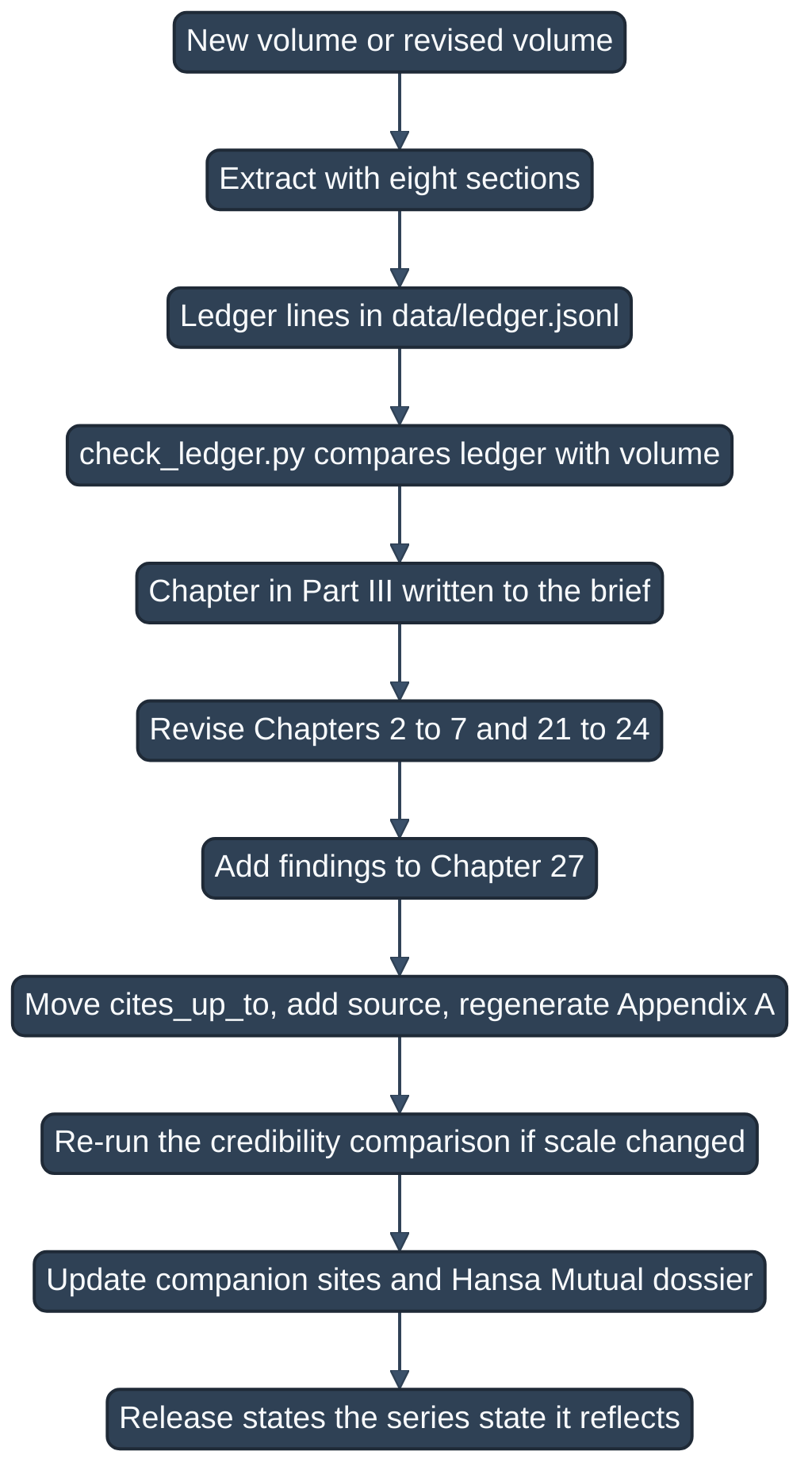
Figure 28.1: How the dossier follows the series. A new or revised volume enters at the top and the release states the series state it reflects at the bottom.
What Nordvik Region teaches that Hansa Mutual does not
The series chooses the two organisations to contrast, and Chapter 2 gives the contrast: a regional public authority of about 6,000 employees in one jurisdiction against a mutual insurance group of about 9,500 in several, with seven legal regimes. The Region mostly buys and builds little, it permits no Mode 5 agent by rule, and its principal lever is the contract. The sibling dossier covers the other side in the same plan. Five lessons belong to the Region.
- A buyer's discipline is publicity and paper. AI Threat sets the Region's discipline as publicity, against Hansa Mutual's as engineering. The Region's public minutes, its fundamental rights impact assessment, its notified registration and its council debates (Chapter 22) make it a case of AI governance done where the public can see it. The sibling shows the same duties met inside a company's engineering.
- Capability has to be created where the other organisation already has it. The series puts it twice. The Transformed Security Architect says that the Region "had to build what Hansa already has", and AI Blue says that the Region must create detection engineering while Hansa must keep its detection engineers from drowning. The lesson is that a public authority that buys most of what it uses still has to own a few things that decide quality: detection content, the isolation policy, the stop path (Chapter 7).
- Supplier dependence is the main risk and the main design problem. The Region's AI lives in the supplier's product, its night watch and its cloud. The volumes therefore build annexes with a stop path outside the supplier's platform (
MS-1,MS-2), exit tests that fail first and pass on retest, and the independent observer of AI Operations. These cases are less visible in the sibling, whose problem is the attack surface of its own agents. - A single jurisdiction does not make the duties simpler. The Region is under one national co-determination regime and one body of public law, yet the records of Chapter 22 show duties of fundamental rights, data protection and employee negotiation as numerous as those of a firm in several jurisdictions. Depth, and not breadth, is the Region's difficulty (Chapter 2).
- Choosing not to have a Mode 5 agent is a decision with a record. The Region's rule is a position, held by policy and recorded. It makes the ceilings of Levels 0 to 3 meaningful in a way that an estate with autonomous agents must reproduce through mandates, as the sibling does.
These five lessons are the dossier's own conclusions from comparing Chapter 2 and the Part III chapters. They do not claim that one organisation is better than the other. They claim that a reader who wants to see AI governance in a public authority has in the Region a case in which the decisions are written down, and in the sibling a case in which the engineering is.
What the credibility check says
Chapters 25 and 26 compare the fiction with four real Swedish regions of 308,357 to 410,676 residents, three real welfare-automation cases, four public sources on governance and supervision and two supplier incidents, all read on 2026-11-16. Of eighteen dimensions, six are credible without reservation, two are credible with a qualification (the security organisation by pattern, and the supplier incidents with a gap), four are generous, two are thin and four are not verifiable because no public figure was found. The four that are generous are the application volume, the financial assistance mandate, the staff assistant roll-out and AI Act readiness. The two that are thin are staff per 1,000 residents and the coordination wording of the mandate. The four that cannot be verified are assistant cost, platform team size, bought red teaming and the total budget.
Four conclusions follow. First, the fiction is plausible in its pattern: real regions are at the stage of strategies, policies, pilots and a first AI centre, and the Region is a few steps ahead of them, which suits a case study if the book declares it. Second, the contested step in the real welfare cases is what follows a score, and the Region's design (the system ranks, the caseworker decides every case, a blind sample, override alarms, a stop to date order) addresses exactly that step. Third, shared suppliers are the usual source of simultaneous disruption in the real incidents, and the Region's supplier incidents have the same shape. Fourth, no real body that handles needs-based financial assistance on behalf of municipalities was found, so that mandate is not verifiable by comparison and is the least certain part of the profile. The credibility check is no statement about a real organisation beyond what its cited sources state, and no verdict on the accuracy of a fictional one.
What has to be fixed in the fiction
The fixes are of two kinds, those that the credibility check proposes and those that the register of Chapter 27 proposes. They are proposals for the author. The dossier makes none of them, because a change to a volume is made in that volume's repository.
From the credibility check (Chapter 26). State in the first volume's profile that the Region runs two local hospitals and primary care and buys specialist care, so that the staff figure can be read. Name the legal basis on which a region handles financial assistance for its municipalities, define "application" for the triage figure and reconcile 40,000 a month with 31,000 a year. Describe the early application of the AI Act duties as voluntary, with the dates, and make the two registry identifiers consistent. Add an illustrative total budget for the Region. Add an HR or payroll platform outage to the incident record. Keep the sizes of the platform team and security unit as stated and make the load visible.
From the register (Chapter 27). Seventy-six threads are open: 37 contradictions, 14 identifier collisions, 14 date clashes, 7 scope mismatches and 4 missing outcomes, the last grouping many single outcomes. Five matter most.
- One value for the stop of the benefits-triage ranking. The series gives 60 seconds in AI Governance and five minutes in AI Platform and Security. A stop that has two times has no test (
OT-NR-01). - One ceiling for the builders' assistant and for the platform team. Vibe to Dev gives builders Mode 2 and Mode 3 at Level 3 Bounded while
DLG-NR-DEV-01holds generate, refactor and test at Level 1, and AI Developer sets the platform team's agentic drafting at Level 2 fromAIDR-1116against the same Level 1 ceiling (OT-NR-02,OT-NR-03). - One identifier per record.
RST-NR-2031-0001is two tests,AIDR-1002two records andNR-SEC-004two programmes (OT-NR-41toOT-NR-43). - One state. The profile says "a Nordic member state" and three volumes use Swedish law (
OT-NR-70). - The outcomes the series leaves open. The tender
NR-2030-041, the exit test of benefits triage, the status ofMS-2and the claims that expired in 2030 (OT-NR-77toOT-NR-80).
Most of the remaining threads are small and are closed by correcting a figure, a date or an example. The register makes a further point. The threads arise from the way the series is made, one volume after another with its own subject, and from the fact that the Region has one profile and fourteen sets of chapters. A discrepancy in the register is therefore not a sign that the Region is badly drawn. It is a sign that no one has yet been asked to read the fourteen volumes together, and this dossier is that reading.
How the dossier is updated
The dossier follows the series in the order set out in docs/UPDATING.md, and the same order holds for the sibling dossier, which is updated in the same set of pull requests.
| Event | What is done | Where it shows |
|---|---|---|
| A new volume appears (Book 15 and later) | Extract with the eight sections; ledger lines; scripts/check_ledger.py; a chapter in Part III written to the brief (a lettered chapter after the last volume chapter until a renumbering release, as Chapter 19A for Book 14); revision of Chapters 2 to 7 and 21 to 24; findings added to Chapter 27; cites_up_to moved, the volume added to the bibliography, Appendix A regenerated; tests and audit_references run |
New chapter in Part III, new source, new rows in the register |
| An earlier volume changes | The volume's profile is diffed; check_ledger.py is rerun; the ledger lines and flagged chapters are corrected; a correction of a recorded inconsistency moves from Chapter 27 to a note in the chapter concerned |
Open threads close |
| A volume gives the Region a new scale, system class, supervisor or incident | The comparison of Part V is rerun for that dimension | Chapter 26 table |
| Every release | The title page of Chapter 1 states the series state it reflects (the last volume and its date); the date of the extract is in the header of every file in data/extracts/ |
Chapter 1 |
The dossier refers to Books 1 to 14 and to no later volume. When a Book 15 is published the book gains a chapter, and the claims of Chapters 21 to 24 are re-read for the new volume, as they were for Book 14. The register in Chapter 27 is the part most likely to change: each volume closes some threads and, on the record so far, opens others.
Summary
The series shows through Nordvik Region an organisation that governs AI by written decisions, assigns the stop right to named roles, ages its evidence by clocks, keeps its estate to Modes 0 to 4 by rule and carries the year on a few people. It teaches what a buyer must create where an engineering organisation already has capability, and that supplier dependence, not the absence of engineers, is its main design problem. The credibility check finds the fiction plausible in pattern, generous in four dimensions, thin in two and not verifiable in four. The register finds 90 open threads, most of them small. The dossier is the first reading of the fourteen volumes together, and it is kept in step with the series by the cycle of Figure 28.1. These are the dossier's own conclusions, and no volume or external source is cited for them beyond those of the chapters from which they are drawn.
Sources
- Nordqvist, G. AI Governance: Governing Artificial Intelligence in European Enterprises and Public Authorities. (2, Nordqvist, 2026)
- Nordqvist, G. AI Platform and Security: Building and Securing AI Platforms in European Enterprises and Public Authorities. (3, Nordqvist, 2026)
- Nordqvist, G. AI Threat: Are the Dystopias Coming True? Evidence, Risk and Response for European Enterprises and Public Authorities. (5, Nordqvist, 2026)
- Nordqvist, G. The Transformed Security Architect: Role, Craft and Career in the Age of AI in European Enterprises and Public Authorities. (6, Nordqvist, 2026)
- Nordqvist, G. AI Blue: How Artificial Intelligence Transforms the Blue Team in European Enterprises and Public Authorities. (8, Nordqvist, 2026)
- Nordqvist, G. AI Operations: How Artificial Intelligence Transforms IT Operations in European Enterprises and Public Authorities. (10, Nordqvist, 2026)
- Nordqvist, G. AI Developer: How the Developer Role Changes When AI Is Used Broadly in European Enterprises and Public Authorities. (12, Nordqvist, 2026)
- Nordqvist, G. Vibe to Dev: From Vibe Coding to Professional Software, Step by Step, for Builders Who Are Not Developers, in European Enterprises and Public Authorities. (13, Nordqvist, 2026)