Book 3, AI Platform and Security: The Platform
AI Platform and Security asks what an organisation builds around AI it mostly buys. For Nordvik Region the answer is a reduced reference platform: a gateway, a registry, acceptance suites and a control plane assembled from existing identity, logging and archive services, with no agent runtime. This chapter gathers what the volume establishes about that platform, about the placement of each system, and about the data, model and security decisions around them. It draws on AI Platform and Security (3, Nordqvist, 2026) and on the profile fixed in AI Governance, which Chapter 8 summarises. The profile is established. The volume labels its worked examples illustrative, and every date after November 2026 below is illustrative fiction.
The volume in brief
AI Platform and Security is the series' volume on building, securing and operating AI platforms: a reference architecture, decision records, data and model life cycles (DevSecMLOps), foundation models and retrieval, infrastructure and sovereignty, security for AI, evaluation, observability, cost and sustainability. Each chapter shows its subject for Nordvik Region and for Hansa Mutual. The volume's own conclusion for Nordvik Region (Chapter 24) is that the contract remains the lever, that the narrow spread of usage modes is a choice that lasts only while something enforces it, and that the risks are supplier dependence, capacity and skills in a small team, and the depth of public-law duties (AI Platform and Security, Chapters 1, 19 and 24) (3, Nordqvist, 2026).
The role of Nordvik Region in the volume
Nordvik Region is the volume's example of a platform built around something bought. Its centre is the procured, high-risk benefits-triage system (Annex III point 5(a); the Region is deployer, the provider is TriageSoft, tender NR-2026-117). Around it sits a reduced variant of the reference architecture. The triage system runs in the Region's own data centre; the staff assistant runs on an open-weight model at a European cloud provider (EEA, customer-held keys); workloads with special categories, such as the case-note summariser for 180 social-services caseworkers, stay on premises. There are no autonomous production agents (Mode 5), and Mode 3 is limited to the platform team (AI Platform and Security, Chapters 1, 4 and 24) (3, Nordqvist, 2026).
What the volume establishes
The reduced reference architecture
The platform is written as an overlay, architecture/overlays/nordvik-region.yaml, on enterprise-ai-platform@2.0.0, and recorded as AIDR-0002. Its choices are fixed in the table.
| Element | Nordvik Region's choice |
|---|---|
| Data foundation | National (nordvik-datacentres) |
| External model connections | EEA only |
| Personal data | Only to contracted EEA suppliers |
| Additions to the base | public-algorithm-register and fria-workflow |
| Evidence retention | 120 months, archive regional-archive-service |
| Promotion of a high-risk model | Approved by the head of case management and the data protection officer |
| Kept | AI gateway, model registry, evaluation suites, control plane |
| Left out | Agent runtime |
The control plane is built from identity, logging and archive services the Region already had. The volume's decision rule is to keep the gateway, the registry, evaluation and the control plane, and to regulate in the contract everything the supplier builds (AI Platform and Security, Chapter 4) (3, Nordqvist, 2026).
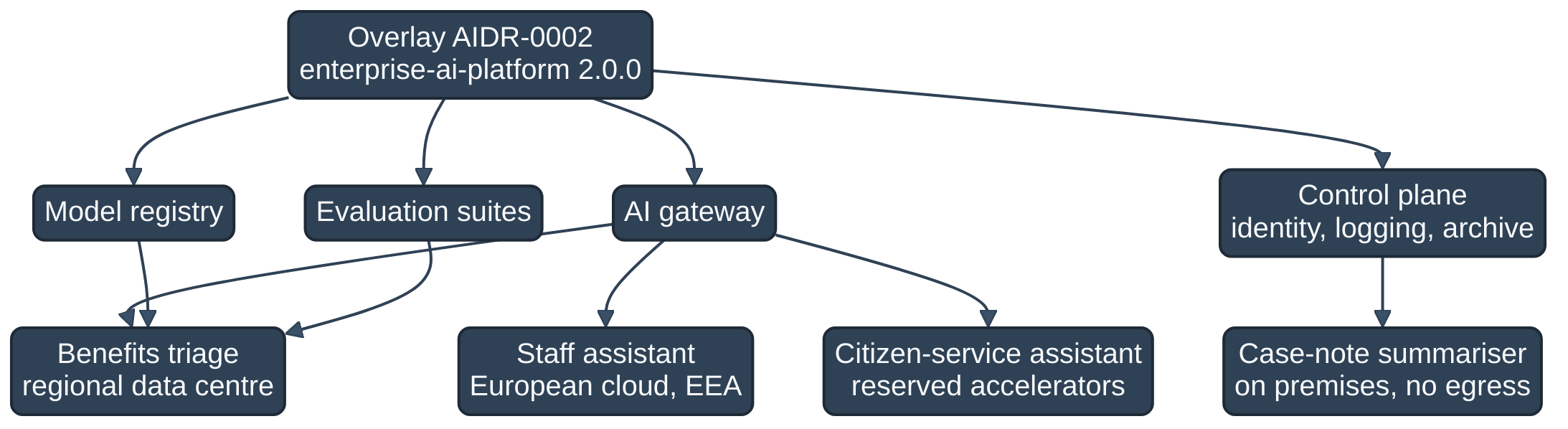
Figure 9.1: The reduced platform. The overlay AIDR-0002 gives the gateway, registry, evaluation suites and control plane; three systems sit behind the gateway and the summariser stays on premises without egress. Placement follows the volume's placement matrix.
Systems and their placement
| System | Mode | Placement and key facts | Records |
|---|---|---|---|
| Benefits triage with the claims ranker | 4 | On premises in the regional data centre (small model, even load); gradient-boosted ranking model via the gateway; TriageSoft retrains quarterly inside the Region's platform, change envelope with a 90-day interval; data never leaves the authority | AIDR-0007, AIDR-0011, AIDR-0018, FRIA-2026-002, registry://claims-ranker/4.0.0 |
| Staff assistant | 4 | About 3,200 users; limited risk; aiActRole: compoundSystem provider, generalPurposeModel deployer; prompt prompts/staff-assistant/system@v3; egress only via the gateway; agentTools: none; evidence retention 120 months |
AIDR-0211, UC-2026-061 |
| Citizen-service assistant | 4 | rag_system v2026.03.1; embeddings on premises (multilingual-embed-v3); generation on an EU-hosted model; prompt citizen-service/v7; entitlement filter before retrieval; Article 50 disclosure; grounding checker entailment-small-v1 |
AIDR-0014 |
| Case-note summariser | 4 | Own platform, two nodes in separate data centres, all egress denied, overflow queued with no cloud burst | UC-2026-017 |
| Correspondence classifier | 4 | Fine-tuned open-weight 7B model; ML-BOM v2.1.0 with SLSA provenance | AIDR-0042 |
| Platform team code agent | 3 | Infrastructure code; sandbox_fail_closed: missing (an open gap) |
NR-UC-017 |
| Explanation service | 4 | Built in house; the Region is provider and deployer of this service only | Chapter 21 of the volume |
The claims ranker is, in the volume, the claims-routing classifier: a scoring component of the benefits-triage system with 11 routing destinations, watched by the daily job claims-routing-drift (owner: the benefits decision-support team) and the evaluation suite claims-routing (AI Platform and Security, Chapters 1, 5, 7, 10, 13, 14, 16, 20 and 21) (3, Nordqvist, 2026).
The staff assistant's intended purpose is drafting and summarising internal guidance; it is forbidden to assess, rank or decide applications and to process special categories about residents. Its agent mandate is empty, and its identity is carried by a token exchange: the subject is the officer, the actor is svc-staff-assistant, the scope is record.read:assigned and the token lives five minutes (Chapter 12).
The agentic tools of the platform team follow a split by data class. Public and internal work may use an approved cloud model; anything above internal uses only a pinned self-hosted code model, upgraded at most twice a year (Chapter 15). The architects have two skills of their own: one that drafts AIDR entries and one that reviews AI pull requests against Region policy (Chapter 11), and the skills catalogue holds consultation-response-summary v1.4.0, owned by regional planning digital (Chapter 8).
Sovereignty and placement
The sovereignty profile for procuring managed inference carries five requirements, and a mandatory requirement excludes a bid.
| Id | Requirement | Weight |
|---|---|---|
| SOV-01 | EEA processing | Mandatory |
| SOV-04 | No training on input | Mandatory |
| SOV-05 | Open-weight and export of weights at exit | Mandatory |
| SOV-06 | Gaia-X-like self-description | 15 |
| SOV-08 | Exit assistance of at least 12 months | 10 |
The placement matrix puts triage on premises, the staff assistant in the European cloud, and the correspondence summariser on hold until two accelerator cards are installed. Reserved accelerators at a European hosting provider in a Nordic data centre (eu-north-1) carry two open-weight models, with burst on demand for the citizen peak. The decision on renewing the GPU reservation (a 12-month reservation) is set for 2027-11-15 (AI Platform and Security, Chapters 13, 14 and 22) (3, Nordqvist, 2026).
Data and retention
Rule RET-04 governs retention and deletion for claims data. It keeps the three latest training releases (at most 36 months), feature rows for 24 months, vector-index chunks for the life of the source document, prompt and response logs for 12 months (at least 6 for high-risk), and the semantic cache for 24 hours. Deletion follows the lineage lineage://nordvik/claims, and re-indexing is done within 72 hours. The datasheet claims-register v2025-12 describes 1.9 million closed cases from January 2021 to November 2025, 7 % of them paper rows with gaps, and notes that two northern municipalities provide 4 % of the rows against 9 % of the population, a representation gap the evaluation has to watch. The registry keeps the last case plus ten years for registry://claims-ranker/4.0.0, with earlier champions held warm (3.2.0 and 3.1.1) (AI Platform and Security, Chapters 5, 6 and 7) (3, Nordqvist, 2026).
Decisions and records
| Record | Content | Dates in the volume (illustrative) |
|---|---|---|
| AIDR-0007 | Decision support for prioritising applications | Proposed 2026-03-02 (PR-41), accepted 2026-04-15 (PR-47), superseded 2027-02-10 (PR-112) |
| AIDR-0011 | Oversight design: band and three reasons, one click plus reason code, suspension to arrival order within five minutes, 5 % without band, override alarm 2 % to 30 % | Separate record because the oversight design changes more often |
| AIDR-0018 | Model 4.0.0 without postcode | Accepted 2027-02-10 |
| AIDR-0002 | Overlay of the reference architecture | |
| AIDR-0211 | Model origin and hosting of the staff assistant: options A open-weight at a European cloud, B proprietary US hyperscaler in an EU region, C national provider; weighted totals A 4.30, B 3.85, C 3.30; A chosen, B kept as a fallback for non-personal tasks; legal counsel note LC-2026-044; exit tested annually |
Accepted "2026-06-18" |
| AIDR-0014 | Citizen-service assistant | |
| AIDR-0042 | Correspondence classifier |
AIDR-0011 shows band and reasons, not scores, to reduce automation bias. The change envelope of the claims ranker, models/claims-ranker/change_envelope.yaml, puts the removal of features outside the envelope: it needs a new record, a risk assessment and an updated FRIA (Article 43(4)), which is why AIDR-0018 was a decision and not a retraining (AI Platform and Security, Chapters 5, 7 and 13) (3, Nordqvist, 2026).
Further artefacts: the statement of applicability records ISO 27001 control 8.9 as "effective with findings" because two inference nodes ran an unpinned serving image for six days; NR-2026-117 (tender), NR-2026-031 (staff-assistant hosting contract) and UC-2026-017; red-team plan RT-2026-11; runbooks runbooks/claims-routing/drift.md and RB-AI-000 v2.2; incident qualifiers IQ-01 and IQ-03; roadmap entries NR-PRM-01, NR-PRM-03 and NR-PRM-04; 90-day items NR-W2-supplier-revision and NR-W4-suspension-path; the carbon calculation citizen-faq-2026-10; the capacity plan benefits-platform-2027q1; and FIN-COST-01 (AI Platform and Security, Chapters 6, 9, 20 to 22, 24 and 25) (3, Nordqvist, 2026).
Events and figures
Events
| Date | Event | Status |
|---|---|---|
| 2026-03-02 / 2026-04-15 | AIDR-0007 proposed / accepted | Dated in the volume |
| 2026-06-18 | AIDR-0211 accepted | Dated in the volume (see open threads) |
| 2026-10-14 | Golden dataset last reviewed; next 2027-01-12 | Illustrative |
| 2026-10 | Carbon measurement for the citizen FAQ; 2026-10-28 evaluation of challenger claims-routing@2026.10.3 (run eval-2026-10-28-0412) |
Illustrative |
| 2026-11-09 to 2026-11-20 | Red-team window RT-2026-11 (staff assistant release 3.0) |
Illustrative |
| 2026-11 | Roadmap NR-PRM begins, to 2028-10 |
Illustrative |
| 2027-01-29 | Model 4.0.0 in shadow | Illustrative |
| 2027-02-10 | 4.0.0 champion; AIDR-0007 superseded | Illustrative |
| 2027-04-14 | Skill review | Illustrative |
| 2027-11-15 | Decision on renewing the GPU reservation | Illustrative |
| 2027-12-02 | Annex III requirements apply | Established in law as amended |
The parity drift that led to AIDR-0018 was 0.06 for 61 days against a retirement criterion of 0.05 for 60 days (AI Platform and Security, Chapters 5, 7, 8, 20 to 22 and 24) (3, Nordqvist, 2026).
Model, evaluation and drift figures
| Figure | Value |
|---|---|
| Applications; median wait | 40,000 a month; 31 days |
| Model 3.2.0 | precision at 100 of 0.83; parity difference 0.03 |
| Model 4.0.0 | 0.82 and 0.02 (before the change 0.06); ML test score 4.5 |
| AIDR-0007 criteria | precision at 100 of at least 0.80; parity below 0.05 |
| Fallback on suspension | About four days longer median wait |
Golden dataset claims-routing-golden v7 |
4,860 cases; 620 from five FRIA groups; 214 disagreements; split DT-SPLIT-004 |
| Routing accuracy | Threshold 0.94; observed 0.951; champion 0.948 |
Slice claimants-without-fixed-address |
0.903 (n=152, interval 0.871 to 0.931) |
| Explanation grounding; injection | 0.974; 0.992 (n=250) |
| Judge agreement | 0.87 (400 samples) |
| Drift | PSI warn 0.10, alert 0.25; JS divergence 0.08; accuracy alarm 0.92; 45-day label delay; minimum 2,000 samples |
| Citizen assistant | Faithfulness at least 0.95; unsupported claims at most 0.02; v7 scored 0.97 over 20 runs |
| Capacity 2027Q1 | Peak 42,000 tokens a second; batch 310 million tokens a day; 16 reserved GPUs at EUR 1.85 an hour; up to 8 on demand at EUR 3.40; utilisation target 0.70, floor 0.45 |
| Cost policy | EUR 18,000 a month; alerts at 50, 80 and 95 %; hard cap 110 %; at most +10 % without approval; target EUR 0.12 per resolved case; 2.0 gCO2e per case; the explanation route is 40 % of cost for 13 % of resolved cases |
| Carbon (October 2026) | Energy 2,266 kWh (PUE 1.15); intensity 32 g/kWh; embodied 62,400 g; R 71,000; SCI 1.90 against target 2.0; at 350 g/kWh, 12.05 |
All of these are illustrative, as the volume labels its worked examples (AI Platform and Security, Chapters 5, 6, 10, 20, 21 and 22) (3, Nordqvist, 2026).
Security
The volume's security content for the Region is the statement of applicability finding (control 8.9), the ML-BOM and provenance of the classifier, all egress denied for the summariser, fail-closed sandboxing still missing for the Mode 3 agent, and a red-team window on the staff assistant. The alert rule group claims-routing-ai is the Region's claims-routing group.
Across the usage modes
| Mode | Platform consequence at the Region |
|---|---|
| Mode 0 and 1 | Governed by data class and approved tools, outside the platform's runtime. |
| Mode 2 | Pilot only; scaling it waits until sensitivity labels are enforced. |
| Mode 3 | Platform team; self-hosted pinned code model above internal data; the sandbox gap is open. |
| Mode 4 | All five systems pass the gateway and registry; promotion of high-risk models needs two approvers. |
| Mode 5 | Absent; the platform has no agent runtime. |
What the volume concludes for Nordvik Region
Chapter 24 of the volume concludes that the contract is the lever and that nothing documents an exit test for the triage supplier. Its 24-month plan is: make the sandbox fail closed (months 0 to 6); practise suspension and the incident path, TriageSoft included; close the deployer evidence gap before 2027-12-02; install the accelerator; test the staff assistant's exit annually; and scale the Mode 2 pilot only once sensitivity labels are enforced. There is no Mode 5 without containment, an independent stop path and evaluation evidence. The narrow spread of modes is a choice that lasts only as long as something upholds it (AI Platform and Security, Chapters 19 and 24) (3, Nordqvist, 2026).
Open threads
- Open thread: AIDR-0211 is dated 2026-06-18 (Chapter 13) but the staff assistant was generally available from 2026-06-01 and has about 3,200 users in Chapter 1, and AI Governance cites AIDR-0211 in April.
- Open thread:
NR-2026-031is the managed-inference tender in the sovereignty profile and the hosting contract in the profile and in Chapters 1, 13 and 24. - Open thread: suspension of triage within five minutes (Chapters 5 and 24) against 60 seconds in AI Governance, Chapter 10.
- Open thread: AIDR-0007 and AIDR-0018 carry 2026 and 2027 dates here while AI Governance gives none; 4.0.0 shadow is 2027-01-29.
- Open thread: a registry example lists
ai_act.roles: [deployer]for claims ranker 4.0.0 although the Region is provider of the explanation service. - Open thread: Chapters 21 and 22 refer to "the social insurance authority introduced in earlier chapters" in routing and incident examples, which the profile does not describe as Nordvik Region; the alert group
claims-routing-aialso contains a rule for amaintenance-agentthat the Region does not have. - Open thread: the cost policy of EUR 18,000 a month equals the figure in Hansa Mutual's route; the token example names
officer-30417andidp.nordvik.example, the only person-level traces. - Open thread: the model name
model-risk/a.lindin a registry example is the only personal name in the volume's Nordvik Region material. - Reading by AI Environment. The carbon line of October 2026 is the aged figure that AI Environment later withdraws (
CLM-NR-0001, 2032-12-13): 1.90 g is 1.02 g operational plus 0.88 g embodied, from 1,970 kWh of IT energy over 71,000 resolved cases at 32 g/kWh; 1,970 kWh times a PUE of 1.15 is the 2,266 kWh above. AI Environment notes that the profile does not say whether the figure includes the facility overhead, and its own Chapter 7 treats it as IT energy (14, Nordqvist, 2026). Chapter 23.
Summary
AI Platform and Security gives Nordvik Region a platform of controls around a purchase: gateway, registry, evaluation suites and a control plane from existing services, placement by data class, and sovereignty requirements that can exclude a bidder. Its worked records (AIDR-0002, AIDR-0007, AIDR-0011, AIDR-0018, AIDR-0211, AIDR-0014, AIDR-0042, RET-04, the change envelope) show how the platform makes a supplier's system governable, and its numbers (40,000 applications a month, 4,860 golden cases, 3,200 assistant users, SCI 1.90) are illustrative. The open items are an unenforced sandbox, no exit test of the triage supplier and several inconsistencies of date, identifier and role, listed for Chapter 27.
Sources
- Nordqvist, G. AI Platform and Security: Building and Securing AI Platforms in European Enterprises and Public Authorities. (3, Nordqvist, 2026)
- Nordqvist, G. AI Environment: Designing AI for the Greatest Benefit and the Least Environmental Harm in European Enterprises and Public Authorities. (14, Nordqvist, 2026)