Book 10, AI Operations: Keeping Services Running
This chapter gathers what AI Operations (Book 10) establishes about Nordvik Region: how its IT operations are organised, which services it runs and promises, which AI systems take part in operating them, what happened to the services between 2026 and 2029, and what the Region can and cannot prove about recovery. It draws on the volume's example-organisation profile and on its chapters on the operations loop (Chapter 4), the observer principle (Chapter 17), the evidence age of resilience claims (Chapter 19), the decision-rights and risk files (Chapter 22), a year in operations (Chapter 29) and the plan and report to the regional executive committee (Chapter 30) (10, Nordqvist, 2026).
The status of the facts is mixed and the chapter keeps the two kinds apart. The profile of the IT and Digitalisation Unit, the services and the suppliers is established. The baseline incidents and restore tests (2026 and 2027) are the volume's profile history, but those dated after November 2026 are illustrative like every event the book dates after its writing. The volume's own year, September 2028 to August 2029, and the plan that follows it are illustrative as well: the volume marks them so, and the book is written in November 2026. Where the chapter gives a figure it says which kind it is.
The volume in brief
AI Operations asks what happens to IT operations, in its modern forms of site reliability engineering, platform engineering, service management and managed operations, when AI takes part in observing, diagnosing, changing and restoring services, and when the operator's own AI becomes one of the most privileged workloads in the estate. Its thesis has five parts. Operations is transformed, not abolished, from the queue to the control loop. Autonomy is matched to reversibility and blast radius and has a budget, with a stop path outside the system it stops. The operator's AI is part of the estate it operates and is Tier 0. A loop closed by machines alone can hide its own failure, so what verifies an action must be independent of what performed it (the observer principle). Resilience is a claim that needs evidence, as does the operator's competence. The work divides into five operations functions: O1 Observe, O2 Diagnose, O3 Change, O4 Restore and O5 Sustain (10, Nordqvist, 2026).
The degrees of delegation are the series' autonomy levels per function and action class, Level 0 Advisory to Level 4 Autonomous, and they carry a budget. Level 4 is never used for an irreversible action on production data, for an action outside an authorised change window or freeze on a critical function, for an action that disables the observation or the stop path itself, or for an action that decides about a named person's access to work. The volume applies the verification pattern of AI Purple to the function that keeps services running every day (10, Nordqvist, 2026).
The role of Nordvik Region in the volume
Nordvik Region is the volume's organisation without a Mode 5 agent. It is a regional authority whose IT and Digitalisation Unit runs its own sovereign regional cloud with a platform team of seven engineers who carry site reliability practice, but which depends on a national shared-service supplier, SamDrift, for DNS, identity federation, a recovery site and night-time monitoring. The volume uses the Region to show the operations thesis in its "should we start at all" form: what a small, bound organisation can prove about recovery, and what an AI may do when it is not allowed to act on its own in production (10, Nordqvist, 2026).
The volume's starting question is AIDR-0900 (2028-09-12, illustrative). The regional executive committee asks the Head of IT and Digitalisation, Henrik Dahl, what operations becomes when the platform team's tools and the suppliers' AI act on the environment, and what the Region can prove about recovery. The first report is due on 2029-03-31 (Chapter 4 and Chapter 1 of the volume). The Region's answer, given in Chapter 30, is that operations becomes a small, owned loop around a bought base, and that what the Region can prove about recovery on Tier 1 is, today, nothing, with a plan that dates when that changes (10, Nordqvist, 2026).
What the volume establishes
The unit and its operating model
The IT and Digitalisation Unit has about 85 people under Henrik Dahl, who reports to the regional director. Its parts and their sizes are in the table. The chief information security officer, the AI architect and the enterprise architect sit beside the unit. There is no dedicated site reliability function: the platform team carries the practice and nobody holds the title (10, Nordqvist, 2026).
| Part of the unit | People | Notes |
|---|---|---|
| Infrastructure and hosting | 22 | |
| Platform team | 7 engineers | Carries site reliability practice |
| Applications and integration | 31 | |
| Service desk | 12 | 07:00 to 17:00 on weekdays |
| IT management office | 10 | Owns the mapping entry for the Cybersecurity Act |
Region Cloud is the Region's sovereign regional cloud, run by the Region in two halls (A and B) of the data centre nordvik-dc, on virtualisation and Kubernetes. There is no hyperscaler tenancy for production. Observability is open source (OpenTelemetry) with 30 days of hot retention and 13 months of archive. Infrastructure is changed as code through a pipeline. Backups go to an immutable object store in hall B with a copy at SamDrift. The IT service management tool is ServiceFlow (fictional, under a national framework agreement), with ambient classification (Mode 0) switched on for the service desk only. The data centre is assumed to draw about 640 kW across the two halls (illustrative), which brings it within reporting under the Energy Efficiency Directive (threshold 500 kW) (10, Nordqvist, 2026).
Suppliers
| Supplier | What it provides | Identifier |
|---|---|---|
| SamDrift (fictional) | Disaster-recovery site, national identity federation, a network operations centre that watches Tier 1 round the clock and pages the Region's on-call, external DNS, out-of-hours service desk telephony | Framework agreement NR-2026-088 |
| European hosting provider in a Nordic data centre | Reserved accelerators for the Mode 4 services | Contract NR-2026-031 |
| TriageSoft | Operates the benefits-triage application | Procurement NR-2026-117 |
| Managed security service provider | Security monitoring outside office hours | NR-2025-044 |
| PeopleCore | National HR and payroll software as a service |
The Region can move load between halls and to the recovery site, but not to a second supplier (Chapter 15 of the volume) (10, Nordqvist, 2026).
The service catalogue
The services carry a tier, an objective record and a recovery time objective (RTO) and recovery point objective (RPO). Service identifiers run SVC-NR-001 onwards and objective identifiers SLO-NR-001 onwards.
| Service | Tier | Objective | RTO and RPO |
|---|---|---|---|
SVC-NR-001 Benefits triage (TriageSoft, NR-2026-117; AIDR-0007, -0011, -0018), high-risk AI, about 40,000 claims a month |
1 | SLO-NR-001: 99.5 % a month, 06:00 to 22:00 on weekdays; a claim ranked within 10 minutes for 99 % of claims |
RTO 4 h, RPO 15 min |
SVC-NR-002 Citizen portal |
1 | SLO-NR-002: 99.9 % |
RTO 2 h, RPO 5 min |
SVC-NR-003 Case management, special categories of personal data |
1 | SLO-NR-003: 99.5 % |
RTO 4 h, RPO 15 min |
SVC-NR-004 Staff identity and access management |
1 | SLO-NR-004: 99.9 % |
RTO 1 h, RPO 5 min |
SVC-NR-005 Citizen-service assistant (Mode 4; AIDR-0014) |
2 | SLO-NR-005: 99.0 %, p95 under 8 s |
RTO and RPO 24 h |
SVC-NR-006 Internal staff assistant (Mode 4; AIDR-0211), about 3,200 users |
2 | SLO-NR-006: 99.0 % |
RTO and RPO 24 h |
SVC-NR-007 Regional public transport journey planner |
2 | ||
SVC-NR-008 E-mail, collaboration and ambient AI |
2 |
The collector fragment in SLO-NR-002 removes user.email, user.full_name, citizen.id and client.address from telemetry before it is stored (Chapter 5 and Appendix A.1 of the volume) (10, Nordqvist, 2026).
People and on-call
The volume names five people from the Region. Maja Lindqvist is the platform lead (14 years in the Region), who owns Region Cloud, the observability stack and the operations assistant, and who holds the right to stop. Joakim Wester is a senior platform engineer (9 years), the Region's most experienced person on restores, who writes runbooks, takes most weekend on-call, ran the restore of 2028-11-21 and wrote the seeded fault of 2029-03-19. Oskar Berg is one of four duty managers and incident commanders (17 years in operations) and holds the stop at exercises. Sara Ekdahl leads the service desk (12 years) and owns the assistant service SVC-NR-005. Henrik Dahl owns the service catalogue and the decision-rights file DRF-NR-001. The regional director is the backstop holder of the stop right. The Head of the Benefits Unit owns SVC-NR-001 and holds the data protection and AI Act clock with the data protection officer. The volume also names Karin Lund of security operations as a contact point, without giving her a role in any chapter (10, Nordqvist, 2026).
On-call is organised in three layers. The service desk covers 07:00 to 17:00 on weekdays. Technical first line is a weekly rota of 11 people (7 platform and 4 infrastructure), so that each person is on call one week in eleven. A duty-manager rota of four people provides the incident commander for Tier 1. The response target for a Tier 1 page is 15 minutes, the platform lead is the escalation point, and stand-by is compensated under the sector's collective agreement. The cap of five pages per shift outside office hours is a design value (Chapter 25 of the volume) (10, Nordqvist, 2026).
Co-determination follows the Swedish pattern (the Co-determination Act, MBL). The agreement MBL-NR-IT-2027-01 says that counts of shutdowns and response times are never reported per person, that stand-by rotas are negotiated and changed with notice, and that every tool that logs engineers' questions or commands is negotiated before it is switched on. It is invoked throughout the volume (10, Nordqvist, 2026).
The AI systems of operations
The volume's usage modes for operations at the Region are these: ambient AI (Mode 0) in ServiceFlow and the software-as-a-service suite; an approved enterprise assistant (Mode 1), not for operational data above the class internal; a pilot of an embedded work assistant (Mode 2); agentic work tools (Mode 3) for the platform team, where four of seven engineers hold the permission, among them Joakim Wester, and the tools may draft infrastructure code and runbooks and never apply them, on open-weight models on reserved capacity; Mode 4 for the operations assistant NR-OPS-001 and for the citizen-service and staff assistants as operated services; and no Mode 5. The Region's rule is that there are no autonomous production agents (10, Nordqvist, 2026).
| Use case | Role | Degree of delegation | Record |
|---|---|---|---|
NR-OPS-001 operations assistant |
Answers and drafts for operators | Level 0 Advisory | AIDR-0901 (Chapter 7) |
NR-OPS-002 scribe |
Drafts timelines and status updates for Sara Ekdahl | Level 1 Assisted | Chapter 16 |
NR-OPS-003 runbook runner |
Executes three portal runbooks: RBK-NR-0002 restart, RBK-NR-0003 scale, RBK-NR-0004 certificate renewal |
Level 2 Supervised; roll back and fail over at Level 1; deploy undelegated | MND-NR-OPS-003, AIDR-0916, in force 2028-11-14, review 2029-02-14, expires 2029-05-14 |
The delegation profile DLG-NR-OPS-001 (Chapter 4) caps every class that changes production at Level 2. The volume records that practice before the profile was Level 0 in most classes (10, Nordqvist, 2026).
Decisions and records
The Region's AI Decision Records for the volume run from AIDR-0900 to AIDR-0949. The ones the volume files are in the table; the identifiers 0903 to 0905, 0907 to 0909, 0911, 0913, 0914, 0917, 0928 to 0934 and 0936 to 0948 are unused.
| Record | Date | Decision |
|---|---|---|
| AIDR-0900 | 2028-09-12 | The commission: what operations becomes and what can be proved about recovery |
| AIDR-0901 | The operations assistant at Level 0 | |
| AIDR-0902 | A supplier's notice of a change is handled as a change request | |
| AIDR-0906 | Golden set for the supplier's alert groupings | |
| AIDR-0910 | 2028-11-06 | No scripted runbook at Level 3 until OBS-NR-0001 applies (in force 2028-11-20) |
| AIDR-0912 | Retrieval-only AI for incident review drafts | |
| AIDR-0915 | 2028-11-14 | Capacity and cost record CAP-NR-AI-001 |
| AIDR-0916 | The agent team and MND-NR-OPS-003 (in force 2028-11-14) |
|
| AIDR-0918 | 2028-11-21 | Remove standing production permissions |
| AIDR-0919 | A calendar trigger for the portal failover retest | |
| AIDR-0920 | Illustrative levelling of scripted runbooks | |
| AIDR-0921 | 2029-01-23 | Report median, p90 and a named list, not a mean |
| AIDR-0922 | 2028-11-28 | The decision-rights file DRF-NR-001 |
| AIDR-0923 | 2028-11-21 | Apply the Cybersecurity Act to all Tier 1 services as an essential operator |
| AIDR-0924 to -0927 | 2029-02-13 | OPA-NR-SD-01, ONC-NR-2029-01, PLAN-NR-OPS-2029-01, HZN-NR-OPS-01 |
| AIDR-0935 | 2029-03-06 | Anti-pattern review |
| AIDR-0949 | 2029-03-31 | The two-year plan OPL-NR-2029-01 |
The decision-rights file DRF-NR-001 (version 0.9.0) names the duty manager as incident commander, with deputies at 15 and 30 minutes. The holders of the right to stop are the duty manager, the platform lead and the platform engineer on call without needing approval, with the regional director as backstop. A risk acceptance on the portal failover, DRF-NR-001/RA-01, held by Henrik Dahl, expired on 2029-03-31 and was renewed on 2029-03-28 to 2029-06-30 (10, Nordqvist, 2026).
The other artefacts of the volume are these. The observer manifest OBS-NR-0001 places the probe at the hosting provider in a Nordic data centre, on a different network from Region Cloud and from SamDrift, and the probe resolves names directly against the authoritative servers. Its design objective is two failures at 60-second intervals. The operations charter CHR-NR-OPS-01 for SVC-NR-002 is dated 2028-11-20. The annex OPA-NR-SD-01 to the SamDrift agreement NR-2026-088 was signed on 2029-03-20. The negotiated subject of the union agreement is ONC-NR-2029-01, which applies from 2029-03-01 with a first review on 2029-09-01, under MBL-NR-IT-2027-01 (negotiation under section 11 of MBL). The plan PLAN-NR-OPS-2029-01, the horizon register HZN-NR-OPS-01 and the two-year plan OPL-NR-2029-01 complete the set, with three anti-pattern records AP-NR-OPS-01 to -03 (a standing administrator key, an observer that follows the supplier's status page, and a failover claim without a retest) (10, Nordqvist, 2026).
The capacity and cost record CAP-NR-AI-001 covers SVC-NR-005: EUR 53,300 a month allocated, 60,000 conversations a month (illustrative), EUR 0.89 per conversation, p95 of 5,200 tokens, and a golden-set pass rate of 0.93 on 2028-11-07. It sets a four-step fallback ladder. A stop exercise on 2028-10-26 reached rung 2 in 41 seconds and rung 3 in 4 minutes, and the handover was staffed in 12 minutes. The record has no energy claim, because none is available (10, Nordqvist, 2026).
Events and figures
Before the volume's year (baseline history)
The profile records seven events that the volume's chapters 2 and 3 take as given. The two of 2026 precede the writing date; the five of 2027 are illustrative. They show the pattern that the volume's year then addresses: the same few services, the same dependence on suppliers, and recovery claims that were not tested.
| Date | Record | What happened |
|---|---|---|
| 2026-03-12 | INC-NR-2026-0071 |
The identity provider's signing certificate expired at 06:40; staff could not log in for 95 minutes (SVC-NR-004); no certificate inventory existed |
| 2026-09-22 | INC-NR-2026-0214 (PIR-NR-2026-0214) |
A TriageSoft release changed a queue setting; ranking stood still for 5 h 10 min (SVC-NR-001); caseworkers fell back on date order; the contract had no release notice period |
| 2027-02-18 | INC-NR-2027-0034 (PIR-NR-2027-0034, PRB-NR-0007) |
Storage controllers failed in hall A; failover to hall B took 3 h 40 min against 2 h for the portal |
| 2027-04-20 | RST-NR-2027-001 |
Case-management restore: 3 h 05 min against 4 h; RPO 11 min against 15; passed; the 180-day clock ended 2027-10-17 |
| 2027-05-24 | INC-NR-2027-0129 |
A hosting provider's container image update caused a 2 h timeout in the citizen assistant, with no notice |
| 2027-10-12 | RST-NR-2027-002 |
Portal failover to the SamDrift site: 5 h 20 min against 2 h; failed (DNS time to live and an unrenewed certificate); no retest at the volume's start |
| 2027-11-08 | INC-NR-2027-0298 |
A SamDrift DNS fault made the e-services unreachable externally for 70 minutes (SVC-NR-002, -004); the Region's own monitoring saw it 22 minutes after the supplier's status page |
At the volume's start the case-management restore evidence was 16 months and 22 days old (Chapter 4) (10, Nordqvist, 2026).
The volume's year, September 2028 to August 2029 (illustrative)
The year begins with AIDR-0900 on 2028-09-12 and the first shadow period for NR-OPS-001. On 2028-10-12 the rollback of CHG-NR-2028-0007 was tested, and on 2028-10-17 the change was carried out between 20:00 and 22:00 and verified at 21:12. The change is an AI-drafted infrastructure change that automates renewal of the portal certificate on the recovery site, motivated by RST-NR-2027-002. It is a normal change because no standard class exists. Maja Lindqvist and Oskar Berg approved it, and an external TLS probe verified it with 89 days to expiry. The Region numbers its change records from CHG-NR-2028-0001. On the same day internal audit reported that the pipeline's automation account held an administrator role in production, that its key had not changed for 26 months, that the pipeline and three ownerless scripts used it, and that a wiki page readable by the whole unit named it (Chapter 18) (10, Nordqvist, 2026).
The vendor incident INC-NR-2028-0163 is the year's clearest case of the observer principle at work. TriageSoft changed its ranking at 22:40 on 2028-11-13, before the notified window. At 08:12 on 2028-11-14 the probe crossed its threshold. At 09:20 Oskar Berg declared the incident, at 09:34 ranking was switched off in the Region's gateway, and at 10:05 the supplier was informed (AI Act, Article 26(5)). 212 claims had been ranked. The data protection, NIS 2 and AI Act clocks were closed: the AI Act clock on 2028-11-16 with a reconsideration on 2028-11-24, NIS 2 assessed as not significant at 14:00, and GDPR as no breach at 15:30. The supplier's report followed on 2028-11-23. Sara Ekdahl's sample of 30 claims verified the re-queue (Chapters 12, 15 and 29) (10, Nordqvist, 2026).
On 2028-11-21 a schema migration locked the case-management database (INC-NR-2028-0391, PIR-NR-2028-0391). It was restored from the immutable store in 7 h 05 min (425 minutes) against the 4 h objective. The same day produced AIDR-0918, the removal of standing production permissions, and AIDR-0923. In the fourth quarter of 2028 the unit had 41 incidents in the quarter, with a median restoration time of 24 minutes and a p90 of 2 h 10 min, with one incident over its RTO. The mean was 72 minutes against a target of 90, which hid the seven-hour disruption, and for that reason AIDR-0921 of 2029-01-23 replaced the mean with the median, the p90 and a named list. It was reconsidered on 2029-07-23 and kept in form. In the same quarter the pipeline moved to ten-minute tokens on 2029-01-31, with two scripts retired and one given an identity of its own. There were 62 deployments in the quarter and three failures (Chapter 20) (10, Nordqvist, 2026).
The tests of the year are the volume's evidence. The break-glass test on 2029-02-07 took two people 9 minutes against a target of 15, valid to 2029-05-07. Its result expired on 2029-05-07 and a retest took 8 minutes, valid for 90 days. The exit test of the staff assistant, RST-NR-2029-001, on 2029-02-27 was within time but missed the quality gate at 0.87 against 0.90; the retest on 2029-04-24 reached 0.91 and passed. The first quarterly seeded fault, on 2029-03-19, took the observer 2 min 41 s against 2 min; the retest on 2029-04-30 took 2 min 4 s and was accepted (SDF-NR-2029-001). The portal failover retest RST-NR-2029-002 on 2029-04-10 failed again at 2 h 25 min against 2 h, because the request waited 31 minutes in SamDrift's normal-priority queue. The annex OPA-NR-SD-01 of 2029-03-20 made the retest possible, and RST-NR-2029-003 on 2029-06-05 passed at 1 h 41 min against 2 h (10, Nordqvist, 2026).
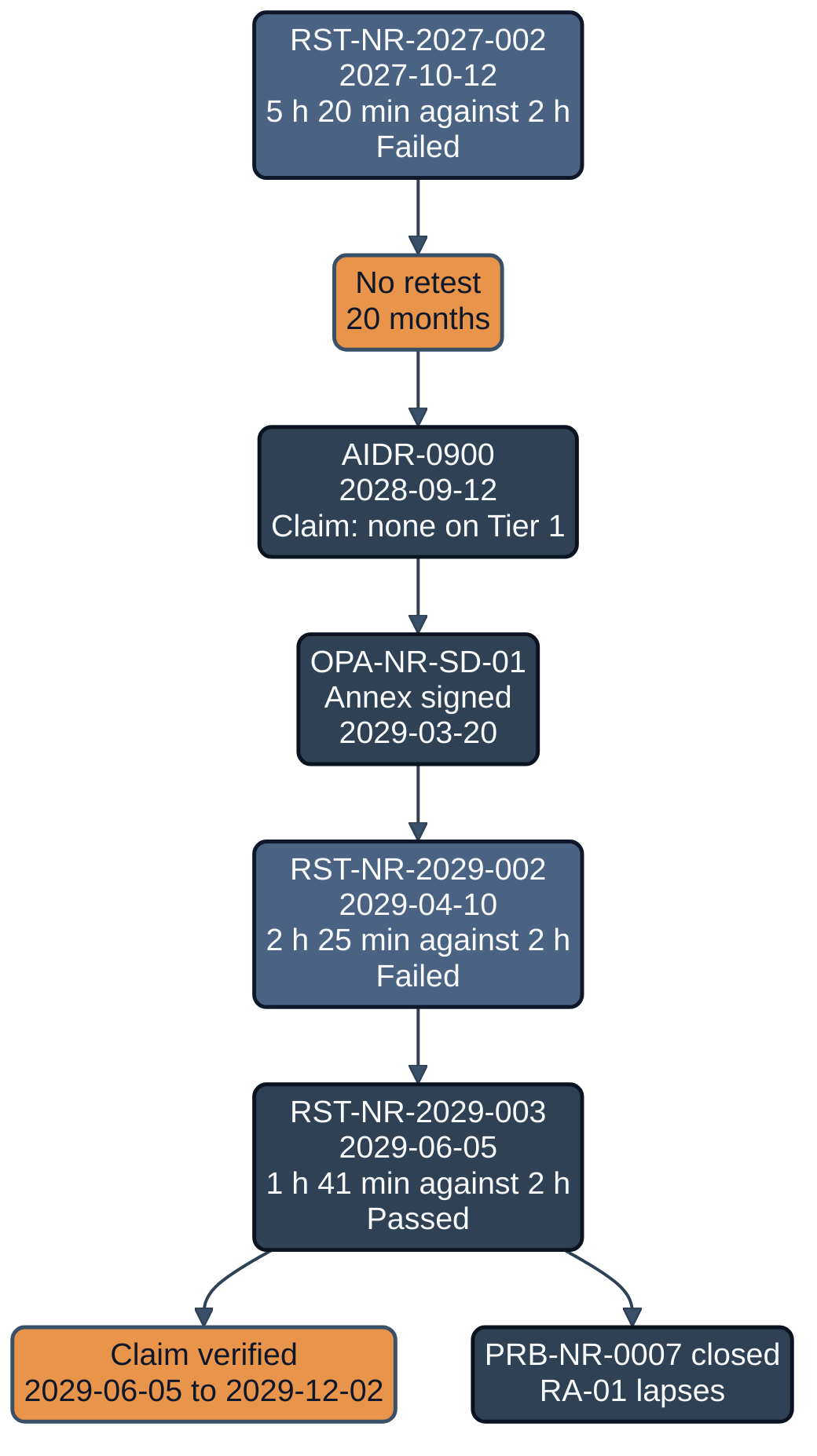
Figure 16.1: The portal failover claim at Nordvik Region. The test of 2027-10-12 belongs to the baseline history; the later records belong to the illustrative year of the volume. All are dated after the writing of the book and are illustrative.
The claim from RST-NR-2029-003 was verified from 2029-06-05 to 2029-12-02 on the standard 180-day clock. The risk acceptance RA-01 lapsed and PRB-NR-0007 was closed. The volume's rule is that a track is closed on a passed retest, not on a change. In May 2029 the first monthly tabletop exercises took INC-NR-2028-0391 as their subject, and the migration runbook gained a prerequisite: a timed restore within 30 days. At the end of the year the Region's indicator "Tier 1 services with a verified claim" stood at 0 of 4 at the baseline, with 2 of 4 planned for 2029-09-30 and 4 of 4 for 2030-03-31, and the floor for the observer's catch rate was 0.80 (10, Nordqvist, 2026).
The plan OPL-NR-2029-01 runs from 2029-04-01 to 2030-03-31 and starts the stand-by secondary site, with Joakim Wester as mentor. Its dates are these: a case-management restore on 2029-08-31; a first review on 2029-09-30, when the assistant's move to Level 1 is decided; a staff identity restore on 2029-10-31; a benefits-triage restore with TriageSoft on 2029-11-30; a failover rerun on 2029-12-15 before the clock ends on 2029-12-27; a case-management rerun on 2030-02-15 before 2030-02-27; and a final review on 2030-03-31. The ceilings are revisited in 2030 and 2033 (10, Nordqvist, 2026).
Across the degrees of delegation
The Region lifted no degree of delegation during the year, and the volume counts that as a result. The table sets the position at the year's end by class of action.
| Class of action | Position at the Region | Condition for more |
|---|---|---|
Answer, summarise, draft (assistant NR-OPS-001) |
Level 0, at most Level 1 | Decision at the review of 2029-09-30 |
Timelines and status drafts (NR-OPS-002) |
Level 1 Assisted | |
Restart, scale, certificate renewal on the portal (NR-OPS-003) |
Level 2 Supervised under MND-NR-OPS-003 |
Level 3 only after the observer catches seeded faults within target, a stop exercise within target and two evidenced conductors per window; certificate renewal is the first candidate |
| Roll back, fail over | Level 1 | Stay at Level 1 |
| Deploy | Undelegated | |
| Restore overwrite | Level 1 | Stay at Level 1 |
The volume's rule for Level 3 is AIDR-0910: no scripted runbook at Level 3 until the observer applies, which it did from 2028-11-20 (10, Nordqvist, 2026).
What the volume concludes for Nordvik Region
The Region's answer to AIDR-0900, given in Chapter 30 of the volume, is that operations is a small owned loop (objectives, runbooks, observer and register) around a bought base (SamDrift and the hosting provider) on contract terms. The assistant stays at Level 0 and at most Level 1, the runbooks at Level 2 with at most one class at Level 3 Bounded, and the observer sits at another supplier. Five decisions go to the executive committee: to use the register as the measure and renew RA-01 once (D1); to raise a level only on evidence (D2); to fund independent verification, with a vacancy as the first step (D3); to use the supplier terms in OPA-NR-SD-01 and to ask for a notice period and a right to hold a release in the next procurement (D4); and to protect the craft and the people (D5) (10, Nordqvist, 2026).
The volume's lessons from the Region are these. The honest figures were lower than the first dashboards. Closure took longer than any plan: the failover failed in October 2027, failed again in April 2029 and passed in June 2029. No level was raised, and that was a result. The same few people carried the year's events, and Joakim Wester in particular is a key-person risk. The mean hid a seven-hour disruption. A negotiated annex with SamDrift made the retest possible. Chapter 31 puts it in a sentence: the Region can prove little about recovery and can say exactly how little. The question for 2029 is whether delegation of any class should begin at all (10, Nordqvist, 2026).
The risks and triggers the volume names are a retest that fails, seven engineers who are not enough (the assistant's move to Level 1 and the optional tabletops give way before a test), SamDrift declining (a confirmed test window by 2029-05-31), Wester's absence, an observer worn out by false pages, and a supplier's AI changing without notice (AIDR-0902) (10, Nordqvist, 2026).
Regulation enters as a constraint. The Region plans as if Tier 1 is covered by NIS 2 under the national transposition, and AIDR-0923 applies the Cybersecurity Act to all Tier 1 services as an essential operator. DORA does not apply. The Region is deployer of a high-risk system under Article 26 of the AI Act. The Critical Entities Resilience Directive does not identify it as a critical entity at the volume's start (illustrative), but it is exposed through its dependence on the neighbouring region's university hospital. Incident reports and annexes follow the public-access rules for official documents (10, Nordqvist, 2026).
Open threads
These findings are collected in Chapter 27.
- Observer measurement. Chapter 30 of the volume, dated 2029-03-31, says the observer's detection time "has not yet been measured by any seeded fault in the records of this book", while Chapter 29 gives a first seeded fault on 2029-03-19 (2 min 41 s). The same chapter 30 plans the failover retest for 2029-06-30, while Chapter 29 reports outcomes on 2029-04-10 and 2029-06-05. The volume explains that each chapter's date governs. The dossier uses the Chapter 29 values.
- Clock end. Chapter 29 gives the verified claim as running to 2029-12-02 (180 days from 2029-06-05); the plan in Chapter 30 names 2029-12-27 as the end of the clock before the rerun of 2029-12-15. The dossier gives both and has no basis for choosing.
- Level 3. The profile says the Region reaches Level 3 only through scripted runbooks. Chapter 13 says only for the automatic rollback of a gateway route, and Chapters 4 and 30 say no Level 3 before the stage N4. It is unclear whether a Level 3 class exists already.
- NIS 2. The profile and Chapters 2 and 3 say it depends on national transposition; Chapters 23 and 24 and
AIDR-0923fix the Cybersecurity Act as applying. - Agent drill. The indicator table of Chapter 30 cites "one drill of the Region's agent on 2028-11-07", although the Region has no agent; the drill probably concerns the assistant or the gateway.
- Records.
AIDR-0916has no date in the ledger, butMND-NR-OPS-003is in force on 2028-11-14.AIDR-0920is marked illustrative. Chapter 8 callsCHG-NR-2028-0007a normal change because no class exists, while certificate renewal is the first candidate for a standard class that does not yet exist.NR-OPS-002and-003are introduced in Chapter 16 of the volume, not in the profile. - Setting. The profile calls the Region a Nordic EU member state; the volume places it in Sweden (Cybersecurity Act, section 11 of MBL).
- Reuse. AI Leader reuses the exit test
RST-NR-2029-001and SamDrift from this volume and cites the test as 322 days old at its decision of 2030-03-12 (Chapter 17 of this book). - Facility figures. The 640 kW of
nordvik-dcis an assumed figure here and a profile figure in AI Environment (with a PUE of about 1.55 and no waste-heat reuse); the reserved accelerators of the capacity plan grow from 16 to 24 in that volume. The service identifiersSVC-NR-001,-005,-006and-008are reused there (14, Nordqvist, 2026).
Summary
AI Operations shows Nordvik Region as an organisation that owns a small loop and buys the base under it. The established facts are the unit of about 85 people, Region Cloud, the SamDrift dependency and eight services with objectives. The baseline history of incidents and restore tests up to November 2027 is illustrative, and among it the failed portal failover of 2027-10-12 is the one that sets the volume's agenda. The illustrative year then produces the Region's evidence: a certificate change with a tested rollback, an observer probe that flagged a supplier's unannounced change, a seven-hour restore that a mean would have hidden, and a portal failover that failed twice and passed on 2029-06-05 at 1 h 41 min against two hours.
The conclusion of this chapter is the volume's own. A recovery claim at the Region has a date, a measured result and an end, and no level of delegation was raised without evidence. What the dossier cannot yet say is whether the claim will be renewed before it runs out, because the two dates the volume gives for the clock disagree, and whether the Region's few named people can carry a second year.
Sources
- Nordqvist, G. AI Operations: How Artificial Intelligence Transforms IT Operations in European Enterprises and Public Authorities. The Transformed Architecture, Book 10. (10, Nordqvist, 2026)
- Nordqvist, G. AI Environment: Designing AI for the Greatest Benefit and the Least Environmental Harm in European Enterprises and Public Authorities. (14, Nordqvist, 2026)